Chinese Zodiac Monkey: The Quick Mind, the Trickster Flame, and the Art of Outwitting Fate
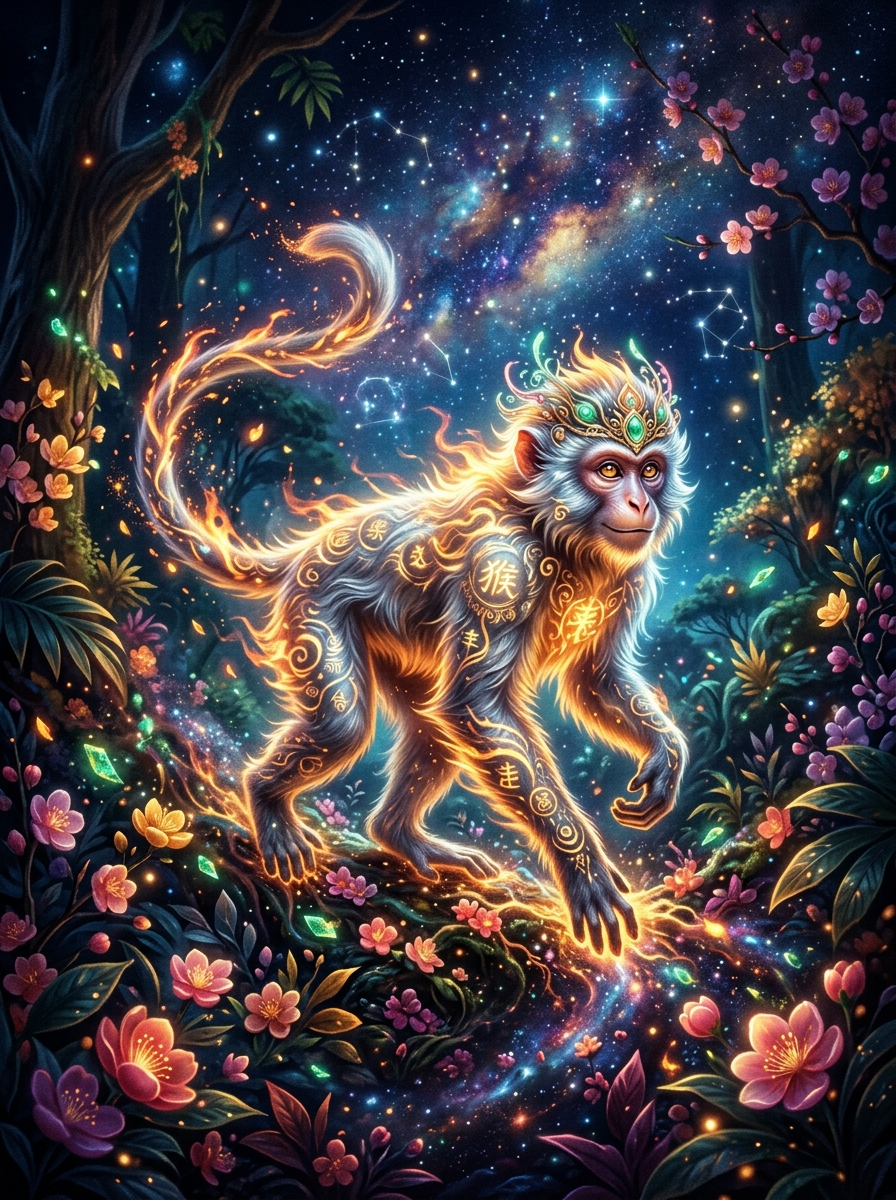
The Monkey is the zodiac’s improviser: alert, verbal, agile, and rarely content to let life proceed in a straight line. In the Chinese zodiac, Monkey energy describes intelligence that moves faster than convention, charm that can tilt into mischief, and survival instincts sharpened by curiosity. The core thesis is simple: Monkey succeeds by reading the room, spotting the opening, and acting before everyone else has finished defining the problem.
The Monkey’s Core Dynamic: Cunning as Survival Instinct
The Monkey is not merely “smart” in the academic sense. Its intelligence is tactical, social, and adaptive. This sign notices shifts in tone, weakness in argument, opportunity in chaos, and boredom before it becomes visible to other people. That makes Monkey natives excellent problem-solvers, but not always patient ones. They prefer leverage over force, wit over solemnity, movement over stasis. You can see why the mechanics of the zodiac matter here: in this system, archetypes are not personality clichés but patterned energies that color temperament, timing, and instinct.
A healthy Monkey mind is quick enough to translate uncertainty into options. It can pivot without humiliation, improvise under pressure, and find the hidden mechanism in a situation everyone else is treating as fixed. This is why Monkey people often shine in environments that reward responsiveness: sales, negotiation, media, strategy, entrepreneurship, performance, crisis management, or any field where language is a tool and timing is currency. The shadow side is equally real: speed can outrun depth. Monkey may diagnose a situation brilliantly and then skip the slow work of consolidation. When immature, this archetype flirts with inconsistency, overpromising, clever rationalization, and the temptation to win instead of to know. The task is not to become dull. It is to make wit answerable to substance.
The Architecture of a Trickster Mind
Psychologically, Monkey carries a trickster charge. The trickster is not evil; it is the force that punctures pretension, exposes rigidity, and keeps psychic life from freezing into dogma. That is part of Monkey’s luminosity. It can be refreshing, liberating, and oddly moral in its refusal to accept empty authority. But the same force can become evasive when accountability becomes inconvenient. The trickster lives on the edge of every rule, always testing, always looking for a gap.
This mental architecture forms early. Monkey natives often grow up reading social signals with an acuity that borders on the uncanny. They learn which words open doors and which close them, which emotions are safe to show and which must be masked. That is not manipulation in the cheap sense—it is a survival strategy that becomes second nature. Over time, it hardens into a style of being: curious, restless, allergic to boredom, and magnetically drawn to novelty. The danger is that the tool becomes the master. A Monkey who has spent years being clever may forget how to be still, how to listen without formulating a response, how to trust without needing an exit strategy. The zodiac wheel shows how each sign occupies a different function in the whole system; Monkey’s function is agility under pressure, not submission to routine. But agility without a tether becomes drift.
The Mature Monkey: When Wit Serves Substance
The mature Monkey is not the cleverest person in the room. It is the one who knows when cleverness serves life and when it serves defense. That is the real initiation of this sign. The goal is not to silence agility; it is to give agility a worthy container. When Monkey becomes disciplined, it can do extraordinary things because it has already learned how to move through complexity without freezing.
Discipline is the element that saves the gift. Monkey benefits from concrete obligations: deadlines, craft, physical training, and projects that require repeated contact with the same material. Repetition may feel tedious at first, but it is exactly what converts talent into authority. This sign also does well with environments that reward experimentation without punishing intelligent failure. If the field is too rigid, Monkey rebels. If it is too loose, Monkey scatters. The ideal setting is structured freedom—think of the difference between a blank canvas and a set of rules for perspective. This is where the Capricorn archetype offers an instructive contrast: Capricorn builds by slow accretion; Monkey builds by inspired shortcut. The mature Monkey learns to combine the two, to let the shortcut land on solid ground.
In relationships, Monkey needs truth that is lively rather than moralistic. It responds better to intelligence than to lecturing, better to transparency than to control. The best partners do not try to tame Monkey’s spark; they invite it into trust. They know the difference between play and evasion, and they insist on the first without tolerating the second. The zodiac sign compatibility page explores how such dynamics play out across the whole system, but the key here is that Monkey’s greatest relational strength—its ability to keep things interesting—becomes a weakness when it is used to avoid depth.
The Monkey in Motion: Love, Work, and the Unfolding Life
Apply the dynamic once, not multiple times. In love, Monkey pairs best with those who can match mental speed without being exhausted by it. The classic allies are Rat and Dragon. Rat provides method, Monkey provides invention; together they form a partnership of mutual alertness. Dragon brings ambition and big energy; Monkey brings tactical finesse. The chemistry is electric when both respect each other’s intelligence, but can degenerate into ego competition if neither yields the last word. The more challenging counterpart is Tiger, who resents being outmaneuvered and values authenticity over strategy. Where Monkey uses wit, Tiger uses force of presence—the conflict is as much about philosophy as temperament.
In work, Monkey thrives in roles where responsiveness is rewarded and hierarchy is flexible. Sales, negotiation, media, strategy, entrepreneurship, performance, crisis management—any field where language is a tool and timing is currency. But the same brilliance can become scattering. Monkey overcommits, loses interest once the novelty fades, or chases the next stimulation before completing the previous task. The antistructure is a system of micro-commitments: daily check-ins, weekly reviews, a partner who holds the timeline. Without that, the trickster becomes a dilettante. For a contrasting temperament, consider how the Gemini archetype also lives in mental speed but is more linguistically curious and less survival-driven; the difference shows how context shapes the same raw agility.
In everyday life, Monkey manifests as the person who always has a workaround, who can talk their way into or out of almost anything, who makes the complex sound simple. That is a gift when it is used to solve problems and a liability when it is used to avoid accountability. The mature Monkey learns the difference between cleverness and wisdom. Cleverness wins the exchange; wisdom wins the decade.
Elemental Tones and Lucky Correspondences
The Monkey is not one fixed personality. Each of the five elements modifies the archetype, giving it different textures. A Metal Monkey is sharper, more self-possessed, more formidable—its wit can be brilliant and cutting. Water Monkey is elusive, socially intuitive, psychologically fluid; it senses currents before they surface. Wood Monkey brings curiosity and a somewhat more cooperative energy, while Fire Monkey is the most restless and spectacular, gifted with charisma and appetite for action—similar in some ways to the Leo archetype in Western thought, though without the fixed-center pride. Earth Monkey is the most grounded, with greater practical sense and an improved ability to finish what it starts.
Traditional Monkey lucky colors are white, gold, and blue, depending on the element year. White and gold reinforce clarity, brilliance, and quicksilver intelligence; blue supports calm and composure. Lucky numbers: 1, 7, and 8—one for initiative, seven for discernment, eight for material fluency. Lucky directions are west and northwest. These correspondences are symbolic technologies: ways of arranging attention so the archetype can work with less friction. They are not guarantees, but tools.
In the end, the Monkey teaches a paradox: intelligence is most attractive when it is answerable to character. Without that, it becomes a performance. With it, Monkey is one of the zodiac’s most inventive powers—restless, amusing, incisive, and startlingly capable of finding a door where everyone else sees a wall. The Taurus archetype may hold the ground, but the Monkey dances on it. The two are not rivals; they are complementary. The trick is to know when to dance and when to hold.
Related
- Chinese Zodiac: The Rabbit and the Art of Quiet Power
- Chinese Zodiac: The Snake, Silent Intelligence and Hidden Power
- Chinese Zodiac: The Rooster and the Art of Standing in the Light
- Chinese Zodiac Goat: The Graceful Soul, the Quiet Strategist, and the Art of Soft Power
- Leo Moon, Gemini Rising: The Laughing Sunlit Heart
Comments
Loading comments…