Synastry Sun Sextile Mercury: The Easeful Spark Between Identity and Mind
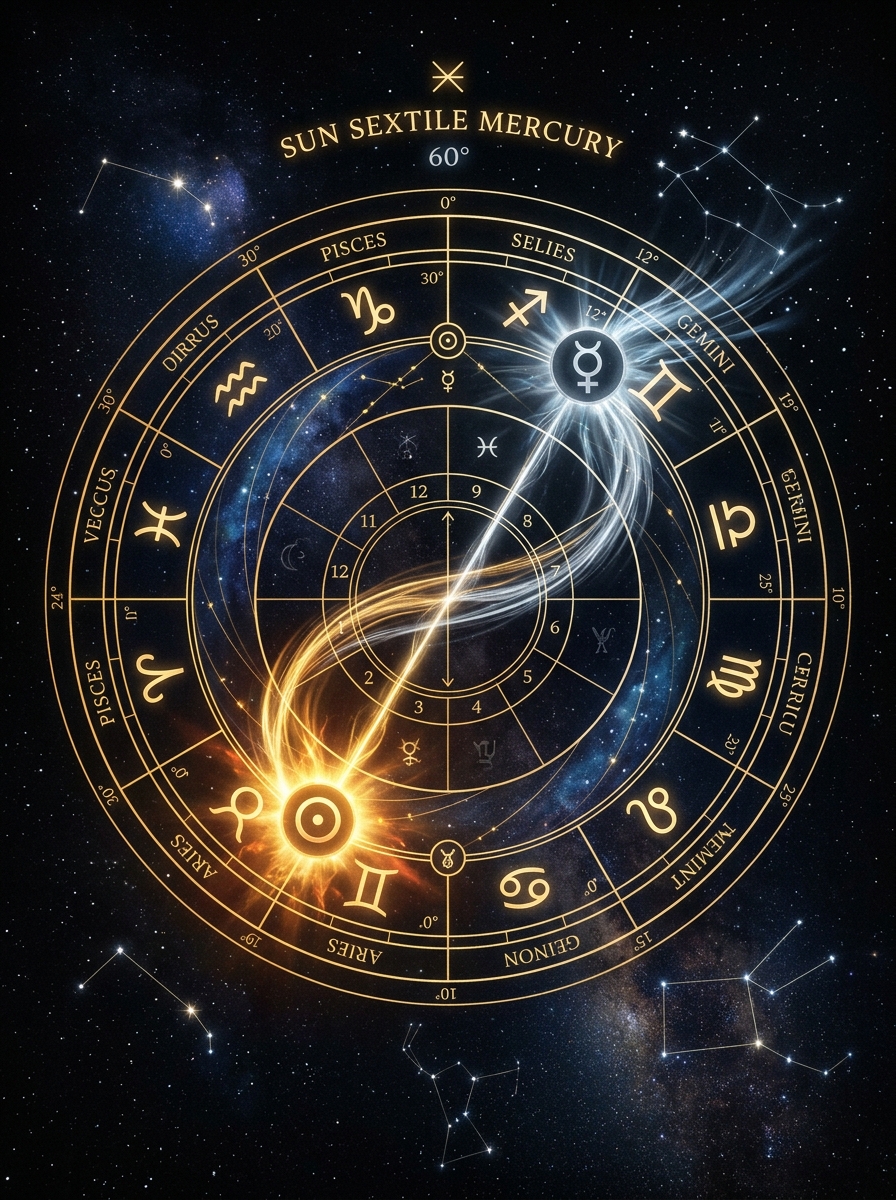
The Core Dynamic – Recognition Without Fusion
When one person’s Sun sextiles the other’s Mercury, identity and intelligence meet in a room where no one has to shout. The Sun brings the weight of selfhood—will, pride, the need to be seen as singular. Mercury brings the nimbleness of mind—language, interpretation, the reflex to name things accurately enough to move through them. A sextile between them does not melt these together; it creates a clean, active bridge. The Sun person feels witnessed without having to perform a defense of their existence. The Mercury person feels their observations land as contributions, not as commentary that fades into silence.
This is not the drowning immersion of a conjunction, nor the provocative voltage of a square. It is an opportunity structure—a relationship pattern that rewards curiosity, humor, and the willingness to follow a thought. The chemistry is real but often mistaken for something lighter than it is. It does not arrive with drama, but it is frequently the aspect that keeps two people in each other’s orbit long enough for deeper bonds to root. For a wider view of how this fits into the grammar of relationship charts, the language of synastry aspects is the real alphabet; this contact is one especially fluent sentence.
The core psychological payoff is mutual competence. The Sun does not need to dominate the exchange, and Mercury does not need to hide behind cleverness. Both can co-author the conversation. That is why this aspect feels flattering without being syrupy: it grants each person the experience of being intelligible to another without being flattened into a summary.
Why Sextile Begets Curiosity, Not Drama
The sextile is often described as “easy,” but that is misleading. It is not a free pass; it is a door that requires active turning. In this pairing, the door leads to mental seduction. One person notices that the other’s sentences feel like keys. The other notices that their own thoughts sharpen in response. The attraction is conversational before it is romantic—but being understood at the level of thought is a form of contact many crave more than they admit.
The Sun person gets a witness who does not distort their light. The Mercury person gets a response that proves their intelligence has traction. This mutual gain creates momentum: witty banter, fast texting, the uncanny experience of finishing each other’s sentences without making a spectacle of it. If other chart factors support affection (for example, through Moon-Venus synastry, which gives the mind somewhere emotional to land), the bond can become a quiet engine of intimacy. Without that, the relationship may remain pleasantly cerebral—alluring but slightly abstracted from the flesh.
The sextile also explains why this aspect appears so often in non-romantic bonds. Friendships, creative collaborations, and professional partnerships thrive here because the exchange is agile and low-defense. The question “Can I work with this person?” often answers itself with a yes. The larger architecture of astrological synastry maps how such mental affinity fits into the whole relationship chart; this aspect is the thread that keeps the pattern coherent.
The Shadow Side – Overconfidence in Clarity
The main friction in Sun sextile Mercury is not conflict but miscalibration. Because the exchange is usually smooth, both people can start assuming they are being fully understood when only part of the message has actually reached shore. Easy communication creates overconfidence. The conversation feels good enough that no one notices when a deeper issue has been politely stepped around.
The Mercury person may flatten the Sun person’s complexity into a smart summary. The Sun person may prefer agreeable wording over honest precision, especially if they enjoy being admired for their ideas. In this way, the sextile can foster a charming mutual illusion: “We communicate well, so we must be aligned.” But communication and alignment are not identical. A couple can be eloquent and still avoid the point.
The shadow is subtle: a tendency to intellectualize tension, narrate around desire, or resolve disagreement by making it sound better than it is. Problems get discussed before they are metabolized. Decisions are reached before feeling has caught up. This is elegant avoidance dressed as agility. When the bond is under strain, the Sun person may experience the Mercury person as slippery or excessively explanatory; the Mercury person may experience the Sun as too attached to being right about its own motives. The friction is rarely explosive—more like a misread tempo. For a deeper look at how the mind shapes itself through relationship, compare this dynamic with Mercury in the 7th House, where thought itself becomes formed by the presence of the other. The same principle appears here, but between two people rather than inside one natal chart.
Context Shapes the Experience – Sign, House, and Chart
A sextile is always more than the planets involved. Its flavor changes dramatically with the signs, houses, and surrounding aspects. Sun sextile Mercury in fire and air signs (Aries, Leo, Sagittarius, Gemini, Libra, Aquarius) often reads as rapid-fire enthusiasm, ideological play, or mutual inspiration. In earth and water signs (Taurus, Virgo, Capricorn, Cancer, Scorpio, Pisces), it leans practical, nuanced, or emotionally intelligent. The bones remain the same—a bridge between identity and mind—but the tone of the conversation alters entirely.
If the Mercury person has Mercury in Gemini or Mercury in Virgo, the sextile becomes precise, nimble, and incessantly refining. A Sun in Aries may turn the dialogue into immediate action; a Sun in Taurus makes it steadier, more resistant to sloppy wording. The question is not just whether they talk, but how language is used: to initiate, to clarify, to persuade, to seduce, to define.
House overlays matter because they tell you where the conversation becomes consequential. If Mercury falls into the Sun person’s 10th house, the bond may shape reputation, work, or public voice. If it lands in the 4th house, the dialogue feels intimate, ancestral, domestic. Chart geography modifies the planet-to-planet contact, and synastry house overlays is the layer that reveals where the talk actually lives. Additionally, other aspects can amplify or cancel the sextile’s effect. Supportive links to Venus, the Moon, or Jupiter magnify the ease; hard contacts to Saturn, Neptune, or Pluto complicate it. A shared Mercury-to-Sun harmony may not save a relationship from cruelty or evasiveness—it simply means the people can usually name what is happening sooner. That is valuable but not a guarantee of wisdom. For a full reading order that prevents overfocus on a single contact, see synastry step-by-step.
How It Plays Out in Life – Love, Work, Friendship
In romance, Sun sextile Mercury makes courtship feel nimble and private. Inside jokes, instant debriefs, the pleasure of being mentally invited in—these become the texture of intimacy. The bond survives not because of constant agreement but because both partners keep showing up with new things to say. The Sun person continues to reveal themselves, and the Mercury person continues to adapt their understanding without becoming cynical. That adaptability is why this contact often outlasts flashier aspects.
In work partnerships, it is one of the cleanest indicators of productive collaboration. Feedback flows without constant bruising. Ideas are tested quickly. The energy is co-creative rather than competitive. In friendship, it shows up as easy banter, honest curiosity, and the sense that one person keeps the other mentally awake. They do not need to share every value to share a rhythm.
When desire enters the picture, the mental affinity can become erotic in a non-obvious way. The Mercury person translates desire into language that the Sun person recognizes as true; the Sun person animates that language with vitality. For the sexual charge to feel complete, the chart often needs other grounding—Venus and Mars synastry explains the erotic spark, while Sun-Mercury explains why that spark has a voice and a mind. The two together are far more convincing than either alone.
At its deepest, Sun sextile Mercury is the art of being intelligible to one another without becoming predictable. The Sun keeps the relationship from turning into mere cleverness. Mercury keeps it from becoming a mute performance of identity. Together they produce a bond where meaning circulates, and circulation itself becomes a source of affection. That is the subtle power: the relationship feels alive because it can think, and it thinks better because it is alive. For a final layer of context, Mercury in Astrology names the planet’s larger role as messenger, connector, and interpreter—the exact function this synastry wakes up between two people.
Related
- Synastry Mercury Sextile Mercury: The Ease of Being Understood
- Synastry Moon Sextile Mercury: When Feeling Finds a Voice
- Synastry Mercury Conjunct Mercury: The Shared Language of the Mind
- Synastry Venus Sextile Mercury: When Desire Learns to Speak
- Synastry Sun Trine Mercury: When Identity Finds a Language
Comments
Loading comments…