Synastry Mercury Trine Mercury: The Mind That Finds Its Mirror
The mental grammar of recognition
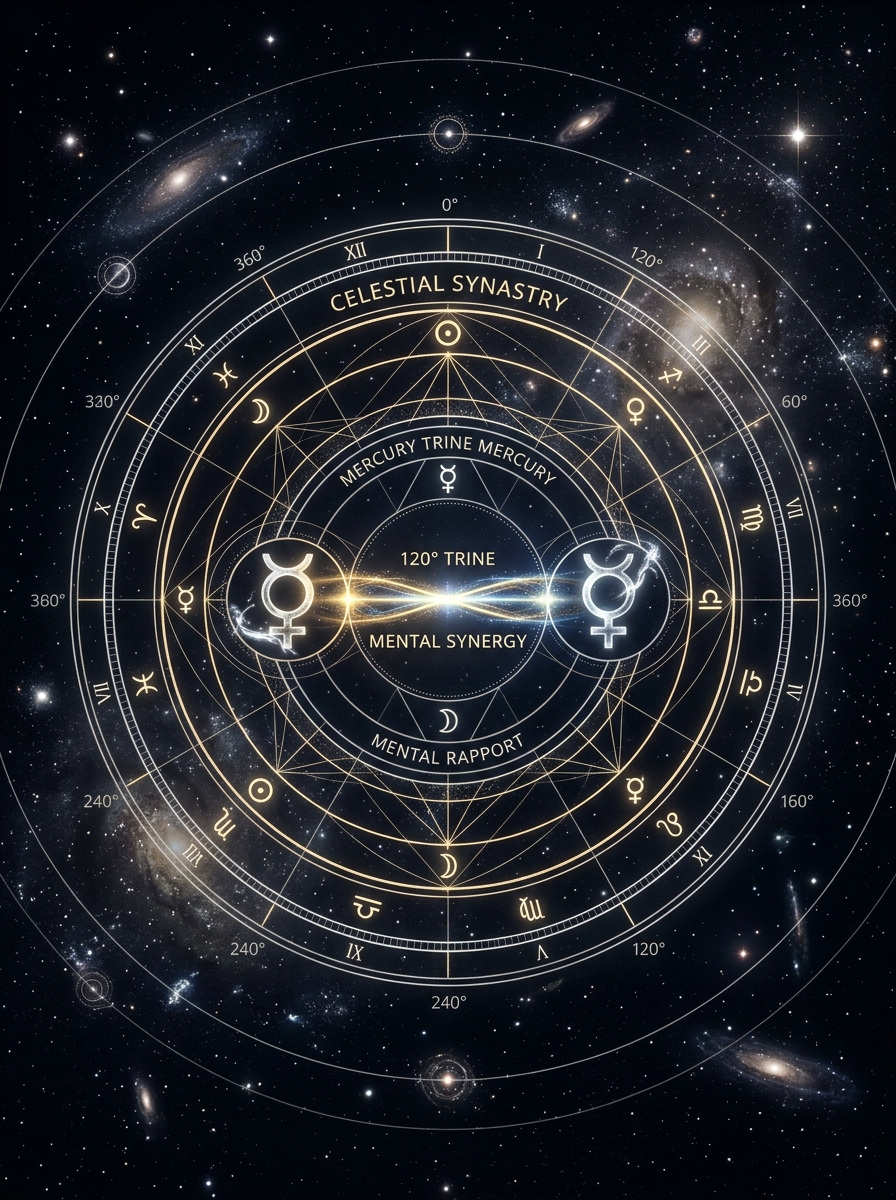
Mercury trine Mercury in synastry describes two minds that operate on a shared syntactic wavelength. The trine is a 120-degree angle, and in relationship astrology it marks a flow of communication that feels less like translation and more like recognition. This is not agreement; it is compatibility in the machinery of thought. Two people can hold opposing views and still understand each other’s reasoning instantly because their Mercuries favor the same cognitive tempo: both leap associatively, both build stepwise, both think in images or in numbers. The labor of decoding is nearly absent.
The aspect does not collapse two minds into one, as a conjunction might. It creates a clean channel. Words arrive where they were aimed. Jokes land. Explanations are unnecessary. This ease is often mistaken for depth, but it is only infrastructure — the mental equivalent of a well-paved road. For the broader mechanics of how a trine aspect works in relationship contexts, the geometry itself teaches why current flows freely but may fail to erode old riverbeds. And to see where this single aspect fits within the full field of relational cues, the taxonomy of synastry aspects places it among challenging and flowing contacts alike.
Why it feels like home — and why that can stall growth
The immediate experience of Mercury trine Mercury is relief. Being understood before you finish your sentence is neurologically rewarding; it lowers the nervous system’s guard. People who have been chronically misread in past relationships may feel an almost addictive pull toward someone whose mind mirrors their own. This is the aspect’s gift: it makes conversation a place of safety, not performance.
But the same fluency can become a trap. Because the channel is so smooth, neither person feels the friction that would normally force them to examine their assumptions. The trine preserves sameness rather than intimacy. Two people can talk elegantly for years without ever discovering where their beliefs actually diverge, because the shared style masks the content’s gaps. This is the shadow of flowing aspects: they do not generate the heat required for transformation. When the ego feels validated, it stops questioning. For the emotional counterpart of this dynamic — where feeling-life compatibility either deepens or avoids raw spots — the Sun-Moon synastry often shows where identity and emotion meet or miss.
The psychological roots here are Jungian: we are drawn to those who reflect our own cognitive habits because that reflection makes us feel substantial. But a mirror that only flatters cannot show what lies behind the face. The trine asks for a discipline it does not naturally provide: the willingness to disturb the smooth surface with real inquiry.
How the aspect matures: from fluent conversation to shared inquiry
Over time, Mercury trine Mercury either becomes a vessel for genuine exchange or a polished habit of mutual cleverness. The deciding factor is whether the relationship uses the open channel for truth or for comfort. When both parties are conscious of the trine’s tendency toward complacency, they can deliberately introduce questions that do not have easy answers: “What do you actually mean by that word?” “What are we avoiding by agreeing so quickly?”
This is where the aspect matures. It ceases to be merely a pleasant conversational style and becomes a shared instrument for revision. The mind learns to hear itself more clearly because the other person’s reception is accurate but not uncritical. In relationships that can bear this, the trine supports repair: misunderstandings heal fast because the underlying grammar is still intact. The couple can disagree without the disagreement becoming a relationship crisis.
For a systemic view of how such an aspect evolves over the life of a relationship, the synastry step-by-step method shows how to weigh a single trine against other chart factors. And because Mercury’s house placement determines where this shared language lives — in daily tasks, in intellectual pursuits, in private conversations — the synastry house overlays give the terrain.
Concrete expressions in relationship terrains
Romantically, Mercury trine Mercury often appears as the initial attraction of minds. A couple may fall into long conversations that feel like a discovery of a home dialect. This can evolve into a relationship that thrives on shared observation, private humor, and intellectual play. But if the emotional synastry is weak, the bond may remain cerebral — two people who talk beautifully but cannot touch each other’s wounds.
In friendship, this aspect is one of the most durable. Friends with a Mercury trine often stay connected across time and distance because their mental wavelength persists. They can pick up mid-thought after a year apart. Collaboration in work or creative projects benefits from efficiency: ideas move from one mind to the other without friction, making them effective for editing, strategy, teaching, or any craft that relies on precise articulation.
In families, the trine can create a household where meaning is transmitted intuitively. Siblings may share a private code; parents and children may argue without lasting resentment because the underlying understanding is intact. The downside is that the shared language can become a closed system that excludes emotional candor. A family may be verbally synchronized but emotionally under-oxygenated. Identifying a Mercury style — for example, the quick associative leap of Mercury in Gemini — can help each person see where their natural tendencies reinforce or limit the conversation.
The esoteric edge: when two minds become a thinking system
At its highest expression, Mercury trine Mercury is not just communication but shared cognition. Two people begin to think as a duet, each completing the other’s mental half-phrases. This is the archetype of the koinonia — a community of mind that does not erase individuality but multiplies insight. In a psychologically informed reading, this aspect activates the Jungian anima/animus of intellectual recognition: the other mirrors your cognitive style back to you, making your habits visible and, with care, transformable.
But the same mirror that illuminates can also blind. The trine’s flow can feel so natural that neither person realizes they are reinforcing each other’s blind spots. The risk is a kind of intellectual incest where shared assumptions go unchallenged. The cure is not to break the mirror but to look at it with intention. Ask: “Is this ease helping us see more, or helping us avoid what we do not want to see?”
The larger geometry of the grand trine shows how multiple flowing aspects can create a self-sealing loop of comfort. The Mercury trine on its own is only one harmonic line; when it becomes part of a wider pattern of ease, the shadow of inertia deepens. The periodic recalibration offered by Mercury retrograde cycles — times when the messenger runs backward — can jolt the pair out of automatic conversation and force a re-hearing. Real intimacy between Mercuries requires not just fluent exchange but the courage to let the channel go quiet and see what emerges when the mirror stops reflecting.
Related
- Synastry Sun Trine Mercury: When Identity Finds a Language
- Moon Trine Mercury in Synastry: When Feeling Finds a Voice
- Synastry: Mars Trine Mercury — The Spark of Quick Minds and Clean Friction
- Synastry Mercury Square Mercury: The Spark, the Snag, and the Mind Games of Love
- Sun Trine Mercury: The Clear Flame of Self and Speech
Comments
Loading comments…