Synastry Sun Square Moon: Desire, Disruption, and the Emotional Fault Line
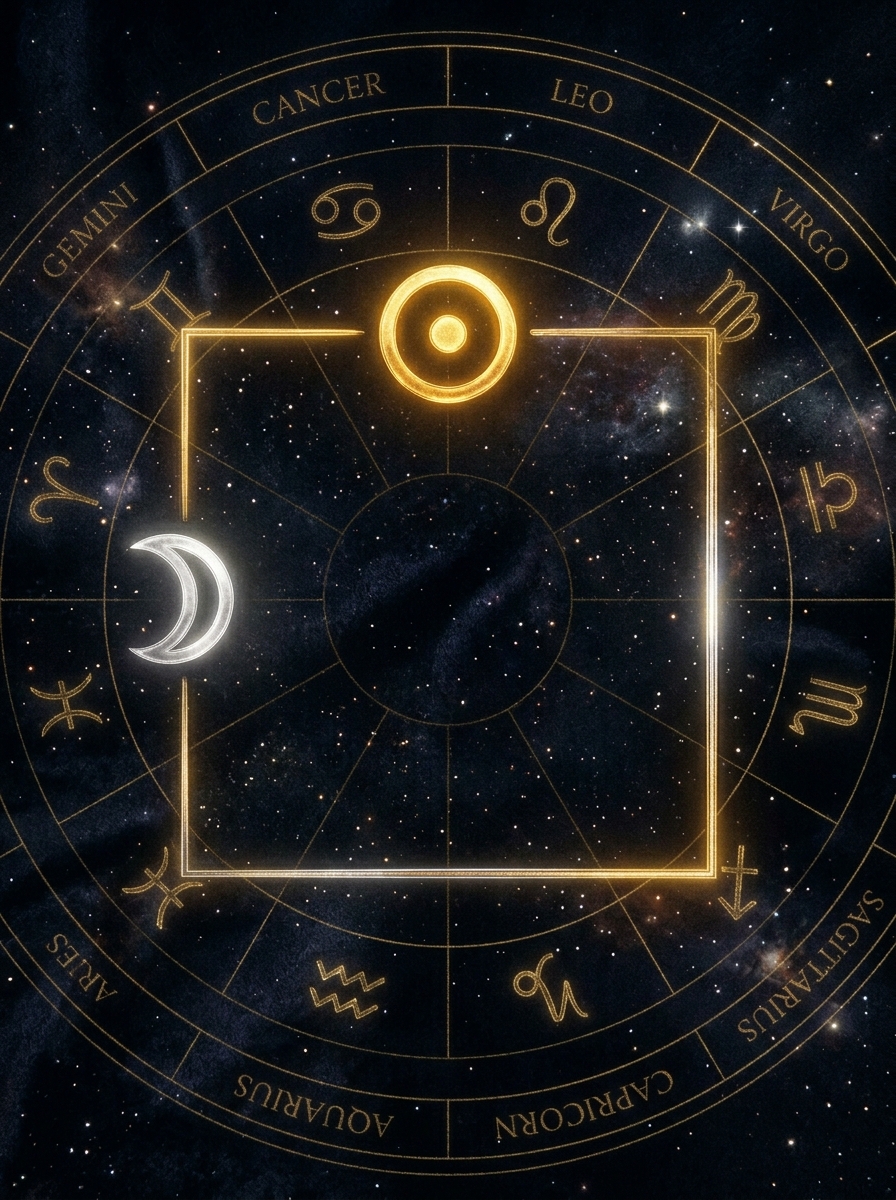
The core dynamic: identity versus emotional reflex under tension
When one person’s Sun squares the other’s Moon in synastry, the contact is immediate, intimate, and rarely neutral. The Sun person’s conscious self-expression — their will, their ego, their sense of purpose — meets the Moon person’s emotional body at a right angle. The result is not quiet comfort but a charged field of attraction and irritation, often simultaneous. The Sun feels seen but also subtly provoked; the Moon feels moved but also vaguely unsafe. This is a square, not a trine: the two planets are 90 degrees apart, which in the astrology of the square aspect signals friction that demands adaptation rather than easy flow.
The chemistry is real because each person activates something the other cannot fully control. The Sun person’s directness can feel like a bright light on the Moon’s privacy; the Moon person’s emotional weather can feel like an invisible barrier the Sun keeps running into. Neither is wrong. They are operating from different layers of psyche — the Sun from the will-to-be, the Moon from the need-to-feel-safe — and the square keeps those layers misaligned. The relationship feels personal because it goes right to the nerve of how each person orients toward life: one forward, one inward; one assertive, one receptive.
Psychological roots: the script that rewrites itself
Because the Moon is tied to early conditioning and the Sun to core identity, this square often activates unconscious family patterns. The Moon person may unconsciously expect the Sun to provide the emotional attunement they never got — steady, patient, intuitive. The Sun person may unconsciously expect the Moon to adapt, to accommodate, to validate without needing much explanation. When those expectations fail, the relationship can feel like a repetition of an old wound: one person feels emotionally abandoned, the other feels controlled or blamed.
This is not destiny; it is an invitation to rewrite the script. In Sun-Moon synastry generally, the two luminaries represent the couple’s basic psychological contract. Here, that contract is written in friction, not harmony. The Sun person must learn that their clarity can land as insensitivity; the Moon person must learn that their sensitivity is not always a reliable gauge of the other’s intent. The work lies in distinguishing the present relationship from the ghosts of the past. Without that distinction, the square becomes a cycle of accusation and withdrawal. With it, it becomes a laboratory for emotional literacy.
How the square shows up in daily life
The first signs of strain are usually timing and tone. The Sun person wants resolution now; the Moon person needs to sit with a feeling first. One speaks bluntly; the other interprets bluntness as disregard. Arguments often unfold around small things — a missed cue, a premature joke, a silence read as rejection. These are not trivial; they are the square’s way of saying that two different emotional tempos are trying to share one space.
The body often registers the tension before the mind does. The Moon person may feel a knot in the stomach around the Sun, while the Sun feels a restless urge to “fix” something that isn’t broken. Unlike the clear erotic charge of Venus and Mars synastry, the Sun-Moon square is more existential: it asks whether two people can coexist without one permanently editing their natural rhythm. The sexual attraction can be strong, but it is often laced with an undercurrent of “I want you, but I can’t relax around you.”
The path through: what each person must learn
The square does not demand that one person change into the other. It demands translation — the willingness to make one’s inner world legible across a difference that will not vanish.
The Sun person’s task: develop emotional tact
The Sun person must learn that intention does not cancel impact. Their brightness, however well-meaning, can overwhelm a Moon that needs gradation. The gift here is not self-erasure but timing: learning when to speak and when to listen, when to act and when to wait. Tact is not dishonesty; it is the skill of delivering truth in a form the other person can receive. If the Sun can soften their assertiveness without abandoning it, the Moon person will begin to trust that the relationship is not a performance but a dialogue.
The Moon person’s task: separate feeling from verdict
The Moon person must learn not to treat every emotional dissonance as a final judgment on the relationship. The Moon is extraordinary at registering injury — but that register is not always a complete map. A momentary irritation is not incompatibility; a bout of disappointment is not betrayal. The task is to honor the feeling without granting it absolute authority. That means articulating needs explicitly rather than expecting psychic reading, and allowing the Sun person space to learn without being punished for imperfect attempts.
This is the deeper promise of the square: two people discovering that love does not mean matching. It means making oneself understandable. For a fuller map of how this works within a broader chart, synastry aspects like this one are always read in context — a single square can be buffered by harmonious contacts from Venus, Saturn, or the angles.
How it plays out in love, work, and daily life
Because the square touches the core of each person’s being, it does not confine itself to one domain. It shows up wherever the two people interact.
- In romantic partnership: The couple may have intense chemistry but struggle with domestic comfort. They can excite each other intellectually and sexually, yet find it hard to simply rest together. The Sun may feel the Moon is too moody; the Moon may feel the Sun is too demanding. The alchemy of love synastry often relies on other factors to soften this tension — a supportive Venus, a solid Saturn, or a shared sense of purpose. Without those, the relationship can become a series of passionate reconciliations followed by quiet resentments.
- In creative or professional collaboration: The square can be a motor for innovation. The Sun person’s drive pushes the Moon person out of comfort zones; the Moon person’s intuition catches blind spots the Sun would miss. The friction becomes productive when both parties respect the other’s contribution. The Sun learns to listen before acting; the Moon learns to act despite discomfort.
- In friendship or family: This aspect can produce a bond that is both loyal and prickly. The two may have a history of misunderstandings that never quite resolve, yet they keep coming back because each offers something the other lacks. The friendship that survives the square is one where both have stopped trying to be right and started trying to be clear.
The square in the larger synastry story
A single square does not make or break a relationship. It is one thread in a tapestry that includes house placements, planetary dignities, and the overall pattern of contacts. Synastry house overlays tell you where the square lands — a Sun in the partner’s 4th house squaring a Moon in the 7th behaves very differently from a square across the 6th and 12th. Similarly, the presence of a T-square involving the luminaries amplifies the pressure and raises the stakes for growth.
To understand the full relationship, synastry step by step recommends first identifying the strongest aspects, then checking for repeating motifs. The Sun-Moon square is a loud voice, but it is not the only one. When it appears in a chart that otherwise shows respect, warmth, and shared values, it becomes a source of dynamism rather than despair. The question it keeps asking — can I be myself and still remain emotionally met? — is one that every deep relationship must answer eventually. The square just insists on an answer sooner.
Related
- Sun Square Sun in Synastry: When Two Solar Egos Strike Spark and Steel
- Synastry Moon Square Moon: When Two Weather Systems Share a Sky
- Sun Square Mercury in Synastry: The Spark That Argues with Itself
- Sun Square Moon: The Inner Weather of a Divided Will
- Moon Square Mercury Synastry: When Feeling and Thought Refuse Easy Peace
Comments
Loading comments…