Sun Square Moon: The Inner Weather of a Divided Will
The core pattern: two legitimate authors, one psyche
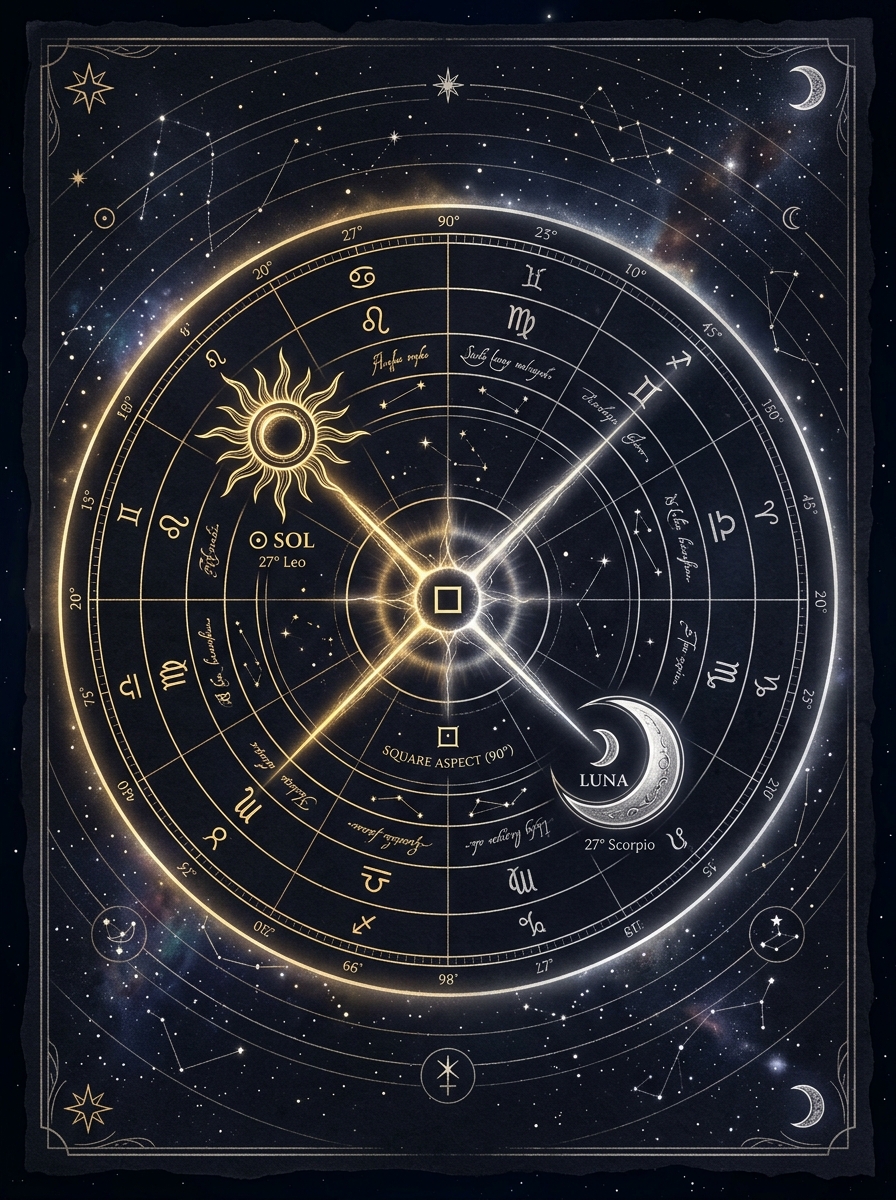
Sun square Moon is the birth-chart signature of a person who must negotiate with themselves before they can act. The Sun wants coherence, direction, and self-authored meaning; the Moon wants safety, attachment, habit, and emotional continuity. In a square, those drives do not blend. They insist on different truths at the same time. This is not ego versus emotion — that framing is too crude. It is a conflict between two legitimate authors of the self, each with its own survival logic.
The friction can look like indecision, mood swings, or a life organized around crisis, but the deeper story is developmental pressure. The psyche keeps forcing contact between identity and instinct until both become stronger, clearer, and less naive. This is why the square aspect is often called a catalyst: it demands consciousness where harmony aspects allow sleep. People with this aspect are rarely simple. They may seem self-possessed in one setting and vulnerable in another, decisive one day and compromised the next. The split does not signal weakness; it exposes a psyche that cannot settle until it learns to hold contradiction without collapse. For a closer look at how the square works mechanically, see the astrology of the square aspect.
How the conflict forms: the early imprint
The origins of the Sun square Moon dynamic nearly always trace back to early environments where the two drives were not mirrored cleanly. The person may have learned that being true to themselves disturbed belonging — that expressing the Sun put emotional safety at risk. Or they discovered that emotional loyalty required self-editing — that the Moon’s need for attachment demanded hiding parts of the will. These lessons get encoded before language, and the square becomes an internalized tug-of-war.
The Sun comes to distrust the Moon: the conscious ego suspects feelings as unreliable, irrational, or inconvenient, then later discovers that the very moods it sidelined were accurately tracking reality. Meanwhile, the Moon distrusts the Sun: emotional memory treats the will as reckless, exposed, or insufficiently protective. The result is a self that hesitates at thresholds. Even when externally competent, there is a private sense of being pulled off-center by invisible tides. This early wound is not a dysfunction; it is the ground from which psychological depth grows — but only if the person eventually recognizes the pattern as inherited, not inherent.
The path through friction: maturation versus the pendulum
Sun square Moon can mature into genuine agency, or it can trap a person in oscillation. The shadow form is living as a pendulum: one week identifying with discipline, the next with abandon; one season with independence, the next with emotional dependency. This cycling is the psyche’s attempt to honor both sides without building a third thing — a self that can hold both belonging and becoming. The person may repeat childhood tensions in adult relationships, calling the repetition chemistry. They may excel in bursts and crash from overidentification with performance.
But the same friction also breeds gifts. The person becomes psychologically astute because they have had to observe themselves from multiple angles. They learn that being sincere is not identical with being transparent, and that feeling something deeply does not automatically make it wise. That education produces unusually nuanced judgment — the kind that tracks mixed signals without moralizing them. This is the gift of the T-square, a configuration where the Sun-Moon square is often embedded: the pressure becomes a forge for mastery. Yet even alone, the Sun-Moon square offers a similar crucible. The psyche does not ask for victory of one pole over the other; it asks for negotiation. As in the symbolic journey of the Moon and Sun tarot combination, the movement is from confusion toward clarity, but in the birth chart it is less a revelation and more a lifelong apprenticeship in inner diplomacy.
Where it lives: relationships, work, and the body
Once the core dynamic is understood, its expressions across life become legible. In close relationships, a person with Sun square Moon craves fusion and autonomy at once. They want to be fully seen yet bristle when seen too accurately. Partners experience them as sincere but contradictory, affectionate but guarded. The pattern is not lack of love; it is difficulty inhabiting love without losing a piece of the self. In work, the Sun side drives toward impact, distinction, and measurable accomplishment, while the Moon side needs rhythm and emotional viability. The person may become an excellent crisis manager because they know from inside what it means to live under unresolved pressure. But they must learn that productivity is not the same as selfhood.
The square also registers somatically. Clenching, shallow rest, disrupted sleep, appetite irregularities — the organism behaves as though it must choose between survival and expression even when no concrete event is happening. This is why the aspect benefits from embodied practices that do not ask the person to think their way out of feeling. The issue is not a concept; it is a pattern of lived tension. A specific sign pairing, such as Aries Sun, Taurus Moon, can show how the square manifests differently when the Sun is fiery and the Moon is earthy — but the square’s architecture remains the same: a demand that the life become one person without pretending the psyche is simple.
Working the aspect without flattening it
The most common mistake is trying to eliminate one pole in favor of the other. That usually backfires. The square is not asking for victory; it is asking for negotiation. In lived terms, that means noticing which side has been exiled and giving it disciplined, concrete expression rather than letting it erupt indirectly. A person who has overdeveloped the Sun may need to make room for rest, tenderness, and relational dependency. A person ruled by the Moon may need to tolerate self-definition, risk, and the discomfort of being individuated.
The process is rarely linear. There will be moments of settled inner weather and moments of storm. That is normal for a square. Over time, many people with this aspect become masters of emotional realism. They stop expecting a single part of the psyche to supply everything. Identity without feeling becomes brittle, and feeling without identity becomes engulfing. The integration is not a weak compromise; it is a more exact self — a psyche that knows both hunger and purpose, both need and choice, both the private room and the public face. When integrated, that is not a divided self. It is a self with depth. For a deeper exploration of how this tension plays out in specific sign combinations, see the Capricorn Sun, Cancer Moon pairing, where the square between ambition and nurture is especially vivid. But the square itself always describes the same essential demand: the life must learn to be one person without pretending the psyche is simple.
Comments
Loading comments…