The T-Square Aspect Pattern: The Celestial Crucible of Growth
Understanding the T-Square: Structure and Celestial Mechanics
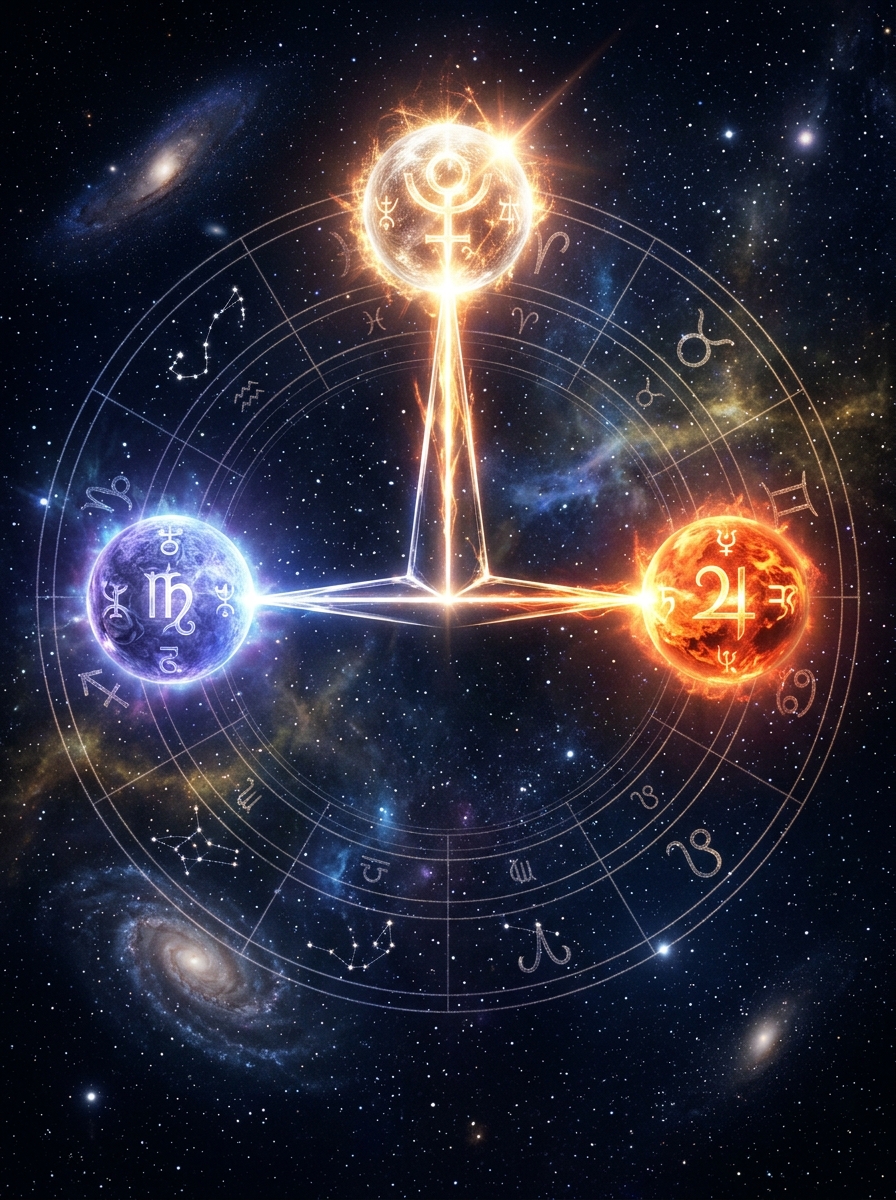
In the lexicon of astrological configurations, few patterns command as much respect, and occasionally trepidation, as the T-square. To understand the T-square is to understand the mechanics of dynamic tension, planetary polarization, and the structural integrity of the birth chart. In terms of celestial geometry, a T-square is a major aspect pattern formed when two planets in a state of mutual opposition (separated by 180 degrees) both form a square aspect (90 degrees) to a third planet. This third body, situated at the midpoint of the opposition, is known as the apex planet or the focal planet. Visually, when plotted upon a birth chart, these lines of aspect construct a right-angled triangle, a celestial "T" that dominates the circular landscape of the natal map.
The Geometry of Celestial Tension
To dissect this pattern, one must first appreciate the distinct astronomical and energetic qualities of the aspects that comprise it. The opposition is an aspect of polarity. It represents two forces occupying opposite ends of the zodiacal wheel, locked in a perpetual tug-of-war. The planets involved in the opposition are typically in signs of the same modality but contrasting elements (such as Fire and Air, or Earth and Water). This relationship generates a feeling of external division, a sense of projection where the individual fluctuates between the two poles, often experiencing them as conflicting external events or interpersonal relationships. The orb of influence for this opposition is typically up to 8 or 10 degrees, meaning the tension is felt broadly across the houses involved.
The square aspects, by contrast, are dynamic, friction-fueled dynamics of the same modality. The apex planet, positioned at the midpoint of the opposition, forms a 90-degree angle to both opposing bodies. In celestial mechanics, a square represents an impasse, a block in the flow of energy that demands direct, physical action to resolve. When two squares are joined to an opposition, the result is a closed circuit of high-voltage energy. The orb for the squares must also be relatively tight, ideally within 6 to 8 degrees, to ensure the configuration functions as a singular, unified network of force.
Unlike soft aspects like trines or sextiles, which allow energy to flow smoothly and harmoniously along paths of least resistance, the T-square acts as a spiritual pressure cooker. The energy cannot circulate passively. The two opposing planets, unable to find a common ground, throw their unresolved tension directly onto the apex planet. The apex planet, caught in the crossfire of this structural standoff, becomes the focal point of the entire chart's drive, acting as the singular outlet through which the accumulated pressure must be released.
Thus, the T-square is not an indicator of weakness, misfortune, or cosmic punishment, but rather a powerful, self-sustaining engine of growth. It is the catalyst that prevents life from sinking into comfortable stagnation. In the words of modern psychological astrologers, the T-square is the raw fuel of character, demanding that we develop conscious awareness and take concrete action to resolve our deepest internal splits.
The Psychology of the Opposition: Polarization, Projection, and Enantiodromia
At the heart of the T-square lies the axis of the opposition. To truly comprehend the psychological landscape of the individual carrying this configuration, we must look to the insights of Swiss psychiatrist Carl Jung and his theories of the shadow, projection, and the law of enantiodromia. The opposition is not merely an angle of distance; it is a split in the unified self, a line drawn down the middle of the psyche that forces the individual to navigate the challenge of dualism.
Projection and the Other
An opposition in the birth chart represents a fundamental psychological split. The psyche naturally struggles to contain two opposing planetary principles simultaneously. For example, if an individual has Mars in the First House opposing Venus in the Seventh House, the conscious ego may identify strongly with the self-assertive, independent, and competitive qualities of Mars while disowning the relational, peace-seeking, and cooperative qualities of Venus.
Because the psyche abhors a vacuum, the disowned Venusian qualities do not simply vanish; instead, they are projected onto the outer world. The individual encounters Venus through "the Other"—attracting partners who seem overly dependent, passive-aggressive, or obsessively focused on relationship harmony. The individual then blames these external figures for preventing them from acting out their Mars drive, completely unaware that the conflict is entirely internal. This projection creates an exhausting cycle of polarization. The individual swings wildly from one end of the opposition to the other, identifying with one pole and fighting the other in the external world. There is a sense of being at the mercy of external fate, of constant relational crises, and of feeling chronically misunderstood by those around them.
Enantiodromia: The Swing of the Pendulum
This psychological swinging brings us to Jung’s concept of enantiodromia, a term derived from ancient Greek philosophy meaning "running opposite." Jung defined it as the emergence of the unconscious opposite in the course of time. When one extreme is lived out to the exclusion of the other, it inevitably collapses, and the repressed side forces its way to the surface, often in a disruptive or chaotic manner.
In the context of the T-square, the opposition creates a high-tension psychic pendulum. The individual might spend years focusing entirely on career security, structure, and emotional control (Cancer-Capricorn opposition axis) only to suddenly abandon their responsibilities in a desperate, chaotic bid for emotional freedom or domestic revolution. The presence of the apex planet complicates this swing by acting as a third point that demands attention. The apex planet, by squaring both sides of the opposition, represents the persistent crisis that prevents the pendulum from ever resting.
To heal this split, the individual must engage in active integration, recognizing that both ends of the opposition are necessary components of their own psyche. As psychological astrologer Liz Greene notes, the opposition is only integrated when we can stand at the center of the seesaw, acknowledging both forces without succumbing to either. By withdrawing projections and accepting the internal tension, the individual stops fighting the external world and begins the true work of self-actualization.
The Apex Planet: The Pressure Valve and Catalyst for Action
If the opposition represents the psychic split and the source of tension, the apex planet is the focal point where that tension is translated into action. In any T-square, the apex planet is the most heavily stressed body in the configuration, but it is also the most potent. It represents the path of least resistance for the release of energy, functioning as a psychological pressure valve.
Dane Rudhyar, a pioneer of humanistic astrology, emphasized that the apex planet is the key to understanding the individual’s creative potential. Because the opposition is locked in a state of perpetual checkmate, the psyche naturally channels all its frustration, ambition, and drive into the house and sign occupied by the apex. It is here that the individual feels a compulsive need to act, to build, to achieve, and to express themselves. The apex planet is where the subconscious says, "Since I cannot resolve this opposition directly, I will pour all my life force into this third area."
For example, if the apex planet is Mercury in the Tenth House, the psychological tension of the opposition will drive the individual to communicate, write, speak, or intellectualize their way into a prominent public position. They will use their intellect as a shield and a sword to resolve their inner conflicts. If the apex is Saturn, the individual may respond to internal tension by erecting rigid boundaries, working tirelessly to build structures of authority, or taking on immense responsibilities to prove their worth. The constant friction from the squares forces the apex planet to mature rapidly, often making it the most developed, utilized, and masterfully expressed function in the native's life.
However, the apex planet also carries a significant shadow. Because it is under constant pressure from two sides, it can easily become overcompensated. The individual may lean too heavily on this planet's functions, leading to burnout, obsession, or defensive behavior. A Mars apex can manifest as chronic irritability, aggression, or a compulsive need to fight battles that do not exist. A Moon apex can result in intense emotional volatility, defensiveness, or a tendency to use emotional manipulation to establish safety. The key to working constructively with the apex planet is awareness. The individual must learn to treat the apex not as a master to be blindly obeyed, but as a skilled tool that requires conscious directing. By understanding the specific needs of the apex planet, one can deliberately channel its raw energy into creative, constructive channels rather than allowing it to erupt in destructive behavioral patterns.
T-Squares by Modality: Cardinal, Fixed, and Mutable Dynamics
The flavor, speed, and expression of a T-square are profoundly influenced by the modality of the signs involved: Cardinal (Aries, Cancer, Libra, Capricorn), Fixed (Taurus, Leo, Scorpio, Aquarius), or Mutable (Gemini, Virgo, Sagittarius, Pisces). Each modality approaches tension, crisis, and action in a fundamentally different way.
Cardinal T-Squares: The Crisis of Action
A Cardinal T-square is characterized by an urgent need for movement. Cardinal signs are the initiators of the zodiac; they represent beginnings, drive, and the impulse to impact the environment. When a T-square occurs in cardinal signs, the tension is immediate, dynamic, and oriented toward the outer world.
Individuals with a Cardinal T-square live in a state of perpetual crisis management. They are driven by an intense ambition and an impatience to make things happen. The danger here is impulsivity and a tendency to launch into action without adequate planning, using busyness as a defense mechanism against inner anxiety. The cardinal energy wants to solve psychological problems by changing the external environment—changing jobs, ending relationships, or moving to a new city—rather than doing the slow, internal work of integration. For instance, an Aries-Libra opposition squaring a Cancer apex forces the individual to navigate the tension between independence and relationship harmony by overemphasizing emotional security or defensive domestic maneuvers. The lesson for the Cardinal T-Square is to learn the value of deliberate, conscious action and to recognize that not every tension can be resolved by running forward.
Fixed T-Squares: The Iron Will and Stagnation
A Fixed T-square represents the ultimate battle of wills. Fixed signs are the stabilizers, builders, and maintainers of the zodiac. When locked in a T-square, the tension is internal, deeply rooted, and resistant to change. The energy does not explode outward as it does in cardinal signs; instead, it implodes, creating a dense, highly pressurized psychological core.
The primary challenge of the Fixed T-square is stubbornness and resistance to adaptation. These individuals will cling to outworn situations, beliefs, or relationships long after they have ceased to be viable, simply because the prospect of change feels like a threat to their survival. The tension accumulates over years, manifesting as deep-seated resentment, physical rigidity, or sudden, catastrophic breakdowns when the structure can no longer hold the pressure.
However, the Fixed T-square also grants an extraordinary capacity for endurance, concentration, and focus. Once these individuals decide to direct their energy toward a creative goal, they possess the iron will necessary to overcome any obstacle. For example, a Taurus-Scorpio opposition squaring a Leo apex manifests as a deep struggle with security and shared resources that is expressed through a powerful, dramatic drive for personal creative control. Their growth lies in learning to surrender, to flow with the currents of change, and to recognize that rigidity is not the same as strength.
Mutable T-Squares: The Windmill of the Mind
A Mutable T-square operates primarily in the realms of intellect, belief, and adaptation. Mutable signs (Gemini, Virgo, Sagittarius, Pisces) are the agents of transition and adjustment. When a T-square occupies these signs, the tension is experienced as mental restlessness, fragmentation, and an overwhelming influx of information or perspectives.
Unlike the Fixed T-square, which resists change, the Mutable T-square suffers from an excess of it. The individual may struggle to commit to a single path, constantly scattered by competing interests, philosophies, or doubts. They are highly sensitive to the thoughts and feelings of others, often adapting their personality to suit their environment until they lose touch with their authentic core. The mutable tension manifests as anxiety, nervous exhaustion, and a tendency to intellectualize emotions rather than feeling them.
Yet, this configuration also bestows immense versatility, empathy, and intellectual brilliance. A Gemini-Sagittarius opposition squaring a Virgo apex, for example, demands that the individual resolve the conflict between broad philosophical concepts and immediate facts by building highly analytical, detailed, and service-oriented systems. The key to integrating a Mutable T-square is developing focus, grounding the mind in physical reality, and learning to sit with silence rather than seeking constant mental distraction.
The Focal Planets: How Each Planet Manifests as the Apex
The specific planet occupying the apex position determines the primary psychological mechanism through which the T-square's tension is expressed and resolved. Below, we explore how different celestial bodies function when placed at this critical focal point, serving as both the obstacle and the path to mastery.
Personal Planets as the Apex
- The Sun as Apex: When the Sun is the focal planet, the individual’s very sense of identity, self-expression, and vital purpose is caught in the crossfire. There is an intense, driving need to be recognized, to shine, and to achieve creative self-actualization. This can manifest as an overcompensated ego, a dramatic search for attention, or a profound fear of insignificance. The individual must learn to ground their sense of identity in internal self-worth rather than external validation, turning the spotlight inward to light their path.
- The Moon as Apex: With the Moon at the apex, the tension is deeply emotional and instinctual. The individual's sense of safety, belonging, and emotional stability is constantly challenged by the opposing planets. They may experience intense mood swings, family conflicts, or a tendency to absorb the emotional energy of their environment. The path to integration involves establishing healthy emotional boundaries and learning to self-soothe rather than relying on others to validate their feelings or protect them from the harsh realities of life.
- Mercury as Apex: A Mercury apex channels the dynamic energy of the T-square directly into the mind and communication channels. These individuals are compulsive thinkers, writers, and speakers, driven to constantly analyze, categorize, and explain their experiences. They possess an incredibly active intellect but are prone to nervous tension, racing thoughts, and mental exhaustion. The challenge is to move from superficial mental agility to deep, reflective wisdom, learning to quiet the mind through mindfulness, structured writing, or meditation.
- Venus as Apex: When Venus is the apex, the focus is on relationships, values, aesthetics, and self-worth. The individual may experience chronic relationship dramas, struggles with intimacy, or a tendency to compromise their values to maintain peace. There is often a conflict between their desire for connection and their need for independence. The lesson is to cultivate unconditional self-love and to build relationships based on mutual respect rather than using partnerships as a shield to escape the tension of the chart.
- Mars as Apex: A Mars apex is one of the most explosive and high-energy configurations in astrology. The individual possesses an immense store of drive, ambition, and physical energy, but also a low threshold for frustration and a tendency toward defensive anger. This can manifest as interpersonal conflict, competitiveness, or a tendency to force issues prematurely. The work here is to channel this potent energy into constructive physical outlets, leadership roles, or creative projects, transforming raw aggression into disciplined assertion and courage.
Social and Transpersonal Planets as the Apex
- Jupiter as Apex: With Jupiter at the focal point, the individual seeks resolution through expansion, philosophy, and the pursuit of meaning. There is a tendency toward excess, dogmatism, or unrealistic optimism. The individual may constantly chase the "next big thing" or indulge in grandiose plans to avoid dealing with current limitations. Integration requires grounding Jupiter’s ideals in practical reality, learning that true growth is often slow and steady, and finding meaning within the ordinary.
- Saturn as Apex: A Saturn apex demands discipline, structure, and the acceptance of responsibility. The individual often feels a heavy burden of duty, fear, or inadequacy early in life, squaring their core needs. They may overcompensate by working tirelessly to achieve status, control, and authority. The lesson of Saturn is to build inner authority and emotional maturity, recognizing that true security comes from self-mastery and integrity, not from external control.
- Uranus as Apex: Uranus at the apex demands radical individuation, innovation, and the breaking of outdated societal norms. The individual must channel the revolutionary energy of Uranus to resolve their internal conflicts, acting as a reformer or visionary. The danger is a compulsive need to rebel for rebellion's sake, leading to alienation. Mastery involves using unique insights to build constructive, progressive alternatives.
- Neptune as Apex: Neptune requires spiritual surrender, artistic expression, and the integration of the collective unconscious. The individual may struggle with escapism, boundary dissolution, or confusion. To resolve the T-square's tension, they must learn to channel Neptune's transpersonal vision into art, mysticism, or compassionate service, grounding their dreams in physical reality.
- Pluto as Apex: Pluto demands deep psychological shadow work, transformation, and the conscious use of personal power. This is a highly intense placement, forcing the individual to undergo cycles of death and rebirth. They may struggle with power dynamics, control, or paranoia. Integration requires surrendering the ego's need for control, embracing vulnerability, and using their profound psychological insight to heal themselves and others.
The Empty Point: Finding Balance and Integration in the Chart
While the apex planet is the natural outlet for the T-square's energy, relying solely on it can lead to psychic exhaustion and behavioral extremes. To find true balance, astrologers look to the mathematical point directly opposite the apex planet: the Empty Point, also known as the resolution point or the "leg" of the missing Grand Cross.
If you imagine the T-square as a three-legged table, it is inherently unstable, constantly leaning toward the apex. The Empty Point represents the fourth leg that would turn the T-square into a stable Grand Cross. Although there is no physical planet located at this point (unless a transiting planet passes over it), the house and sign of the Empty Point represent the qualities and life experiences the individual must consciously cultivate to balance the configuration.
For example, if the apex planet is in Leo in the Eleventh House, the Empty Point will be in Aquarius in the Fifth House. The individual may compulsively seek validation from their social group or community (Leo in the 11th) to resolve their inner tensions. To find balance, they must learn to embrace the Aquarian qualities of objective detachment and engage in creative, individual self-expression (5th House) without worrying about group approval.
By consciously developing the traits of the sign and house of the Empty Point, the individual creates a psychological counterweight. This prevents the apex planet from becoming overloaded and allows the energy of the opposition to flow more smoothly. It acts as a sanctuary, a place of quiet reflection and integration where the individual can step back from the dynamic pressure of the T-square and find a sense of inner peace.
Furthermore, monitoring transits to the Empty Point is a vital practice for anyone with a natal T-square. When a transiting planet passes through this point, it temporarily completes the Grand Cross, highlighting the specific lessons of integration and providing a window of opportunity to build the structural support necessary to stabilize the entire chart configuration.
Myth vs. Reality: Why a T-Square is a Gift for Personal Evolution
In classical astrology, the T-square was often viewed with alarm, classified as an unfortunate affliction that promised a life of hardship, conflict, and struggle. Modern psychological astrology, however, has discarded this fatalistic view, recognizing that some of the most accomplished, creative, and resilient individuals in history carry prominent T-squares in their birth charts.
The myth of the T-square is that it is a curse designed to make life difficult. The reality is that human beings rarely grow when they are comfortable. A birth chart filled with harmonious trines and sextiles may describe a person who is charming, talented, and easygoing, but it can also lead to a life of passive complacency, where gifts are left undeveloped because there is no inner drive to use them.
The T-square provides that drive. The perpetual tension it generates acts as a divine discontent, a voice that refuses to let the individual settle for mediocrity. It demands that we ask hard questions, face our shadows, and develop the courage to act. The struggles associated with the T-square are not meaningless suffering; they are the friction required to polish the soul, turning raw potential into refined genius.
By embracing the T-square, recognizing the split of the opposition, channeling the power of the apex consciously, and seeking balance through the empty point, the individual transforms this celestial crucible into their greatest asset. It becomes the foundation of their strength, the source of their creativity, and the primary vehicle for their personal evolution.
Frequently Asked Questions about the T-Square
What is the difference between a T-square and a Grand Cross?
A T-square consists of three planets forming a right-angled triangle (an opposition and two squares). A Grand Cross (or Grand Square) consists of four planets forming a complete square within the chart, featuring two oppositions and four interlocking squares. While the T-square has an open "empty point" that allows for a dynamic release of energy through the apex, the Grand Cross is a fully enclosed structure. The Grand Cross creates a feeling of being locked in from all sides, requiring a high degree of integration and balance across all four points, whereas the T-square is more action-oriented and driven toward a singular focal point.
Can a T-square involve planets in different modalities?
Yes. While most T-squares occur within the same modality (all Cardinal, all Fixed, or all Mutable) due to the geometric requirements of signs, it is possible to have a "dissociated" or out-of-sign T-square. This happens when the planets involved are at the very beginning or end of their respective signs, causing the mathematical aspects (90 and 180 degrees) to cross over sign boundaries into different modalities. A dissociated T-square presents a unique psychological challenge, as the individual must integrate contrasting elemental and modality drives that do not share the typical structural relationship.
How do transits affect a natal T-square?
Transits act as temporary triggers for the natal T-square. When a transiting planet conjuncts, opposes, or squares any of the three planets in the configuration, the entire pattern is activated, often bringing the core psychological tension to a head in the form of external events or internal crises. Crucially, when a transiting planet passes through the "Empty Point" opposite the apex, it temporarily completes a Grand Cross. This period often represents a time of significant breakthrough, demanding that the individual integrate the missing qualities of that sign and house to resolve long-standing issues.
Is having a T-square in my chart a sign of a difficult life?
Not necessarily. While a T-square indicates areas of life where you will experience significant tension, challenge, and the need for effort, it does not guarantee an unhappy or difficult life. The challenges of a T-square are purposeful; they are designed to build resilience, character, and skill. Many highly successful, creative, and influential people have prominent T-squares. The configuration provides the necessary drive and determination to overcome obstacles and achieve great things, which might not be present without this dynamic tension.
How do I start integrating my natal T-square?
The first step in integrating a T-square is to identify the planets involved, particularly the apex planet, and the houses they occupy. Observe how you express the energy of the apex planet—are you overcompensating, or using it defensively? Next, look to the opposition and try to identify where you might be projecting one side of the conflict onto other people. Finally, look to the house and sign of the Empty Point opposite your apex planet. Cultivating the qualities of this empty point consciously will provide the balance and perspective needed to ease the tension of the configuration.
Comments
Loading comments…