Sun Square Sun in Synastry: When Two Solar Egos Strike Spark and Steel
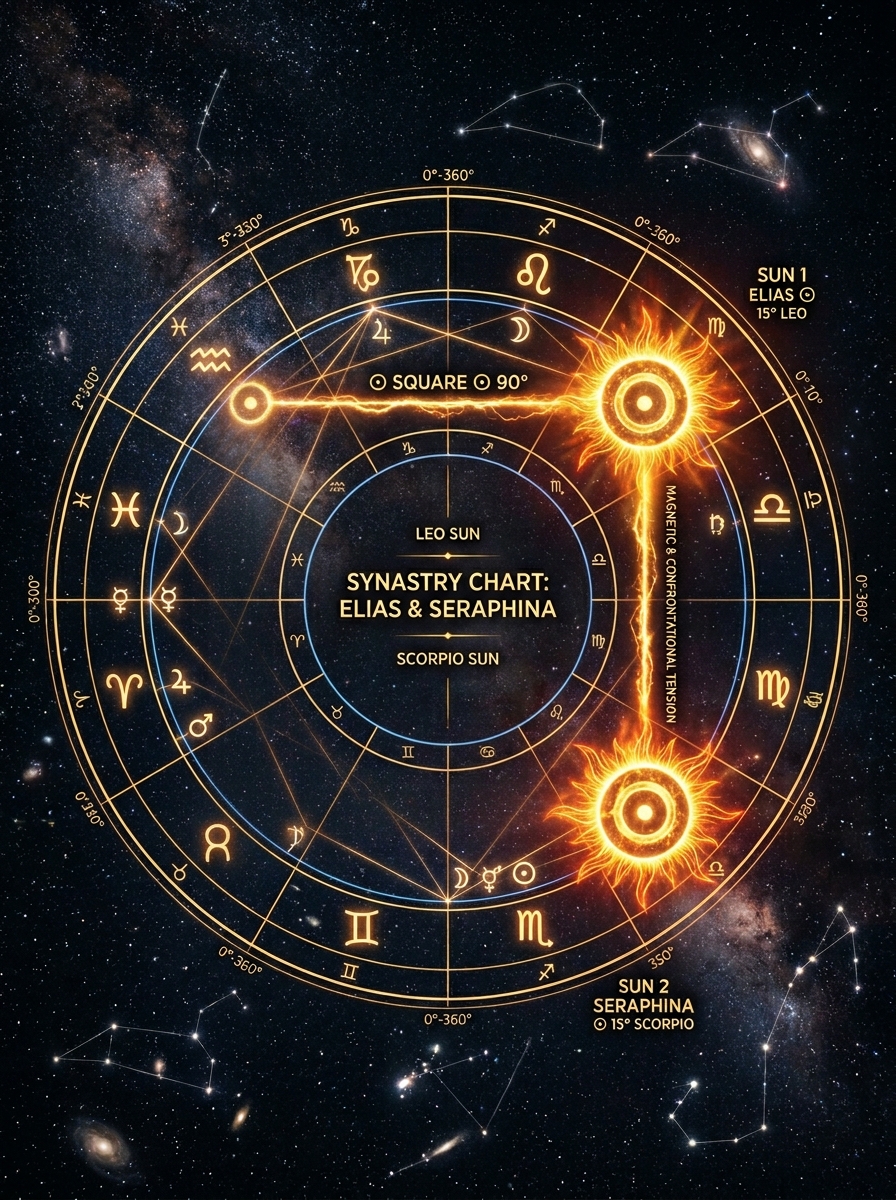
Two centers of gravity
When one person’s Sun squares the other’s Sun, the relationship does not begin in softness; it begins in voltage. Each person feels the other’s selfhood as real, vivid, and impossible to ignore, but also as structurally different enough to provoke resistance. This is not the quiet compatibility of shared habit. It is the meeting of two centers of gravity that keep trying to occupy the same emotional sky.
The core truth is simple: Sun square Sun creates mutual recognition without easy alignment. The attraction is often immediate because each person senses vitality in the other—something alive, definite, and self-possessed. Yet that same clarity can feel like challenge. The partner mirrors not just desire, but difference; not just admiration, but irritation. In synastry aspects, the square is one of the most catalytic contacts, and here the catalyst strikes the identity itself.
Why the Sun matters more than “ego”
The Sun is not merely vanity or confidence. It is the organizing principle of the psyche: will, direction, creative intention, and the right to exist in one’s own pattern. When two Suns form a square, neither person can easily inhabit the relationship as a neutral field. Each arrives as a whole design. Each insists, consciously or not, “This is how life should be lived.”
That is why this aspect often feels personal faster than many others. A Venus-Mars contact may ignite desire; a Moon-Moon contact may generate familiarity; but a Sun square Sun can make two people feel seen and contradicted at the same time. The friction comes from incompatible styles of self-expression, not from lack of affection. For a broader framework on the geometry of this aspect, see the square aspect astrology.
The charge and the friction
The chemistry of Sun square Sun is real, but it is not the chemistry of resemblance. These two people are often drawn together precisely because the other carries qualities they cannot naturally embody. One may be direct where the other is strategic, proud where the other is pragmatic, restless where the other is fixed. The square creates a kind of relational asymmetry that can feel invigorating: “You are not me, and that is exactly why I want to know you.”
Yet that same asymmetry generates the friction. The conflict in Sun square Sun is rarely about the stated issue. It usually comes from tone, pace, and basic assumptions about how life should be approached. One person wants to initiate; the other wants to calibrate. One thinks in terms of momentum; the other in terms of coherence. These are not superficial disagreements. They reveal different operating systems.
The square demands friction because each Sun is the source code of identity. When the two codes conflict, the relationship can become a stage for unconscious pride. The argument is not merely “your way bothers me.” It is often “your way implies mine is incomplete.” That is the raw nerve. The partner’s selfhood feels like commentary on your own.
Not all Sun square Sun contacts behave alike. The sign modalities determine how the tension moves. A cardinal square tends to produce power struggles around initiative. A fixed square is more stubborn, with each person holding position with remarkable endurance. A mutable square is more slippery—the disagreement may shift form, becoming a series of revisions or mixed signals. This is one reason the same aspect can look dramatically different from couple to couple.
A lone Sun square Sun can already feel demanding, but it can also function like the engine room of a larger pattern. If other planets hook into the square, the relationship may begin to resemble a T-square: more pressure, more urgency, more inevitability. In those cases, the couple is not merely negotiating difference; they are carrying a shared developmental task that refuses to stay theoretical.
Maturation and shadow
The mature expression of Sun square Sun is not harmony in the sentimental sense. It is competence under pressure. The couple learns to treat difference as information rather than insult. Each person retains their core identity while recognizing that the partner’s mode of being is not a mistake to be corrected. That kind of maturity takes more than goodwill; it takes repeated encounters with the limits of one’s own default style.
The great danger is identity inflation. Each person can unconsciously begin to defend a self-image instead of the living self. Then every disagreement becomes a referendum on worth. The couple stops arguing about choices and starts arguing about legitimacy. The antidote is not self-erasure; it is precision. Each partner must learn to say, in effect: “This is my way, and I can stand in it without requiring you to mirror me.” That statement honors the Sun properly.
When softened by supporting contacts—a warm Moon-Venus synastry connection, for example—the square can become creative rather than combative. Emotional rhythms synchronized even when identities differ. The relationship then develops a surprisingly high caliber of mutual respect because neither person can survive by drifting into passive consensus.
In life, this aspect plays out distinctively across domains. In love, couples often need separate spheres and clear roles to avoid a power struggle over who leads. In work, the square can fuel a shared enterprise if each person owns a different part of the process—one the starter, the other the finisher. In friendship, the bond may feel competitive on the surface but is underpinned by a fierce respect that prevents stagnation. The dynamic remains the same: two bright wills learning how to share a sky without pretending they are the same star. For a deeper emotional frame around romantic dynamics, see The Alchemy of Love Synastry.
Reading the aspect in context
A Sun square Sun never acts alone. The rest of the synastry tells you whether the square becomes a creative edge, a chronic wound, or a meaningful trial. The same two people may be fierce in one life period and surprisingly workable in another because the surrounding transits, house overlays, and supporting aspects shift the lived experience.
House overlays matter: if one person’s Sun lands in the other’s seventh house, the tension may become overtly relational; if it lands in the tenth, the square may show up as status, ambition, or public identity. Synastry house overlays are often where the lived context of the aspect becomes visible. A strong Venus contact can preserve goodwill, while Mars can amplify both attraction and combativeness.
The most useful question is not “Is this good or bad?” but “What kind of identity work does this relationship require?” That is the real gift of Sun square Sun. It refuses the fantasy of effortless fusion and asks for adult love: one person meeting another without demanding sameness, and without surrendering selfhood. When handled well, the square does not diminish attraction. It deepens it by adding respect, edge, and earned understanding.
If you want the more fluid, emotionally consonant version of solar compatibility, compare this contact with Sun-Moon synastry. But if what you have is Sun square Sun, you are in the realm of forged identity: two bright wills learning how to share a sky without pretending they are the same star.
Related
- Synastry Sun Square Moon: Desire, Disruption, and the Emotional Fault Line
- Sun Square Mercury in Synastry: The Spark That Argues with Itself
- Synastry Sun Conjunct Sun: When Two Selves Ignite
- Sun Square Venus in Synastry: Attraction, Friction, and the Price of Chemistry
- Synastry Sun Square Mars: Desire, Defiance, and the Spark That Won’t Sit Still
Comments
Loading comments…