Synastry: Venus Sextile Mars — The Ease of Mutual Spark
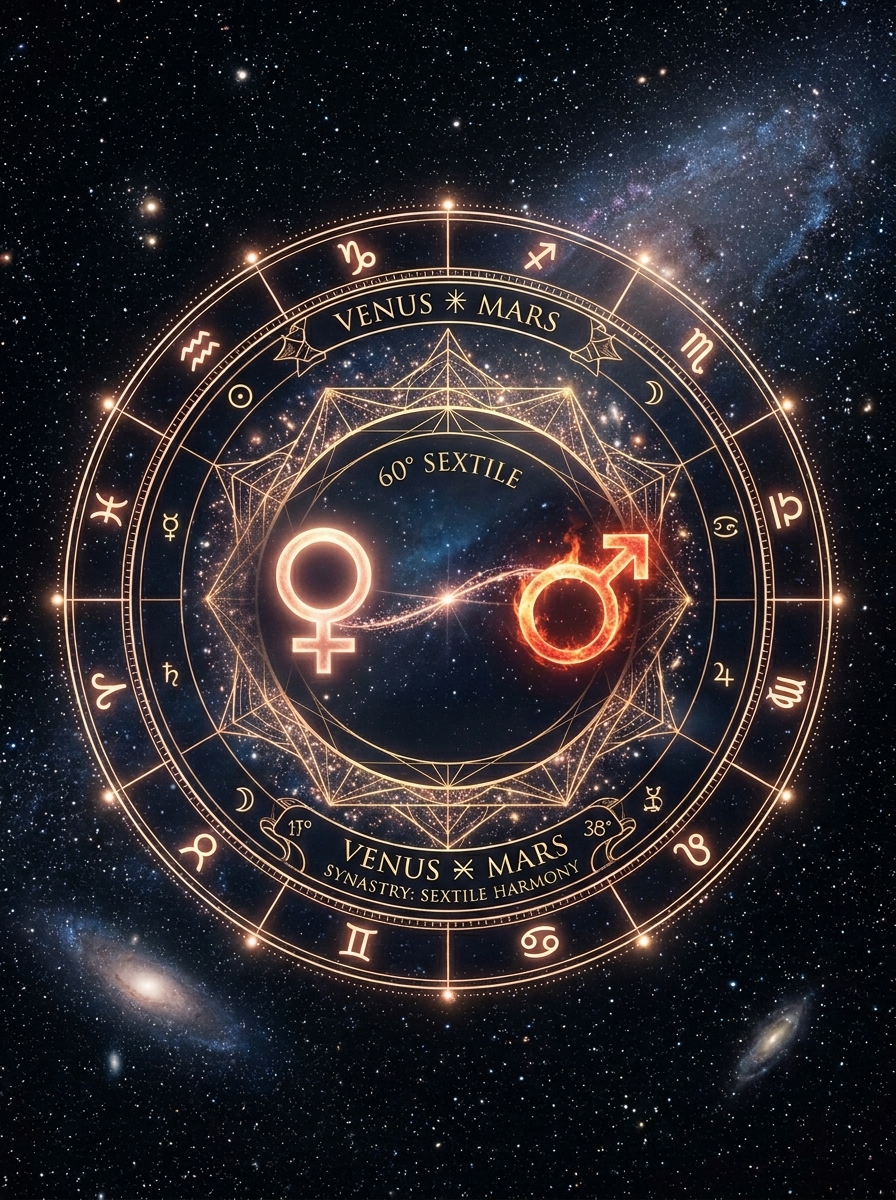
The cooperative current between wanting and being wanted
When Venus sextile Mars appears in synastry, the attraction is not the question — the articulation is. This 60-degree link connects one person’s way of valuing and receiving pleasure (Venus) with the other’s way of pursuing and asserting desire (Mars) in a relationship that feels less like tension and more like timing. The keyword is not passion but fit: two instincts that can dialogue without one overpowering the other.
Unlike a conjunction, which fuses the energies into something almost too intimate to name, or a square, which generates friction that can either ignite or corrode, the sextile offers cooperation without combustion. The Venus person senses that their affection is met with initiative that respects its contours. The Mars person feels that their desire is welcomed, not deflected. This is why couples with this aspect often describe the early stages as effortless — not because nothing happens, but because everything that happens seems to arrive at the right moment.
The sextile is an invitation, not a guarantee. It sets up a channel; the current still needs to be switched on. In a live chart, the aspect’s promise depends on whether the partners consciously choose to use its rhythm — and that choice is shaped by signs, houses, and the rest of the synastry field. For a fuller context of how these dynamics work across a relationship, see the guide to Venus and Mars Synastry.
Why ease is not simplicity
A common misreading of the sextile is to assume it means “no problems.” In fact, it often means problems are workable because the foundational attraction is not adversarial. The Mars person does not need to prove dominance; the Venus person does not need to hold back for safety. Each can show up directly, and that directness tends to prevent the kind of misunderstanding that builds resentment. But directness requires honesty, and the sextile can also tempt a couple to smooth over edges that need to stay sharp.
The distinction between ease and avoidance is the central tension of this aspect. It shows up in the difference between a flirtation that deepens into intimacy and one that stays forever on the surface. The aspect itself does not decide; the people do. That is why understanding the broader architecture of Synastry Aspects matters — the sextile is a resource, not a destination.
How the desire organizes itself
What separates Venus sextile Mars from other harmonious connections is the way it structures erotic and affectionate exchange. The Venus person’s preferences — what they find beautiful, how they like to be touched — become something the Mars person can respond to with instinctive accuracy. The Mars person’s initiations — the timing, the boldness, the playful nudge — land on ground that the Venus person has already cleared. This is not telepathy; it is two people who happen to speak similar dialects of desire.
The result is a relationship where attraction does not have to be continuously negotiated. The couple can move from wanting to action with fewer false starts. This shows up in the bedroom, certainly, but also in the way they plan a trip, decide what to eat, or handle a moment of flirtation across a crowded room. The Mars person’s drive finds an aesthetic; the Venus person’s receptivity finds a worthy target.
For a deeper look at how sign placements color this interaction — a Venus in Aries responding to a Mars in Gemini, for instance — the profile of Venus in Aries helps clarify why some sextiles feel like a race and others like a slow dance. The element pairing matters: fire-air sextiles tend to be quick, verbal, and experimental; earth-water sextiles are slower, more tactile, and emotionally nourishing. Neither is better, but each requires a different kind of attention.
The role of house overlays
No synastry aspect lives in a vacuum. The houses where Venus and Mars fall determine the life arena where the chemistry becomes tangible. If the Mars person’s Mars falls in the Venus person’s fifth house, the spark tends to manifest through play, creativity, romance, and sex — the couple may feel that they come alive together in the bedroom or on a dance floor. If it lands in the seventh house, the partnership itself becomes the stage: ease of collaboration, shared decisions, a sense of being “on the same team” about life direction.
If it lands in the eighth house, the chemistry takes on an undercurrent of vulnerability and transformation — the attraction may be sweet on the surface but quickly pulls into deeper waters around trust, shared resources, or sexual merging. That overlay changes the tenor of the sextile entirely. To map these possibilities with your own chart, consult the Synastry House Overlays guide.
The shadow of pleasant inertia
Every aspect has a shadow, and the sextile’s is complacency. Because Venus sextile Mars makes attraction feel natural, the couple can drift into a rhythm that looks alive but never reaches the core of either person. The flirting continues, the physical response remains warm, but nothing is risked. Venus wants to be cherished — but also to be challenged into deeper appreciation. Mars wants to win — but also to be met with resistance worthy of its strength. A relationship that only gives each planet what it already knows can become a cage of comfort.
This shadow is especially likely when the rest of the synastry is also easy. A couple with several harmonious aspects and no major squares may develop an unspoken agreement to keep things pleasant. The sextile becomes the oil that lubricates the avoiding mechanism. Over time, the attraction stays pleasant but loses its capacity to transform. The difference between this and a mature relationship is whether the couple can introduce friction intentionally — whether they can use the sextile as a base from which to explore harder conversations, deeper vulnerability, and the kind of honest conflict that seasons love.
For a contrast, consider how the Moon-Venus Synastry aspect handles emotional shelter: that contact offers a different kind of safety, one that tends to prioritize softness over edge. Venus sextile Mars needs both. It is not meant to eliminate friction but to make friction productive. The question to ask is not “Is the chemistry still there?” but “Is the chemistry still teaching us something?”
Keeping the spark alive without flattening it
The healthiest expression of Venus sextile Mars is responsive vitality. The couple benefits from novelty, shared creation, and the deliberate introduction of new contexts for desire. Planning a project together, learning something that requires coordination, traveling to unfamiliar places — these activities give the sextile something to do. Mars supplies the initiative; Venus shapes the experience into something that satisfies both partners. The result is a relationship that feels not just compatible but collaborative.
A practical tool: the couple can experiment with alternating who leads in different domains. Let the Venus person initiate the aesthetic choices (where to go, what to create) while the Mars person initiates the timing and execution. Or let Mars take the lead on risk-taking while Venus softens the landing. The sextile thrives on exchange, not stasis. For a step-by-step method of evaluating how such dynamics play out across the whole chart, see the Synastry Step-by-Step guide.
The mature version
Mature Venus sextile Mars does not mistake ease for passivity. It knows that attraction is a renewable resource, not a fixed inheritance. The couple continues to choose each other through small acts of timely desire: a word that lands, a touch that matters, a plan that gets made, a repair that happens before resentment hardens. The relationship stays alive because both planets remain in motion, but the motion is deliberate.
In the end, this aspect is about the art of making desire livable. Venus brings elegance to appetite; Mars brings courage to affection. Together they create a chemistry that is less theatrical than a hard aspect but often more sustainable — a bond that says yes with style, and keeps saying yes as long as both people keep showing up. For the full landscape of relational astrology, return to the Astrological Synastry overview and place this sextile within the whole.
Related
- Synastry Venus Sextile Venus: Ease, Taste, and the Art of Mutual Attraction
- Venus Trine Mars in Synastry: The Ease of Mutual Desire
- Synastry: Venus Conjunct Mars — The Heat Between Wanting and Being Wanted
- Sun Sextile Mars in Synastry: The Ease of Shared Fire
- Synastry Sun Sextile Venus: The Ease That Makes Desire Feel Human
Comments
Loading comments…