Synastry: Sun Opposition Sun — The Axis of Recognition and Friction
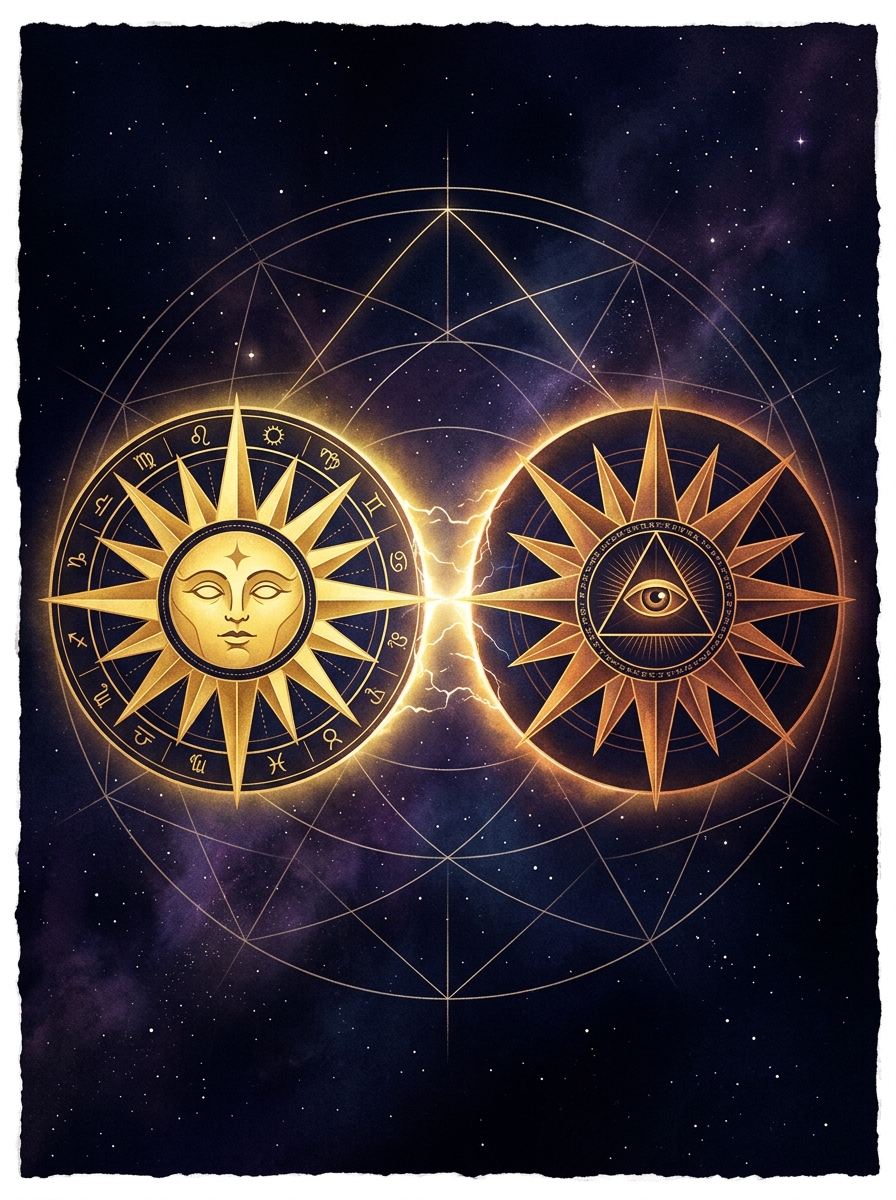
The Axis of Recognition
A Sun opposition Sun in synastry places two people’s core identities directly across the zodiac, each one the other’s missing half—and each one’s natural counterweight. This is not a soft aspect of easy blending. The opposition is a tense, awareness-driven geometry: it forces confrontation, not fusion. What draws these two together is the shock of seeing something vital and unexpressed in another person. What keeps them honest is the recurring reminder that the other’s way of being is not a flaw to be corrected but a truth to be met.
The richest truth about this contact is simple: it does not erase difference; it dramatizes it. Each person’s Sun—the planet of will, vitality, and sovereign selfhood—wants to shine on its own terms. In an opposition, those two centers of gravity pull in opposite directions. The relationship becomes a perpetual field of negotiation between how each partner lives, leads, and defines reality. The couple does not merge; they stand across from one another, and the space between them becomes the relationship.
Astrologically, the opposition is a mirror with distance—a structural pattern explored in depth in the full study of the opposition aspect. In synastry, it operates as a spotlight on identity itself. For a broader frame on how chart overlays create this kind of tension, the complete guide to astrological synastry places the Sun opposition in the larger ecology of a relationship chart.
The Psychology of the Mirror
The immediate attraction in a Sun opposition Sun stems from the fact that each person often embodies qualities the other has underdeveloped, repressed, or over-relied upon. A Sun in Aries meets a Sun in Libra and feels the strange relief of encountering tact, reflection, and relational intelligence; the Libra native feels awakened by Aries’ directness and appetite for life. Neither is “better”—each is a corrective. That is why the connection can feel fated without being easy. The pull comes from complementarity; the friction comes from autonomy.
Yet the same mechanism that creates attraction also triggers the ego quickly. The Sun rules the need to be seen and to express oneself with authority. In an opposition, those two authorities do not harmonize—they contend. Arguments that appear to be about scheduling, social style, or leadership often turn out to be about whose mode of being sets the emotional weather. The relationship becomes a constant, subtle referendum on who is “more authentic,” “more mature,” or “more right.” This is the aspect’s shadow terrain.
When a Sun opposition Sun goes astray, projection takes over. Each partner begins to personify the other’s disowned trait and then resents being corrected by it. The Capricorn partner sees the Cancer partner as too reactive; the Cancer partner sees Capricorn as emotionally remote. These are not lies—they are partial truths inflated by defensiveness. The couple stops relating as whole people and starts defending symbolic positions. For a deeper look at how this dynamic manifests across relationship patterns, the overview of synastry aspects provides context for how opposition energy plays out alongside other contacts.
The specific sign axis determines the flavor. Aries-Libra is about self-assertion versus relational finesse; Leo-Aquarius pits personal radiance against collective vision; Virgo-Pisces contrasts precision with surrender. The geometry is the same, but the signs supply the content. The axis matters because it tells you exactly what each partner is defending—and what they are missing.
The Art of Conscious Alternation
The mature expression of a Sun opposition Sun does not involve compromise in the weak sense of splitting the difference. It requires conscious alternation: letting one partner lead where their solar style is strongest, then the other. Let initiative and diplomacy trade seats. Let vision and realism take turns commanding. This is the hidden genius of the opposition—it can create a relational field more intelligent than either person alone, provided neither insists on monopolizing the center.
Respect, not agreement, is the glue. Respect means being able to witness another mode of being without reducing it to a flaw. The couple becomes strongest when difference is treated as a design feature rather than a defect. In practice, this demands that each person know who they are without needing the other’s approval to confirm it. That is a harder and more mature form of intimacy than fusion.
The shadow side of the opposition—criticism, projection, chronic scoring—can be mitigated by remembering what each Sun is actually defending: the right to exist in one’s own pattern. The other person feels like a threat because they naturally bring the absent half of the picture into view. But that threat is also the medicine. The relationship keeps both people honest about where they over-identify, over-control, or overperform their role.
For couples who can sustain this tension, the bond deepens into something the alchemy of love synastry describes not as easy harmony but as a crucible for character. The wider conversation in the alchemy of love synastry explores how such contacts can evolve into a dialogue that changes both speakers.
Where the Axis Touches the Ground
The lived expression of Sun opposition Sun depends heavily on the houses involved. In a 7th-house overlay, the relationship itself becomes the arena—partnership, projection, and negotiation are front and center. In a 1st-house overlay, identity and self-presentation activate immediately; the partners feel like they are defining themselves against each other from day one. In a 10th-house overlay, ambition, reputation, and life direction dominate the conversation. The same aspect can feel romantic, competitive, domestic, or public depending on where it lands. The full map of synastry house overlays shows how the stage transforms the performance.
In daily life, the dynamic shows up in competing rhythms. One person prefers initiative before discussion; the other needs discussion before initiative. One trusts instinct; the other trusts calibration. This is not a defect—it is the axis in action. The relationship becomes a negotiation between action and interpretation, assertion and balance, speed and sequence. The key is learning to trade the lead without resentment.
Other aspects can soften the edge. If the charts also contain strong Sun-Moon synastry, the couple has an emotional sanctuary where they can feel seen at a deep, non-confrontational level. Venus-Mars connections add the sweetness of desire and the instinct to care for one another’s moods. Without such support, the opposition can remain all voltage and no shelter. With it, the relationship becomes a living axis: one partner presses outward, the other anchors or translates. Then the bond feels less like a duel and more like a shared mechanism with two indispensable functions.
Ultimately, a Sun opposition Sun does not tell you whether a relationship will be easy. It tells you that the relationship will force both people to become more themselves, less defensive, and more capable of honoring a sovereign other. That is not a promise of comfort. It is a promise of growth. The aspect is less about romance-as-merger than romance-as-dialogue—and the kind of dialogue that can change both speakers, if they survive their own need to win.
Related
- Synastry: Sun Opposition Mars — Attraction at the Edge of Friction
- Synastry Sun Opposition Venus: Attraction at the Edge of Friction
- Synastry Sun Conjunct Sun: When Two Selves Ignite
- Sun Square Sun in Synastry: When Two Solar Egos Strike Spark and Steel
- Synastry: Sun Opposition Mercury and the Electric Argument
Comments
Loading comments…