Synastry: Sun Opposition Mars — Attraction at the Edge of Friction
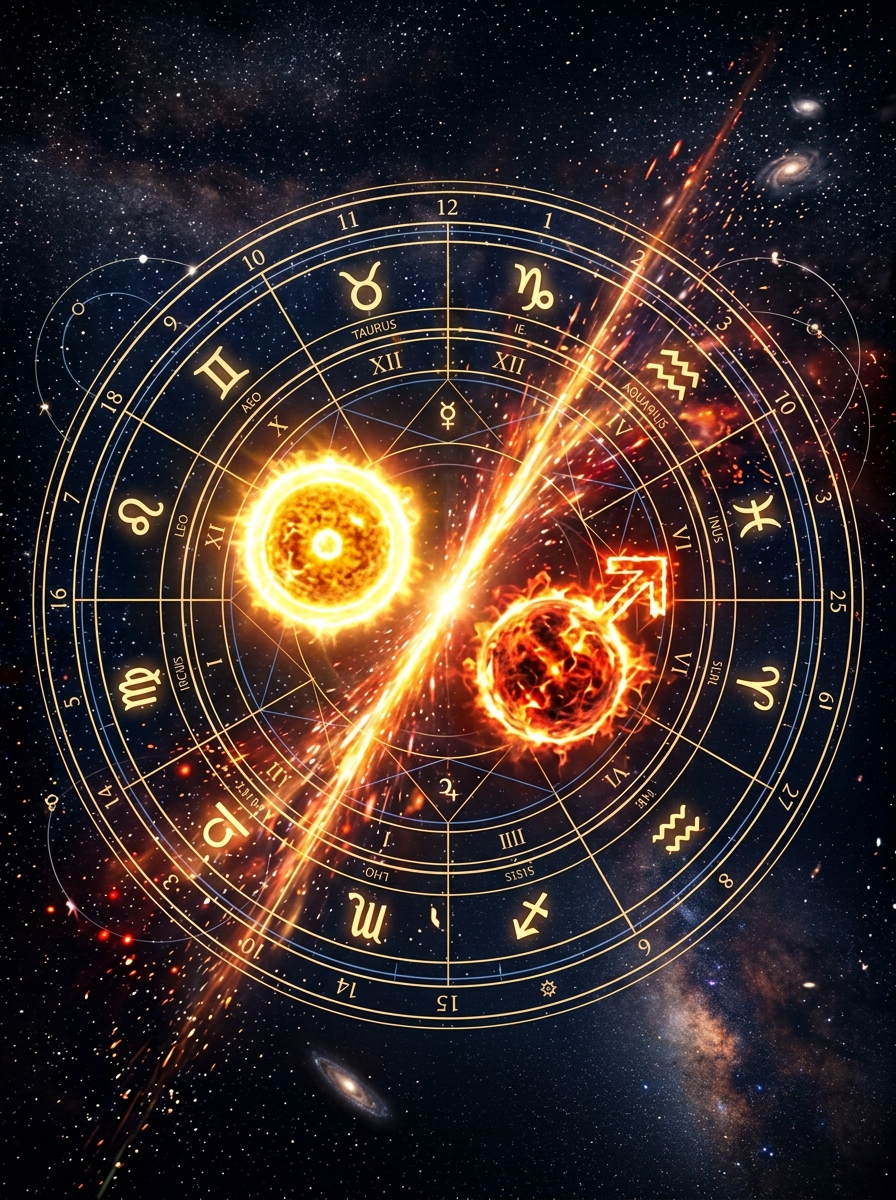
The Core Dynamic: Two Wills in Mirror Opposition
Sun opposite Mars in synastry is a contact that bypasses small talk. The Sun person embodies identity, purpose, and the need to shine without apology; the Mars person moves as initiative, appetite, and the instinct to act before asking permission. When these planets stand 180° apart across the two charts, they create a direct line of tension that is also a line of electricity. Each person sees in the other something they themselves are not yet fully owning, and that lack feels both magnetic and threatening.
The opposition does not allow passive coexistence. The Mars person’s will presses against the Sun person’s sense of self; the Sun person’s radiance challenges the Mars person’s impulse to dominate the space. The result is a relationship that rarely feels neutral. From the first meeting, the air can thicken with a mix of attraction and irritation that the pair can’t easily name. This is because the opposition, as explored in the opposition aspect, is fundamentally a mirror — but a mirror with sharp edges. It asks each partner to recognize what they have projected onto the other, and then to integrate it.
The bond often begins because each person carries a quality the other secretly admires: the Sun person may long for the Mars person’s boldness; the Mars person may envy the Sun’s composure. But admiration alone doesn’t hold. Oppositions escalate into friction because each planet experiences the other as an interruption of its preferred rhythm. The Sun wants steady recognition; Mars wants immediate action. Their timing clashes. Yet that clash is the very engine of the connection — without it, the relationship would lack the fire that makes it unforgettable.
Why It Hits So Hard: The Reflexive Challenge
The psychological root of this aspect lies in what psychologists call the “shadow” — the parts of the self we disown. The Sun person often prides themselves on being centered, rational, or dignified. The Mars person — with their raw assertiveness, quick temper, and unbidden desire — appears as the direct opposite of that composure. Instead of merely admiring Mars, the Sun may feel provoked: “Why does this person always push?” Meanwhile, the Mars person may see the Sun’s steadiness as a wall to be broken, a stillness that feels like passive resistance. Each is triggered by what they have repressed.
This reflexive challenge is why the attraction often contains an edge of hostility. The Mars person may awaken the Sun’s competitive streak; the Sun person may force Mars to confront its own need for approval. Neither gets to stay comfortable. The relationship becomes a training ground where identity meets will — and neither can fully control the outcome. The question is not whether conflict will arise, but whether the pair will use it to grow or to wound.
In healthy expression, the friction teaches both partners to stand their ground without needing to dominate. The Sun learns that being challenged is not the same as being diminished; the Mars learns that force is more effective when aimed with purpose. But the shadow side emerges when either partner mistakes the opposition for a duel. Then every disagreement becomes identity warfare: not “I disagree with you” but “your existence threatens mine.” The antidote lies in recognizing that the opposition is not a sentence of doom but an invitation to consciousness — a theme the opposition aspect explores in depth through the mirror-shadow dimension.
Maturation vs Shadow: From Combat to Alliance
Healthy expression: courage, directness, mutual animation
At its best, Sun opposition Mars produces a relationship with a strong pulse. The couple develops the ability to speak hard truths without humiliation. They can compete without sabotage — in business, in play, in the bedroom — because the underlying respect is intact. The Sun person discovers an unsuspected backbone; the Mars person finds that their drive can be channeled into support rather than conquest.
This matures into what the Jungian tradition would call a “union of opposites”: the Sun’s centered radiance and Mars’s directed fire become a single flame. The pair no longer wastes energy in power struggles because they have learned to negotiate territory — whose schedule takes precedence, who leads a conversation, who apologizes first. The friction becomes a productive tension, like the draw of a bow before the arrow flies. In relationships that carry other supportive contacts — such as a strong Sun-Moon or Moon-Venus link — the opposition’s heat can be metabolized into warmth rather than burned off in arguments. For context, compare the quality of this attraction to Venus and Mars synastry, where desire is usually more affectionate and less identity-threatening.
Shadow expression: contempt, escalation, identity warfare
The aspect turns corrosive when either partner starts treating the other as an obstacle to selfhood. The Sun can become proud, theatrical, or punitive — withdrawing praise as a weapon. The Mars can become reactive, accusatory, or addicted to provocation. Then the relationship becomes a loop: a spark of attraction, a flash of irritation, a battle for dominance, an exhausted truce, then another spark. The pair may not even notice that the cycle has replaced genuine intimacy.
The deepest shadow is when the friction is no longer serving life. When conflict only feeds the hunger to win, the opposition devolves into a chronic contest that drains both partners. One sign of this is when arguments never resolve — they only pause. Another is when sexuality becomes a tool for reasserting control rather than for connection. At this stage, the opposition needs conscious intervention: clearer agreements, better pacing, and honest channels for frustration. It may also require reading the aspect alongside the complete synastry overlay to see whether the rest of the chart provides enough emotional glue to hold the tension.
Where the Heat Lands: House Overlays and Life Expression
The specific arena where this opposition plays out depends on the houses involved. The houses determine the stage — private or public, domestic or professional, creative or financial. For example, if one person’s Mars falls in the other’s 1st house, the Mars person may feel entitled to challenge the Sun’s very self-presentation: appearance, manner, directness. In the 7th house, the friction becomes explicitly relational — each sees the other as both partner and opponent, and the relationship itself is the battleground. In the 4th house, tension may center on home, family, or emotional safety; in the 10th, ambition and reputation become charged terrain. Synastry house overlays are indispensable here because they show where the heat will land in daily life.
The same opposition also expresses differently depending on the Mars sign and any retrograde status. A Mars in Capricorn may express the opposition as controlled pressure, strategic pushing, or status-based competition. A Mars in Aries brings sharper immediacy and less patience for delay. A Mars retrograde internalizes the friction, making it feel like suppressed anger or delayed assertion rather than open confrontation. These nuances are covered in dedicated pages such as Mars in Aries or Mars retrograde — but for this aspect, the key is that the natal signature does not disappear; it colors how the opposition is enacted.
In practical terms, this opposition shows up in three main life areas:
- Romantic and sexual bonds: The attraction is often immediate and bodily, but it can be fused with provocation. The couple may flirt through argument and find that even irritation arouses. The challenge is to let desire coexist with respect, not just with adrenaline.
- Collaborations and creative partnerships: The aspect powers joint initiative — “let’s do this now” energy that can produce impressive results. But the same charge can make it hard to rest together. Partners may burn out if they don’t learn to downshift.
- Friendships and family dynamics: Even non-romantic bonds with this opposition can feel charged. Siblings, close friends, or parent-child relationships may be marked by an undercurrent of competition that actually strengthens loyalty — if handled well.
Reading the Aspect in Context
A Sun–Mars opposition should never be read in isolation. Its effect is radically modulated by the rest of the synastry chart. A strong Sun-Moon or Moon-Venus link can provide enough emotional attunement to soften the edge — arguments may happen, but they heal quickly because affection remains intact. Without such supports, the opposition can feel stark and exhausting, with attraction repeatedly tipping into grievance. The stepwise approach described in synastry step-by-step is the best practice: start with the aspect pattern, then read the emotional and erotic bonds, then examine house overlays, then check the broader relational architecture through a guide like synastry aspects to see how the opposition interacts with other contacts.
Ultimately, this aspect offers a rare gift: the chance to meet one’s own will through another person. When used well, Sun opposite Mars gives a relationship heat, courage, and an unforgettable sense of aliveness. When ignored, it becomes a loop of provocation and pride. The difference is not whether the couple argues — it is whether the argument is serving life, or simply feeding the hunger to win.
Related
- Moon Opposite Mars in Synastry: Desire, Friction, and the Pulse of Attraction
- Synastry Mars Opposite Mars: Desire, Collision, and the Chemistry of Equal Fire
- Synastry Sun Conjunct Mars: Attraction That Strikes the Match
- Synastry: Sun Opposition Sun — The Axis of Recognition and Friction
- Synastry Sun Square Mars: Desire, Defiance, and the Spark That Won’t Sit Still
Comments
Loading comments…