Venus Opposite Mars in Synastry: Desire at the Edge of Friction
The Core Dynamic: Polarity as Engine
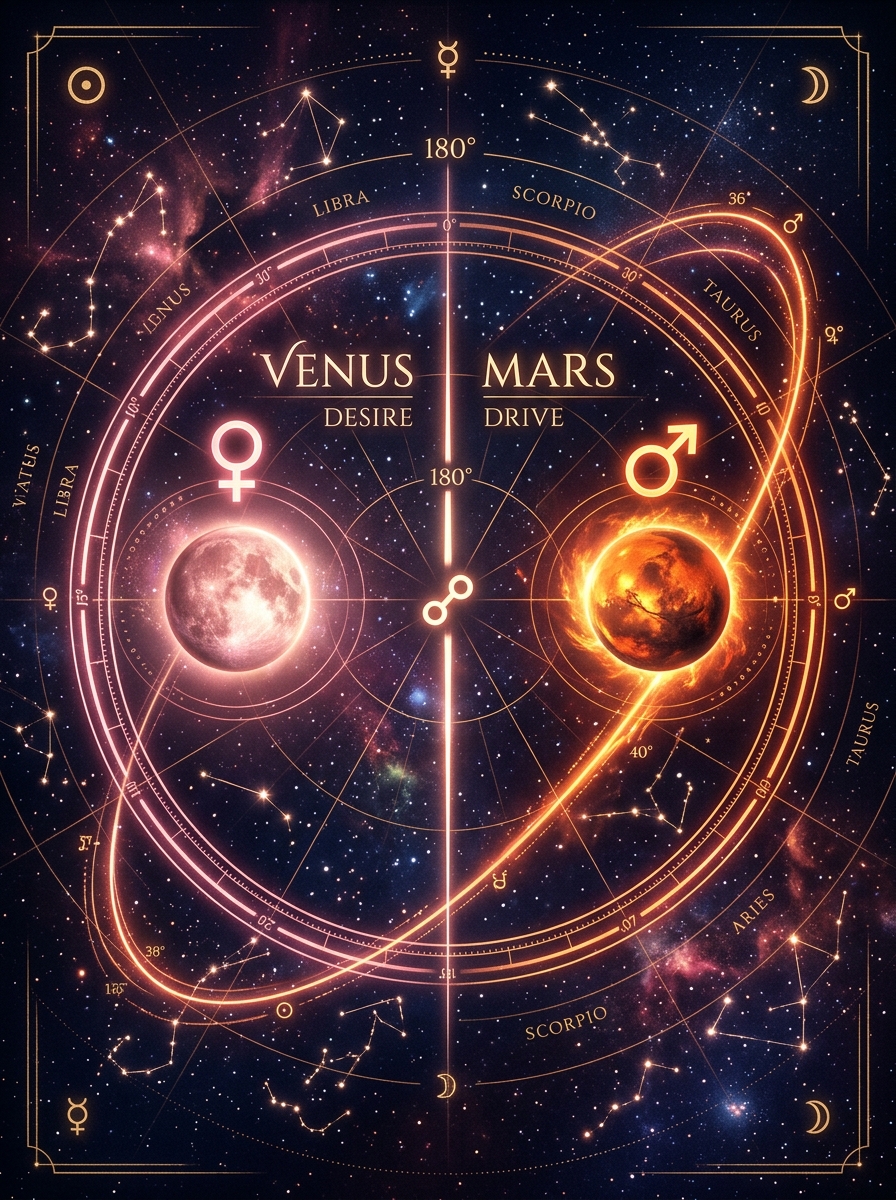
Venus opposite Mars in synastry is not a gentle fusion. It is an attraction built on difference, not similarity, and that difference is the engine. One partner’s Venus wants harmony, reciprocity, and to be chosen; the other partner’s Mars wants pursuit, instinct, and direct action. Because the planets sit 180 degrees apart, they face each other across a relational axis: each becomes the other’s missing half and immediate provocation. The charge lives in the gap. This is why the aspect feels fated, catalytic, and exhausting all at once — chemistry that does not know how to stay quiet.
The opposition structure itself demands negotiation rather than merger. It is a mirror, not a blend. The couple is not asked to share identical appetites but to hold tension without killing the spark. For a deeper look at how opposition works across any pair of planets, see the opposition aspect and its psychological role in relationship work.
The Psychological Roots: How Each Partner Experiences the Other
The Venus person feels desired, pursued, and stylized by the Mars person. Mars feels enlivened by Venus’s beauty, taste, or social ease. But because it is a polarity, each also exposes what the other lacks or resists. Venus may experience Mars as blunt, impatient, or invasive; Mars may experience Venus as withholding, coy, or impossible to please.
This is where Jungian projection enters. Mars carries the projected animus — action, decisiveness, appetite — while Venus carries the projected anima — receptivity, grace, relational attunement. Each partner unconsciously assigns the other the task of completing an inner function they cannot yet own themselves. The danger is that the relationship becomes a theater where each blames the other for not being the perfect complement. The gift is that the opposition reveals exactly where desire has tangled with self-worth. The contact asks both to retrieve their projection and learn the other’s language, not just demand its service.
The Mature Expression: Negotiating the Rhythm
A healthy Venus opposite Mars does not try to dissolve the polarity into a trine. Instead, it develops a rhythm of alternation. Venus teaches Mars that desire needs form, atmosphere, and patience. Mars teaches Venus that desire needs courage, directness, and the willingness to move before perfect safety is assured.
The mature couple learns to separate attraction from hostility. Venus can say, “I need tenderness before intensity.” Mars can say, “I need directness before reassurance.” Those are not opposing truths; they are the two halves of a functional erotic contract. The aspect works best when each partner respects the other’s native tempo — letting Venus set tone sometimes, letting Mars initiate at other times. If one monopolizes the rhythm, the opposition hardens into resentment. For a broader map of how synastry dynamics interact, the complete synastry guide provides the relational frame.
The Shadow: When Polarity Becomes War
Every Venus-Mars opposition carries a shadow of scorekeeping. Venus measures whether love is being valued. Mars measures whether desire is being answered. When hurt, Venus may become passive-aggressive or visibly disappointed; Mars may become argumentative, impatient, or sexually retaliatory. The conflict can quickly feel personal: “You don’t value me” on one side, “You don’t want me” on the other.
The second-worst mistake is romanticizing the friction until irritation becomes proof of love. The worst is trying to make the opposition behave like a harmonious aspect — smoothing over the edges until the spark dies. The shadow emerges when the couple confuses arousal with attachment, or when frustration is acted out through withdrawal, sarcasm, or conquest instead of spoken. Clear speech is the antidote: naming what is being desired rather than using the other as a target for unmet needs. If the relationship falls into pattern of scorekeeping, it helps to review the synastry aspects page to see how this contact fits within a larger chart.
How It Lives in Real Life
In love and sexuality, the erotic field is intense but not automatically easy. Venus may want affection to precede sex; Mars may want desire acted on immediately. The same person who turns you on may also push your buttons. If the couple learns to alternate the erotic tempo — sometimes Mars leads, sometimes Venus — the bed becomes a creative dialect rather than a battlefield.
In daily life, the opposition shows up in how decisions are made. Venus prefers consensus and grace; Mars prefers initiative and speed. A Mars-dominant couple may decide too fast, ignoring Venus’s need for harmony; a Venus-dominant couple may over-negotiate, frustrating Mars’s need to act. The mature approach is to assign roles consciously: Venus handles the atmosphere, Mars handles the launch, and neither blames the other for being different.
In the work sphere, the same polarity can become a productive tension: Venus brings taste, social intelligence, and aesthetic sense; Mars brings drive, competition, and the will to execute. Together they can create something neither could alone — if they remember that the opposition is a partnership of opposites, not a contest. For contrast with a more soothing relational current, see Moon-Venus synastry, which provides the emotional sanctuary this aspect sometimes lacks.
The Sign and House Context
The aspect tells you the archetypal tension; the sign and house tell you how it speaks. Venus opposite Mars in Aries and Libra sounds different from the same aspect in Taurus and Scorpio. A fiery version escalates quickly and theatrically; an earthy version is stubborn, sensual, and territorial; an airy version argues its way through attraction; a watery version turns the tension into longing and emotional entanglement. For sign-specific flavor, the natal pages for Venus in Aries, Mars in Scorpio, or Mars in Libra are useful starting points.
The houses describe the stage. If Mars falls into the other person’s 5th house, romance and play are activated; in the 7th, the relationship itself feels contractual and overt; in the 8th, desire deepens into obsession and transformation; in the 12th, the tension may be unconscious or taboo. These house overlays give geography to the feeling: see synastry house overlays for how this aspect lands in specific areas of life.
In the end, Venus opposite Mars is not a verdict on compatibility. It is a description of heat — how it enters, how it circulates, how it burns, and how, when tended with intelligence, it becomes the very thing that keeps two people vividly awake to each other.
Related
- Synastry: Venus Conjunct Mars — The Heat Between Wanting and Being Wanted
- Venus Opposition Mars: Desire at War, Desire Made Visible
- Venus Square Mars Synastry: Desire, Friction, and the Spark That Won’t Sit Still
- Synastry Venus Opposition Venus: The Beauty of Mismatch, the Friction of Want
- Synastry Sun Opposition Venus: Attraction at the Edge of Friction
Comments
Loading comments…