Synastry Sun Opposition Venus: Attraction at the Edge of Friction
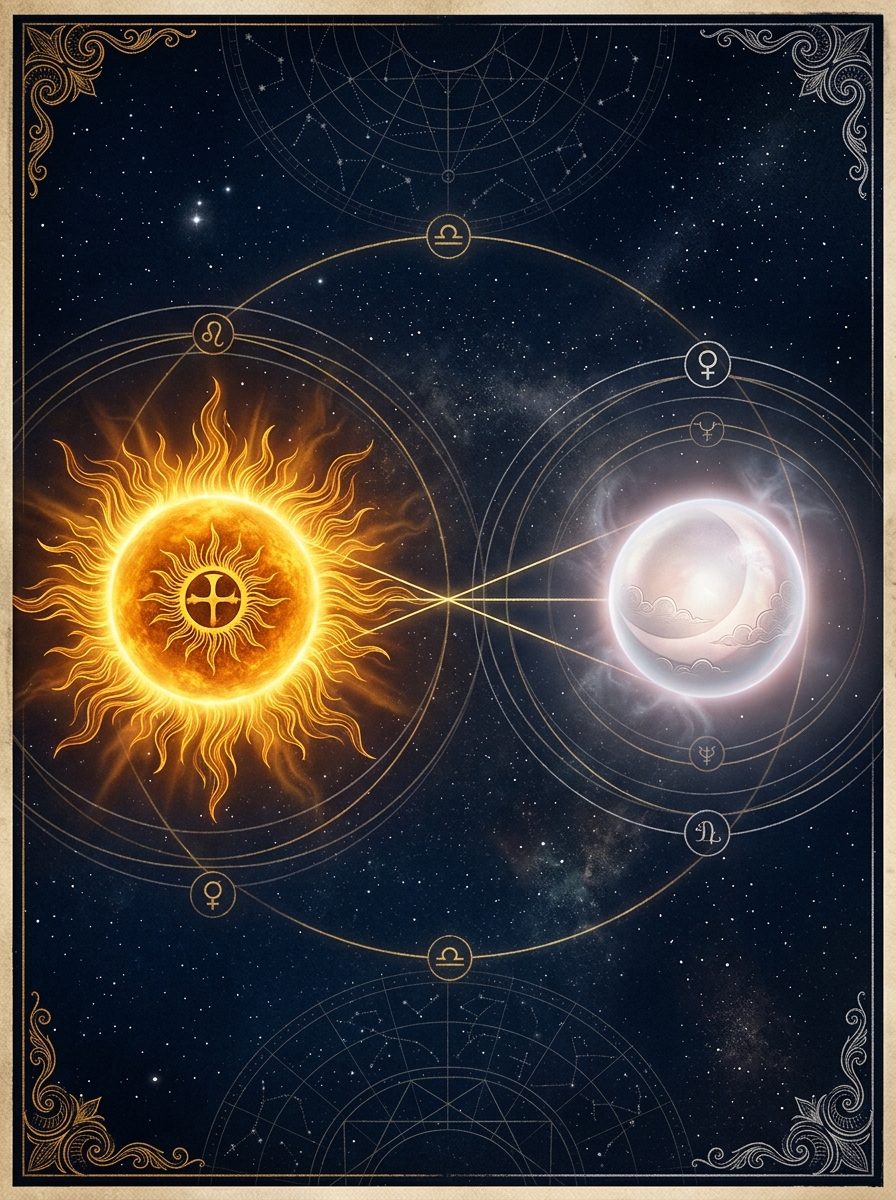
The Mirror That Wants to Kiss Itself
Sun opposition Venus is not a soft harmony; it is a charged polarity that makes two people feel both magnetized and slightly wrong for each other. The Sun — identity, will, the core “I am” — faces Venus — affection, value, the impulse to please and harmonize. In an opposition, these planets do not blend. They stare across a relational horizon, each seeing in the other something it secretly lacks, and something it cannot quite accept. The bond begins as admiration laced with friction, and the friction is the point.
What makes this aspect distinctive is that neither planet is inherently difficult. The tension is not cruelty; it is difference in rhythm. The Sun person wants to exist without apology; the Venus person wants the atmosphere to remain beautiful enough for love to survive. When those agendas collide, the relationship becomes a theater of longing and adjustment. The attraction feels electric because each partner activates a buried quality in the other: the Sun provokes the Venus person’s desire to be seen and valued on their own terms, while Venus softens the Sun person’s need to dominate the space. This is the mirror logic of the opposition itself — a tension that reveals identity through contrast, as explored in the deeper mechanics of Astrological Opposition (180°).
Why Each Partner Sees a Glamour
The chemistry in this pairing runs on projection. In Jungian terms, each partner unconsciously casts an image of the anima or animus onto the other. The Sun person sees the Venus partner as the keeper of grace, desirability, and relational intelligence — a figure who can validate identity without demanding change. The Venus person sees the Sun partner as the charismatic center, someone who gets to shine without permission, embodying the vitality they may feel they must negotiate for.
These projections are seductive because they are partly true. A Venus person with strong Libra or Taurus leanings really does bring an eye for proportion and pleasure; a Sun person in Leo or Aries really does radiate a confidence that needs no apology. But the opposition exaggerates the difference into a glamour. The Venus partner begins to believe that being loved requires constant adjustment to the Sun’s mood and style. The Sun partner begins to feel that acceptance is contingent on performance — on being impressive rather than authentic. This is the psychological root of vanity in the classical sense: the fragile architecture built around being admired.
The relationship can feel like a court of appeal where each person seeks confirmation from the other. That makes the bond potent, but also precarious. Unlike the softer resonance of Moon-Venus synastry, where affection flows without ego, or the direct erotic thrust of Venus and Mars synastry, this opposition asks both partners to examine why they need the other’s approval so urgently. The attraction is real; the work is learning that the other person is not a living guarantee of validation.
When the Chemistry Turns Tactical
The shadow side of Sun opposite Venus is not open conflict; it is passive-aggressive politeness, style disagreements that become accusations of character, and a slow erosion of authenticity. Because Sun concerns identity and Venus concerns desirability, the relationship often becomes a referendum on taste. One partner’s “I don’t love that” lands as “I don’t love you in that form.” The Sun person may take Venus’s refinement as criticism; the Venus person may take Sun’s self-assertion as bad manners. Neither accusation needs to be spoken for the damage to be done.
The friction usually reveals itself through style conflicts that are really about self-worth. A Sun in bold, declarative mode may feel that Venus’s desire for harmony is a demand to shrink. A Venus with a strong aesthetic sense may feel that the Sun’s bluntness is a disregard for the relationship’s tone. When both partners moralize their preferences — “I am honest, you are fake”; “I am graceful, you are crude” — the opposition hardens into a stalemate.
This is where the aspect becomes a test of psychological maturity. The Venus person must resist the temptation to shape the Sun into a more pleasing version of itself. The Sun person must resist the temptation to treat Venus’s tenderness as weakness. If either partner tries to dominate the polarity, the relationship turns into an exhausting negotiation over who gets to set the relational thermostat. For a broader understanding of how such dynamics fit into the full synastry chart, Synastry Aspects: The Astrology of Relationship Dynamics provides the essential framework.
Maturation: From Performance to Partnership
The gift of Sun opposition Venus is that it prevents complacency. The relationship remains awake because each person is perpetually encountering what they are not. That can be irritating, but it is also what preserves fascination over time. The key to maturation is deprojection — the slow, honest work of seeing the other as a whole person rather than a mirror for one’s own unmet needs.
This happens in practice through small, deliberate choices. The Sun person learns that assertion does not need to cancel sweetness; the Venus person learns that love does not require constant adjustment. When each can remain distinct without becoming adversaries, the opposition becomes a bridge between sovereignty and receptivity. The Sun brings the necessary spine; Venus brings the necessary sense of proportion. Together they create a relationship with both pulse and polish.
The specific house axis where the opposition falls shapes how this tension plays out in daily life. A Sun in the 10th opposing Venus in the 4th, for instance, may split the couple between public ambition and private sanctuary. A 1st–7th house overlay forces the question of identity versus partnership directly. Synastry House Overlays help clarify which life arena the friction will occupy. Similarly, the Venus person’s natal sign modifies the response: Venus in Libra may over-correct into endless compromise, while Venus in Scorpio can turn the opposition into possessive intensity. Venus in Aquarius, by contrast, might appreciate the distance that keeps the polarity from becoming clinging theater. Understanding these nuances through the archetype of Venus in Astrology deepens the reading.
Ultimately, this aspect does not improve by being flattened into easy compatibility. It improves when both partners stop treating difference as rejection. The real romance here is not about being perfectly matched; it is about being loved in the presence of another person’s full, unapologetic nature. That is a harder form of love, and a more durable one. For those building a complete synastry portrait, The Alchemy of Love Synastry and Synastry Step-by-Step offer the tools to see how this opposition works in concert with other chart factors.
Related
- Synastry Venus Opposition Venus: The Beauty of Mismatch, the Friction of Want
- Moon Opposite Venus in Synastry: The Beauty That Pulls and the Feeling That Pushes
- Sun Square Venus in Synastry: Attraction, Friction, and the Price of Chemistry
- Venus Opposite Mars in Synastry: Desire at the Edge of Friction
- Synastry: Sun Opposition Sun — The Axis of Recognition and Friction
Comments
Loading comments…