Synastry Sun Conjunct Sun: When Two Selves Ignite
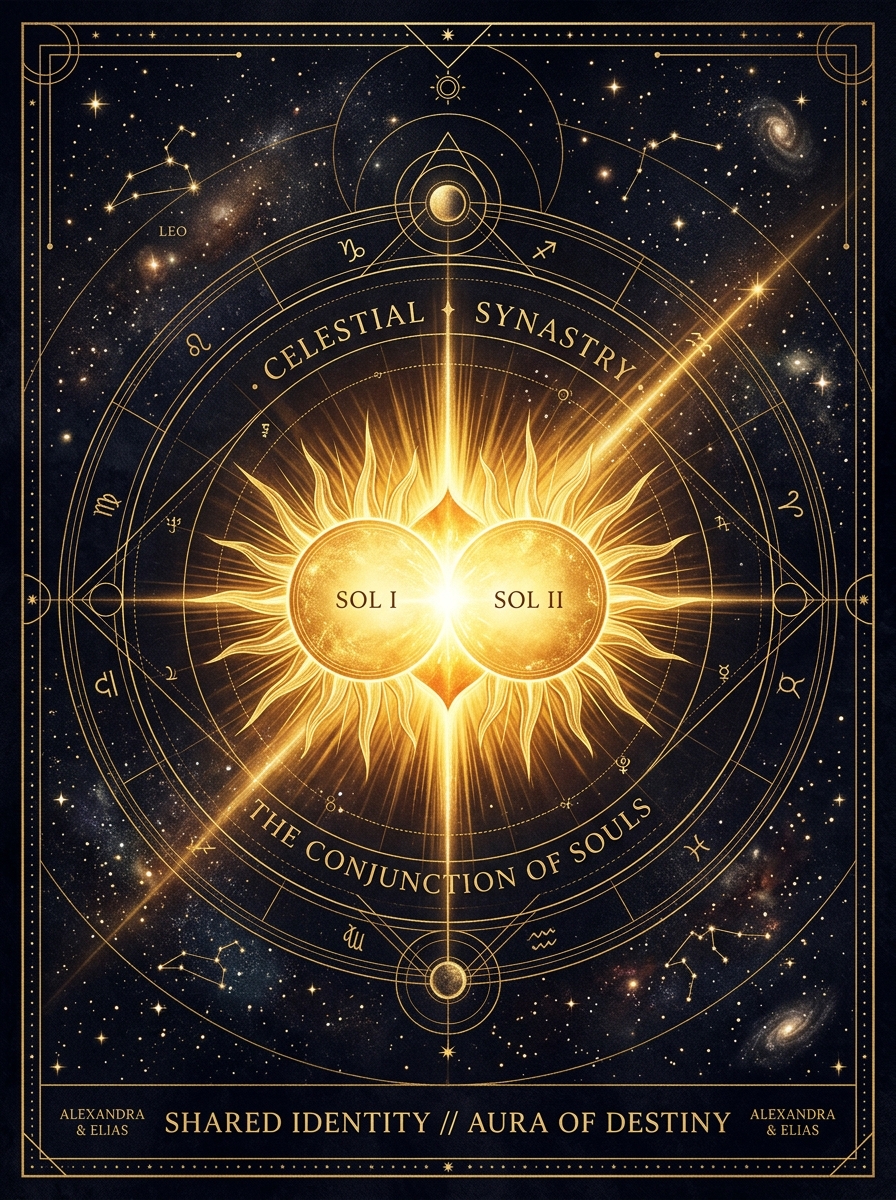
The Core Dynamic: Identity Resonance
Sun conjunct Sun in synastry is a meeting of two conscious identities on a shared frequency. The attraction is immediate not because of complement but because of mirror—each person recognizes their own style of being: how they choose, assert, shine, and declare “this is who I am.” The Sun represents the organizing principle of a life, the agency that says “I am here, and this is what I make of my existence.” When two Suns conjoin, the bond bypasses small talk. Each person feels seen at the level of their core operating system. For a complete map of how chart overlays shape relationships, Astrological Synastry: The Complete Guide to Relationship Chart Overlay frames this aspect within the larger architecture of comparison.
This resonance can feel fated, but it is not inherently romantic. It guarantees mutual visibility, not emotional attunement. The relationship gains coherence through shared solar instinct—similar pacing, ambitions, and ways of taking up space. Yet that very clarity becomes the ground for the aspect’s central tension: two bright centers illuminating the same room can either co-create or compete for the room’s focus.
Why It Feels So Familiar (and Where That Familiarity Fails)
The sense of prior acquaintance that accompanies Sun conjunct Sun arises because each person touches the other’s essential style of agency. They may share the same pace in conversation, the same instinct to lead or to delegate, the same attitude toward visibility. This creates an intoxicating ease: “finally, someone like me.” But that ease can flatten discovery. Where other synastry aspects generate fascination through difference, a Sun-Sun conjunction generates attraction through sameness. The question that follows is not “who are you?” but “who leads, and who follows?”
The psychological root of the friction lies in the Sun’s demand for singularity. The Sun wants to be acknowledged as sovereign in its own right. When two such sovereigns meet, the mirror can flatter—or it can provoke a quiet rivalry over whose preferences set the tone. This is less about overt conflict than about a repeated tension in decision-making, timing, and self-assertion. The other person does not complement your identity; they test its elasticity. If you need a reference point for how this differs from the complementary pull of emotional identity, see Sun-Moon Synastry: The Alchemy of Core Identity and Emotional Compatibility, which supplies the emotional attunement that Sun-Sun alone cannot.
The Maturation Arc: From Mirror to Mission
The conjunction itself is neutral; its expression depends on whether each person can share the spotlight without feeling diminished. In its healthy form, Sun conjunct Sun produces a shared mission with unmistakable momentum. Two people may find themselves chasing the same horizon—building a business, raising a family, pursuing a creative vision—because their internal compasses point in the same direction. The relationship becomes a vessel for mutual ambition. The energy is not about merging egos but aligning them. For a methodical way to assess whether this contact is supportive or merely loud, Synastry Step-by-Step: The Complete Astrological Guide to Relationship Compatibility gives the order of operations that prevents overreading any single aspect.
The shadow form of the conjunction is mutual inflation—a hall of mirrors in which each person validates only the parts of themselves that the other reinforces. If neither has learned to yield, the pair can become a closed loop of self-certainty, blind to outside perspective. The aspect then curdles into a duel of self-definition: both insist on being right by virtue of simply being themselves. The remedy is conscious differentiation. Each person must ask where they lead, where they yield, and how they let the other be fully solar without interpreting that radiance as a threat. The broader framework of aspect dynamics is explored in Synastry Aspects: The Astrology of Relationship Dynamics.
How It Manifests Across Life Domains
The concrete expression of Sun conjunct Sun depends heavily on house overlays—the life arena where the shared brightness lands. If one person’s Sun falls in the other’s 1st house, the relationship intensifies mutual visibility and self-confidence; the couple may feel each other as catalysts for personal growth. In the 7th house, the bond itself becomes a solar project; the pair may feel profoundly partner-like, as if the union is an entity with its own purpose. In the 10th house, shared ambition takes center stage—the couple may build a public reputation or feel their relationship serves a larger mission. Without house context, the aspect sounds generic; with it, the dynamic becomes concrete. See Synastry House Overlays: The Astrological Geography of Relational Resonance for a thorough treatment.
In romantic relationships, the conjunction often creates a strong sense of partnership but lacks the emotional reassurance that comes from Moon or Venus contacts. Two people can admire each other’s courage and still struggle to soothe each other’s inner weather. That is why the strongest Sun-Sun bonds include a supporting aspect for tenderness—such as a Moon-Venus connection, which supplies daily affection and sanctuary. For the attraction-and-desire layer, compare with Venus and Mars Synastry: The Astrological Alchemy of Desire and Affection, which describes the magnetic polarity that Sun-Sun usually does not provide on its own.
In creative or professional partnerships, the conjunction can be a formidable engine. Two Suns in the same sign may amplify each other’s talents and blind spots alike—e.g., Leo-Sun with Leo-Sun doubles visibility, confidence, and the need for acknowledgment; Virgo-Sun with Virgo-Sun doubles discernment, standards, and the risk of overanalysis. The work thrives when both parties consciously assign roles rather than assuming their identical style will naturally harmonize.
Working With the Aspect: Practical Guidance
If Sun conjunct Sun appears in a synastry report, the first task is to identify whether the contact is generating shared momentum or repeated ego collisions—often both. The healthiest expression comes from conscious mutual regard: each person actively recognizes the other’s right to selfhood rather than assuming sameness equals agreement. The relationship works when both can say, “I see your way of being, and I do not need to overwrite it in order to feel myself.”
It helps to cultivate humility through other synastry contacts. A Moon-Venus aspect can soften the social and domestic atmosphere, allowing the solar pairing to remain bright without becoming abrasive. A supportive Saturn connection can provide structure and commitment, channeling the conjunction’s energy into a long-term framework. For a more complete approach to reading the bond, The Alchemy of Love Synastry: A Psychological and Esoteric Guide to Relationship Astrology places this aspect inside the emotional, erotic, and karmic story of relationship astrology.
The bottom line: Sun conjunct Sun is a meeting of centers. It can feel like recognition, rivalry, inspiration, or all three at once. Because the Sun is never neutral, the relationship becomes a stage on which identity is amplified. Used wisely, this is one of the most clarifying synastry contacts—it says: here is someone who activates your core self, not just your preferences. That is both the blessing and the test.
Related
- Synastry: Sun Conjunct Moon — When Identity Meets Instinct
- Sun Square Sun in Synastry: When Two Solar Egos Strike Spark and Steel
- Synastry: Sun Opposition Sun — The Axis of Recognition and Friction
- Synastry Sun Sextile Sun: The Ease That Makes Two Selves Stronger
- Sun Opposite Moon in Synastry: The Magnetic Fault Line
Comments
Loading comments…