Synastry Moon Sextile Mercury: When Feeling Finds a Voice
The Core Dynamic: A Passageway, Not a Fusion
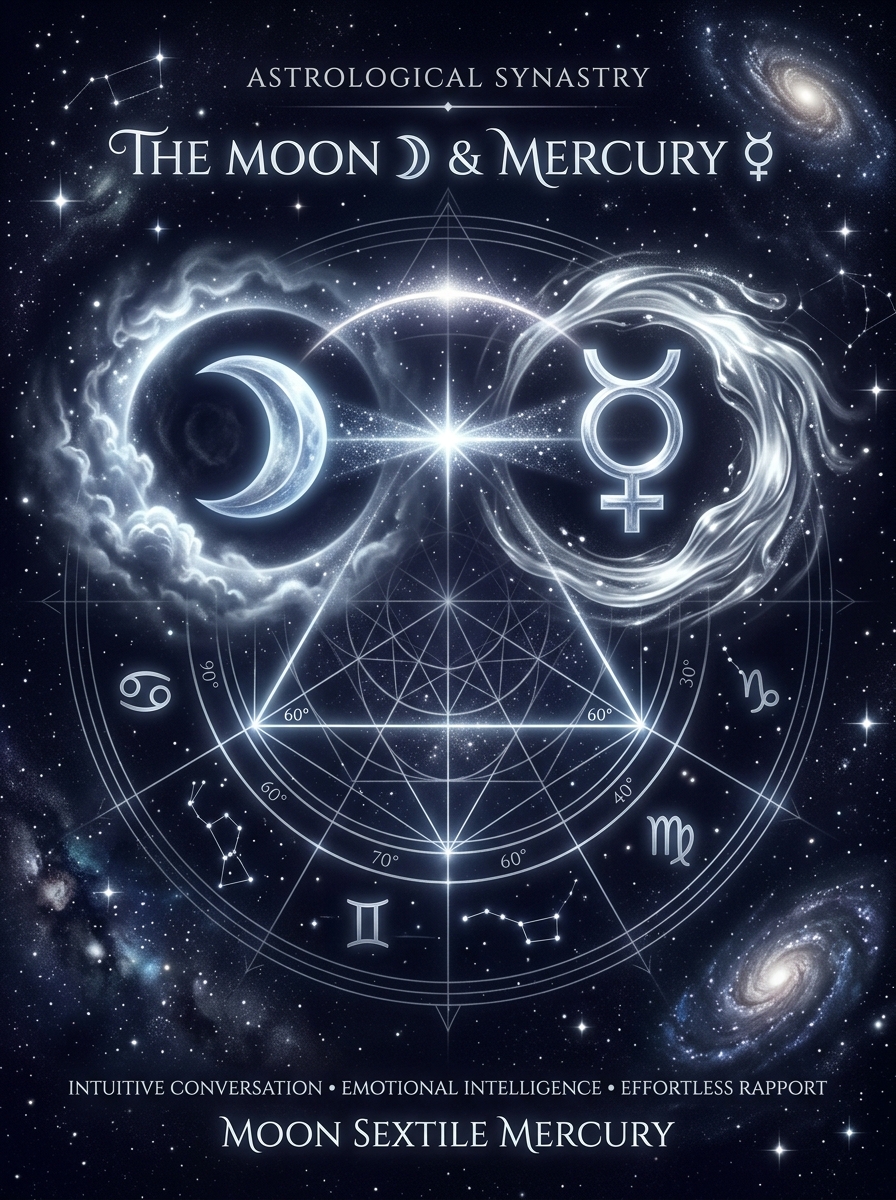
Moon sextile Mercury in synastry is one of the cleanest forms of relational rapport: one person’s emotional life recognizes the other’s thinking, and the other knows how to name what the Moon person can barely articulate. The Moon brings appetite, memory, instinct, timing, and vulnerability; Mercury brings language, pattern, wit, interpretation, and the ability to make experience communicable. A sextile does not fuse them into one substance. It creates a passageway. That distinction matters because this aspect works best when both people actually use the door.
The attraction here is conversational before it is overtly romantic. The Mercury person feels listened to without having to perform explanation. The Moon person feels metabolized rather than merely observed. There is a small but consequential miracle in that exchange: the inner world becomes discussable without being flattened. Unlike a conjunction, which can blur feeling and thinking into one undifferentiated soup, or a square, which forces them to fight for attention, the sextile offers a gentle corridor. For a broader frame on how this fits into relationship astrology, synastry aspects are the grammar, but this contact is one of the cleaner sentences.
What makes the contact compelling is its low-friction intelligence. It doesn’t announce itself as destiny. It shows up as ease: the right text at the right time, a sentence that lands, a joke that doubles as reassurance, a confession that does not have to be pried loose. Compared with hotter pairings like Venus-Mars synastry, this is less about pursuit and more about accessibility. The chemistry is quiet, but it is not bland. It can feel like someone finally speaking your native dialect.
Why a sextile matters here
A sextile is an aspect of opportunity, not compulsion. It asks for participation. In Moon-Mercury synastry, that means the couple is not condemned to instant telepathy nor doomed to misread each other. They are given a usable channel: one that tends to open when someone asks a real question, names a fear directly, or answers with more precision than politeness usually allows. The broader astrological sextile shows up as a relationship between signs with compatible elemental logic, making exchange feel natural rather than forced. Because the aspect is gentle, people sometimes underestimate it. But in relationships, the capacity to talk things through is not background music; it is infrastructure. Moon sextile Mercury often becomes the bridge that keeps a bond from turning into a series of guesses. It is the difference between “I don’t know what’s wrong” and “I think I know what you mean.”
Psychological Roots: Why This Channel Opens
The sextile works because the two signs involved share a compatible elemental logic. If the Moon is in a water sign (Cancer, Scorpio, Pisces) and Mercury in an earth sign (Taurus, Virgo, Capricorn), the dynamic is grounding, tactile, domestic — feeling becomes tangible. If both are in fire and air (Aries/Gemini, Leo/Libra, Sagittarius/Aquarius), the exchange is faster, more verbal, more teasing, more future-oriented. The sextile does not erase the individual styles of the planets; it recruits them into a cooperative rhythm.
Psychologically, each person gets an embodied reward from the other. The Moon is always scanning for safety. A responsive Mercury can make emotional life feel thinkable — and when something becomes thinkable, it becomes less chaotic. The Mercury person discovers that their words have consequence: the Moon person actually feels them. That reciprocal relief can become deeply seductive. There is often a quickening around everyday exchange. These two may flirt through commentary, voice notes, shared references, or the simple pleasure of finishing each other’s half-formed thoughts. The attraction is to mutual fluency. One person feels “caught”; the other feels “met.” That meeting can create a light, mobile intimacy that survives daily life better than grand passion does.
This contact also tends to produce a specific kind of trust: the sense that feelings can be translated without being exposed to ridicule. In relationships where one or both partners have harder placements elsewhere, this aspect can become the one clean corridor in a more complicated building. If you are mapping the larger relationship pattern, astrological synastry helps situate this aspect among the others.
The body listens before the mind objects
The sweetest version of Moon sextile Mercury is somatic before it is conceptual. A person speaks, and the other person’s nervous system settles. That is not a metaphor; it is how the aspect often behaves. The Moon person may not be able to explain why they feel safer with this Mercury person, but they usually feel less interrupted internally. Likewise, the Mercury person may find they think more clearly in the Moon person’s presence, because their words land in a receptive field instead of bouncing off armor. This is one reason the contact can support repair. If a relationship has to negotiate difficulty, the Moon person is less likely to feel linguistically abandoned, and the Mercury person is less likely to feel emotionally overrun. When the conversation is strained, this aspect still remembers the way back to mutual readability.
Where Friction Appears: The Limits of Easy Translation
The danger of Moon sextile Mercury is not conflict. It is overconfidence in the quality of understanding. Because the channel is so open, the couple may assume they are clearer to each other than they actually are. They may rely on implication, shorthand, or a few successful conversations and then be startled when a deeper issue exposes asymmetry. Moon speaks in feeling states; Mercury speaks in distinctions. Those are related languages, not identical ones. A sextile makes translation possible, but it does not eliminate dialect.
The friction usually appears in three subtle forms. First, the Mercury person may explain too quickly, converting emotion into interpretation before the Moon person has fully felt witnessed. Second, the Moon person may assume tone equals intention and miss the literal content of what was said. Third, both may avoid harder truths because the relationship is already pleasant enough. That last one is the most treacherous. Ease can become evasiveness if no one is willing to let the conversation deepen. This is where the aspect’s psychological sophistication matters. A sextile is not a guarantee of innocence; it is an invitation to skill. The pair can become very good at soothing each other without ever reaching the raw center of a problem. In that sense, Moon sextile Mercury can be a form of elegant avoidance if the relationship lacks courage. For contrast, the more frictional intelligence of Mercury in Scorpio shows how communication can become an instrument of excavation rather than mere reassurance.
When the aspect is challenged by signs and houses
The expression of the aspect changes enormously depending on the signs and houses involved. A Moon in Cancer sextile Mercury in Taurus sounds very different from a Moon in Aquarius sextile Mercury in Sagittarius. Earth and water versions tend to feel more grounding, tactile, and domestic. Fire and air versions often feel faster, more teasing, more verbal, and more future-oriented. If one planet sits in a house tied to privacy, family, or psychological depth, the aspect can become intimate and confessional. If one planet sits in a public or social house, the same contact may show up through networking, banter, shared causes, or coordinated logistics. A useful way to read the overlay is to ask not only “Do they understand each other?” but “Where does understanding happen?” In the kitchen, in the car, through messages, in bed after midnight, during practical planning, in jokes made around other people? The answer reveals the actual habitat of the aspect. For a fuller relational map, synastry house overlays are often where the evidence becomes concrete.
The same principle applies if either person has a strongly emphasized Mercury signature elsewhere. Someone with Mercury in Gemini may experience the sextile as enlivening and fast; someone with Mercury in Cancer may experience it as emotionally protective and remembering-oriented; someone with Mercury in Capricorn may turn the exchange toward planning, structure, and follow-through. The synastry aspect does not erase natal style. It recruits it. If one person’s Mercury is retrograde natally, the sextile may carry a revisionary tone — conversations loop back, but not because the bond is stuck. More often, the relationship knows how to re-open a topic without humiliation. For a deeper sense of that rhythm, Mercury retrograde is worth reading alongside the synastry.
How It Plays Out in a Life: Love, Friendship, Daily Maintenance
Moon sextile Mercury is one of the best aspects for a relationship’s invisible maintenance. It helps two people coordinate life without making every coordination feel like labor. Messages get answered. Misunderstandings are easier to revisit. Emotional timing improves. One person tends to know when the other wants a solution and when they want silence — and that subtle calibration can preserve affection for years.
In romantic relationships, this aspect often shows up as conversational intimacy that keeps the erotic charge from turning dumb. The couple can discuss what happened, not just what was felt. They can narrate the bond while still living inside it. That is not trivial. Many pairings are passionate but inarticulate; they burn brightly and miscommunicate constantly. Moon sextile Mercury gives love a running commentary, and commentary can be devotion when it is honest. When combined with softer affection, such as in Moon-Venus synastry, the combination can create both tenderness and verbal clarity. If the larger relationship pattern is also supported by strong identity-emotion alignment, Sun-Moon synastry can show why the bond feels cohesive at the level of life direction, while Moon sextile Mercury shows how that cohesion becomes speakable day to day.
In friendship, the aspect is one of the clearest signatures of being able to talk across temperament. The Moon person can share private material without feeling analyzed into oblivion. The Mercury person can think aloud without feeling emotionally censored. In family dynamics, this contact can be a balm: it often supports the child who needs language for feelings, or the parent who knows how to explain difficult realities without making them cruel. In all of these settings, the aspect is less “romantic chemistry” than “usable trust.”
Repair after conflict
This is also one reason the contact supports repair after conflict. The aspect helps people revise without moral theater. One says, “I didn’t mean it that way,” and the other can hear not only the apology but the attempt at precision. That is a relationship skill, not just a pleasant trait. It lets the bond absorb error without collapsing into narrative catastrophe. The couple can return to the same emotional material until it is actually understood rather than merely summarized.
The Larger Meaning: What This Aspect Is Teaching Both People
At its best, Moon sextile Mercury teaches that emotional reality and verbal clarity are not enemies. The Moon does not have to become articulate by force, and Mercury does not have to become tender by performance. Each person enlarges the other. The Moon person learns that naming a feeling can make it more livable. The Mercury person learns that intelligence without emotional contact is only half awake. Together they can create the rare condition in which thought becomes humane and feeling becomes intelligible.
That teaching is subtle, but it is lasting. People often remember this aspect because it makes them feel easier to be around. Yet the deeper gift is more serious: it reduces the amount of psychic waste in the relationship. Less guessing. Less defensive translation. Fewer emotional dead ends. More usable truth. In a culture where many couples mistake intensity for depth, that kind of quiet permeability is its own form of magic. If you want the broader synastry architecture around this contact, synastry love traces how communication, desire, and emotional patterning braid together over time.
Moon sextile Mercury is not the aspect of grand declarations. It is the aspect of being able to tell the truth while still feeling safe in the room. That may be quieter than myth likes to reward, but in real relationships it is often the difference between a bond that merely excites and one that endures.
Related
- Synastry Mercury Sextile Mercury: The Ease of Being Understood
- Synastry Sun Sextile Mercury: The Easeful Spark Between Identity and Mind
- Moon Trine Mercury in Synastry: When Feeling Finds a Voice
- Synastry Moon Conjunct Mercury: When Feeling Finds Its Voice
- Moon Sextile Moon in Synastry: The Quiet Ease of Shared Weather
Comments
Loading comments…