Sun Opposition Moon: The Split That Learns to Speak
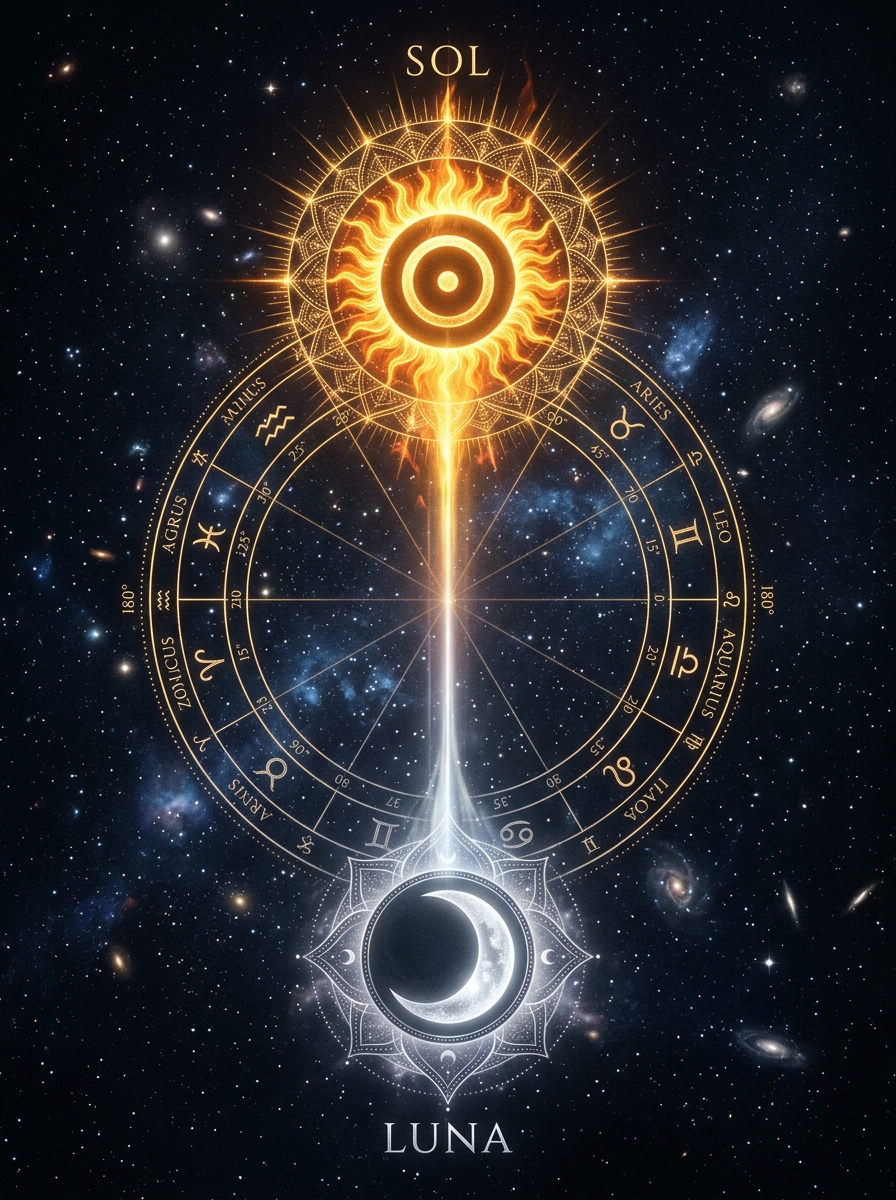
Two Centers, One Sky
Sun opposition Moon is the aspect of daylight facing nightfall. The Sun builds identity, coherence, direction—what you are trying to become. The Moon safeguards emotional continuity, memory, nourishment—what you need in order to feel safe. When these two are 180 degrees apart, neither is weak. The problem is not lack but overabundance: two legitimate drives pulling from opposite horizons, each convinced it is the real center of the life.
This is not “balance” in the soft, symmetrical sense. It is negotiation under pressure. The chart-holder experiences themselves as someone who can see both sides too clearly and yet still feels forced to choose, defend, or compensate. The psyche becomes a room with two doors open at once. What enters through one unsettles what was just organized through the other. If you want the structural logic of the aspect itself, the broader opposition aspect principle is a useful frame, but Sun-Moon opposition has its own distinct drama: the conflict is not abstract. It is intimate, instinctive, and deeply personal.
The person often alternates between acting from will and reacting from feeling, then resentfully asks why those two modes never cooperate for long. That is why so many descriptions mistake this aspect for mere inconsistency. It is more precise to say the person is internally democratic. Competing constituencies speak with real authority. The life cannot be lived from one hard center alone.
Where the Split Begins
Because the Moon is tied to early conditioning, the Sun to the emerging adult will, the split is usually present before the person has language for it. Family systems often reinforce one pole and distrust the other. Perhaps the household rewarded competence but shamed vulnerability, or prized caretaking while dismissing ambition. The child learns to survive by pleasing or by achieving—and then grows up with a divided loyalty: one part learned to secure attachment through adaptation, another through assertion.
These are not just temperaments. They are two survival architectures, each with its own memory. When they oppose one another, the person may unconsciously reenact the original split in every major decision: career versus home, independence versus attachment, visibility versus privacy. The chart does not merely describe a mood. It describes a recurring scene.
This internal polarity can be usefully compared to a sign pairing where the tension is innate but unpolarized—for instance, the Capricorn Sun, Cancer Moon dynamic, where care and control orbit the same axis. By contrast, Sun opposition Moon behaves like a conversation interrupted by a wall. The two voices cannot hear each other without conscious effort.
The Creative Tension That Refuses Fake Unity
The gift hidden inside the conflict is perspective. A person with this aspect knows, from the inside, that reality has two valid versions at once. That can produce unusually strong mediation skills, a talent for reading group dynamics, and a capacity to hold contradictory truths without collapsing into dogma. They become excellent counselors, negotiators, artists, or advocates—any role that demands honoring both private need and public demand.
There is also a deep dramatic intelligence here. The psyche learns through tension, and many such people are compelled to create form out of emotional pressure. The friction keeps them awake. Sometimes the discomfort is the engine of vocation.
But when the opposition remains unconscious, it goes shadow. The native projects one side onto others, pressuring partners or colleagues to carry the disowned Sun or Moon function. This creates magnetism followed by resentment—a pattern that repeats until the split is claimed from within. The Moon and Sun Tarot combination captures a similar movement from obscurity into integration: the night does not vanish, but it becomes readable.
The shadow also manifests as oscillation without awareness—throwing energy into a chosen direction, then letting the Moon interrupt with fatigue, fear, or old loyalties; or retreating into emotional safety, only to feel the Sun accuse the self of betrayal. This is not simple indecision. It is a constitutional tug-of-war between development and preservation.
One Life, Two Irreducible Demands
Because the native lives with an internal polarity, the tension shows up most visibly in relationships. They are often drawn to people who seem to “complete” the missing half. That magnetism can feel fated, but it often leads to projection: the other is expected to carry either the Sun’s ambition or the Moon’s comfort, and when they inevitably fail, resentment replaces idealization. Mature partnerships require both parties to hold their own polarity first.
At work, the same pattern appears as seeming inconsistency. The person is capable but may baffle colleagues who don’t see the internal negotiation. Commitment holds only when both identity and feeling are satisfied. A job that flatters the Sun but starves the Moon will eventually drain; a role that comforts the Moon but leaves the Sun obsolete will suffocate. The native benefits from roles that allow deliberate rhythm—time for visibility, time for retreat.
Timing itself becomes a live issue. Decisions made on a peak of solar confidence may feel emotionally unlivable weeks later. Decisions made under lunar vulnerability may later feel too small or too protective. The wise response is not paralysis but sequencing—waiting long enough to hear both voices, then choosing with the full body.
The person also struggles with continuity across contexts. At work they appear composed; at home they may be emotionally porous. Or the reverse. Conscious ritual helps more than any theory: a walk, a commute, a notebook, a deliberate silence between roles. The psyche dislikes abrupt crossings. It needs to know when one identity ends and another begins.
If you want to see how the same polarity expresses in a specific sign pairing, the Aquarius Sun, Cancer Moon combination shows the split between collective ideals and private protection. Each pair colors the opposition differently—Fire versus Water feels like impulse against feeling; Earth versus Air becomes practicality versus abstraction—but the underlying architecture remains the same.
Becoming the Bridge
Integration for Sun opposition Moon is not the annihilation of one pole by the other. It is a living alternation that becomes conscious enough to be chosen. The mature version is not “having it all” in some easy sense. It is the ability to hear the Sun without suppressing the Moon, and to honor the Moon without letting it veto growth.
That trust changes everything. Relationships become less projective because the native no longer expects partners to carry the missing half. Work becomes steadier because purpose is no longer built at the expense of emotional reality. The person may still live with tension, but it becomes creative tension rather than civil war.
What this aspect asks in practice is self-knowledge that goes beyond mood tracking. It asks for recognition of the recurring pattern—where the Sun insists, where the Moon recoils, what situations make the split sharper. It asks for a life architecture that includes enough privacy, enough ambition, enough nourishment, and enough honest friction that neither luminary has to revolt.
The deepest gift of this aspect is that it refuses fake unity. Some charts glide toward coherence so easily that they never question whether the self is honest. This one exposes the seams. If the native stays with the work, those seams become artistry. The person becomes a bridge between worlds because they have lived on both sides of the bridge. The Sun and Moon do not have to merge into sameness; they have to become allied in purpose. That is the actual achievement of the aspect: not peace through denial, but authority through relationship.
Related
- Sun Opposite Moon in Synastry: The Magnetic Fault Line
- Sun Conjunct Moon: When Will and Feeling Speak With One Voice
- Sun Square Moon: The Inner Weather of a Divided Will
- Moon Opposite Moon in Synastry: Desire, Distance, and Emotional Truth
- Synastry: Sun Opposition Sun — The Axis of Recognition and Friction
Comments
Loading comments…