Moon Opposite Venus in Synastry: The Beauty That Pulls and the Feeling That Pushes
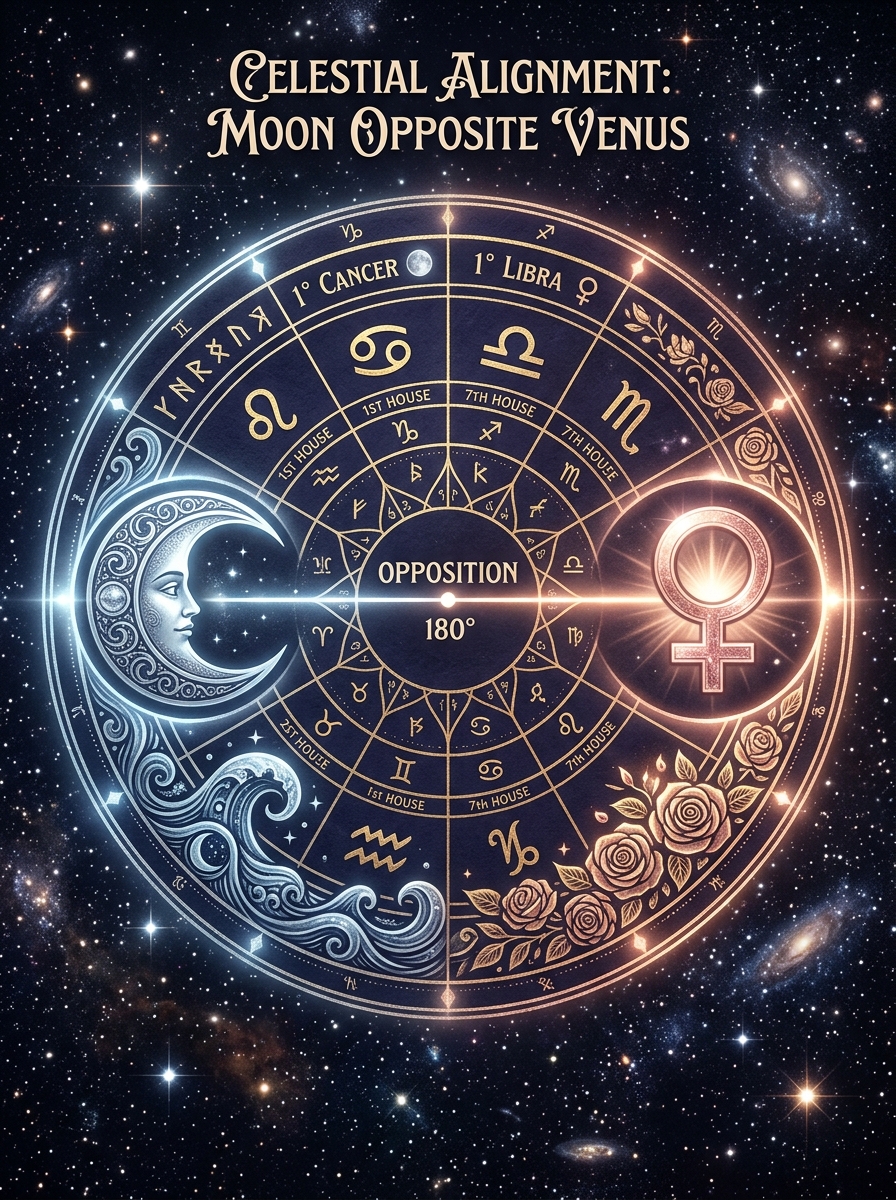
Moon opposite Venus in synastry is the aspect that pulls two people together with an almost gravitational inevitability, then quietly reminds them that gravity is not the same as fit. It creates a charged tenderness: one person’s emotional instinct meets the other’s way of loving, pleasing, and valuing across a fault line of difference. The attraction is real because each side carries what the other lacks; the friction is real because they do not instinctively ask for love in the same language. This is not a “good” or “bad” aspect so much as a living argument between need and taste, nurture and charm, appetite and affection.
The Core Dynamic: The Seesaw of Need and Style
The opposition always stages a confrontation between two poles. Here the Moon seeks safety, attunement, and the right atmosphere; Venus seeks harmony, pleasure, and the grace of being received. In opposition, these needs face each other rather than blending. The Moon person often feels that Venus is too light, too polished, too socially buffered—as if love must be kept pleasant at the cost of emotional honesty. Venus may feel that the Moon is too reactive, too needy, too tidal, as though no amount of sweetness can hit the right note.
Yet the very difference is what makes the contact magnetic from the start. Each person encounters a missing color in the other. The Moon is drawn to Venus’s composure, aesthetic intelligence, and ability to make life feel lovely rather than merely survivable. Venus is drawn to the Moon’s warmth, vulnerability, and unmistakable human pulse. This is the opposition as a relational mirror—each partner holds the other’s disowned capacity. For a deeper grammar of how the 180° aspect works, the archetype itself is worth understanding in Astrological Opposition (180°).
Unlike easy aspects, Moon-Venus opposition does not begin from shared instinct. It begins from recognition across difference. That recognition is immediate, but it is unstable: what calms one person may flatten the other; what delights one may leave the other emotionally underfed. In relationship terms, this is often the first clue that the pair can adore each other and still irritate each other with uncanny precision.
Psychological Roots: The Mirror and the Shadow
The opposition operates through projection. The Moon person projects onto Venus the wish for effortless acceptance, for a love that does not require emotional labor. Venus projects onto the Moon the disowned need for raw emotional truth, for a connection that is not always polite. Each sees in the other something they have not fully claimed in themselves—and that is why the attraction feels both fated and irritating.
In Jungian terms, the beloved becomes a carrier of the shadow. The Moon person may encounter in Venus their own disowned wish to be liked, adored, or made beautiful; Venus may encounter in the Moon their disowned neediness, depth, or hunger for emotional truth. If handled unconsciously, this becomes a cycle of projection and disappointment: “Why are you so shallow?” meets “Why are you so heavy?” Neither question is wholly wrong, but neither is the whole story.
This dynamic is best read within the full synastry context, not in isolation. The same opposition in different houses or signs can tilt the balance toward domestic tension or social performance. Understanding the broader architecture of Synastry Aspects helps clarify where the projection lands—does it play out over money, home, or shared values?
Maturation vs. Shadow: Translation or Stalemate
The opposition does not resolve by becoming identical. It matures through conscious translation. Each side must learn the other’s proof of care. The Moon person can learn that Venus may show love through consistency, manners, pleasure, and thoughtful design—even when the words “I need you” are not spoken. The Venus person can learn that the Moon may show love through sensitivity, memory, and the willingness to be visibly affected—even when the mood is not polished.
When this translation fails, the aspect goes shadow. The Moon becomes clingy or emotionally demanding, interpreting Venus’s calm as indifference. Venus becomes dismissive or conflict-averse, interpreting the Moon’s reactivity as a flaw in the relationship’s elegance. Each partner tries to “fix” the other by insisting on their own love language. The result is a permanent stalemate of unmet expectations.
The shadow version of this aspect often creates a pattern where one person’s bid for closeness arrives at exactly the wrong time for the other. The Moon seeks emotional resonance at peak intensity; Venus prefers emotional smoothing after the tension has already been contained. Neither is wrong—they are calibrated differently. This is why supportive links elsewhere in the synastry matter. A helpful Sun-Moon contact can make the pair feel fundamentally compatible even when this opposition keeps tripping them up. Reading Sun-Moon Synastry alongside this aspect reveals whether the core identity of the pair can hold the tension. Similarly, a conjunction between the Moon and Venus in one person’s own chart might soften the opposition, while a hard aspect between the two planets in a natal chart can intensify it. For contrast, compare the opposition to the easier flow of a Moon-Venus Synastry conjunction, where emotional and aesthetic needs naturally align.
Maturation comes when both people stop treating their own love style as the universal standard. The relationship thrives when the question shifts from “Why aren’t you loving me the way I love?” to “How does your love actually speak?” That shift is the work of the opposition: it forces each partner to expand their definition of affection.
In Life: Where the Tension Takes Shape
The opposition does not stay abstract. It appears in the unglamorous logistics of caring: food, timing, money, affection style, social rhythm, home aesthetics. One person feels loved when life is peaceful and beautiful; the other feels loved when emotion is acknowledged directly. If neither recognizes the other’s register, they can end up living inside a permanent translation error.
In love and intimacy, the physical chemistry is often vivid—the Moon brings appetite for closeness, Venus brings the gift of touch and mutual enjoyment. But the sensuality can be shadowed by the mismatch: what the Moon experiences as deep emotional merging, Venus experiences as engulfing; what Venus experiences as graceful affection, the Moon experiences as surface-level. The result is a relationship that feels rich in desire yet carries an old ache: “Why do I want you so much if you do not always know how to love me?”
In daily life, the opposition shows up as disagreements about taste, spending, or what “a good life” should feel like. Venus may prioritize elegance, enjoyment, and the sense that the relationship itself should be beautiful to inhabit. The Moon may prioritize comfort, familiarity, and a nest-like environment. If one sees the other as indulgent and the other sees the first as emotionally heavy, the issue is not just money or decor—it is competing philosophies of care.
In social settings, the Venus person may want the couple to shine together, to be received well by others. The Moon person may feel that the relationship is too public, too performative, that real connection happens in private, raw and unscripted. This can create a push-pull over how much of the relationship is shared with the outside world.
The houses the Moon and Venus occupy in each other’s charts will color where this tension lands. If Venus falls in the Moon person’s 4th house, the conflict runs through home and family; if in the 7th house, through partnership itself. A full reading of Synastry House Overlays reveals why the same opposition feels domestic in one couple and social in another.
The Deeper Resonance: An Education in Love
At its deepest level, Moon opposite Venus stages a confrontation between two archetypes of attachment. The Moon says, “I need to feel safe enough to be real.” Venus says, “I need to feel pleased enough to keep loving.” One is primordial and lunar; the other is relational and aesthetic. Their opposition creates a mirror in which each person sees not only the other, but their own unfinished education in love.
The relationship becomes an apprenticeship in holding two truths at once: that love must feel good, and that love must also feel true. When the pair succeeds, the opposition becomes a bridge—a way of moving between emotional depth and gracious enjoyment without losing either. When they fail, it becomes a beautiful distance that keeps them circling each other, never quite landing.
This is where the aspect earns its reputation as fated but instructive. It is not designed for effortless harmony; it is designed for integration. The Moon person learns that love can be light, that not every need must be spoken aloud. The Venus person learns that love can be raw, that polished surfaces sometimes hide real feeling. Each partner becomes more whole by absorbing what the other carries.
For readers building a fuller synastry picture, the opposition is best understood within the entire relationship chart. The Astrological Synastry guide provides the map; the Alchemy of Love Synastry offers the deeper psychological lens through which this tension becomes transformative rather than merely dramatic.
The takeaway: Moon opposite Venus is a signature of attraction with a seam in it. The seam is not a flaw to be erased; it is the place where two different love grammars meet and test each other. The relationship thrives when both people stop asking, “Why aren’t you loving me the way I love?” and start asking, “How does your love actually speak?”
Related
- Moon Opposite Moon in Synastry: Desire, Distance, and Emotional Truth
- Moon Opposition Venus: The Heart Torn Between Need and Grace
- Synastry Sun Opposition Venus: Attraction at the Edge of Friction
- Synastry Venus Opposition Venus: The Beauty of Mismatch, the Friction of Want
- Sun Opposite Moon in Synastry: The Magnetic Fault Line
Comments
Loading comments…