Moon Opposite Mercury in Synastry: When Feeling and Speech Pull Against Each Other
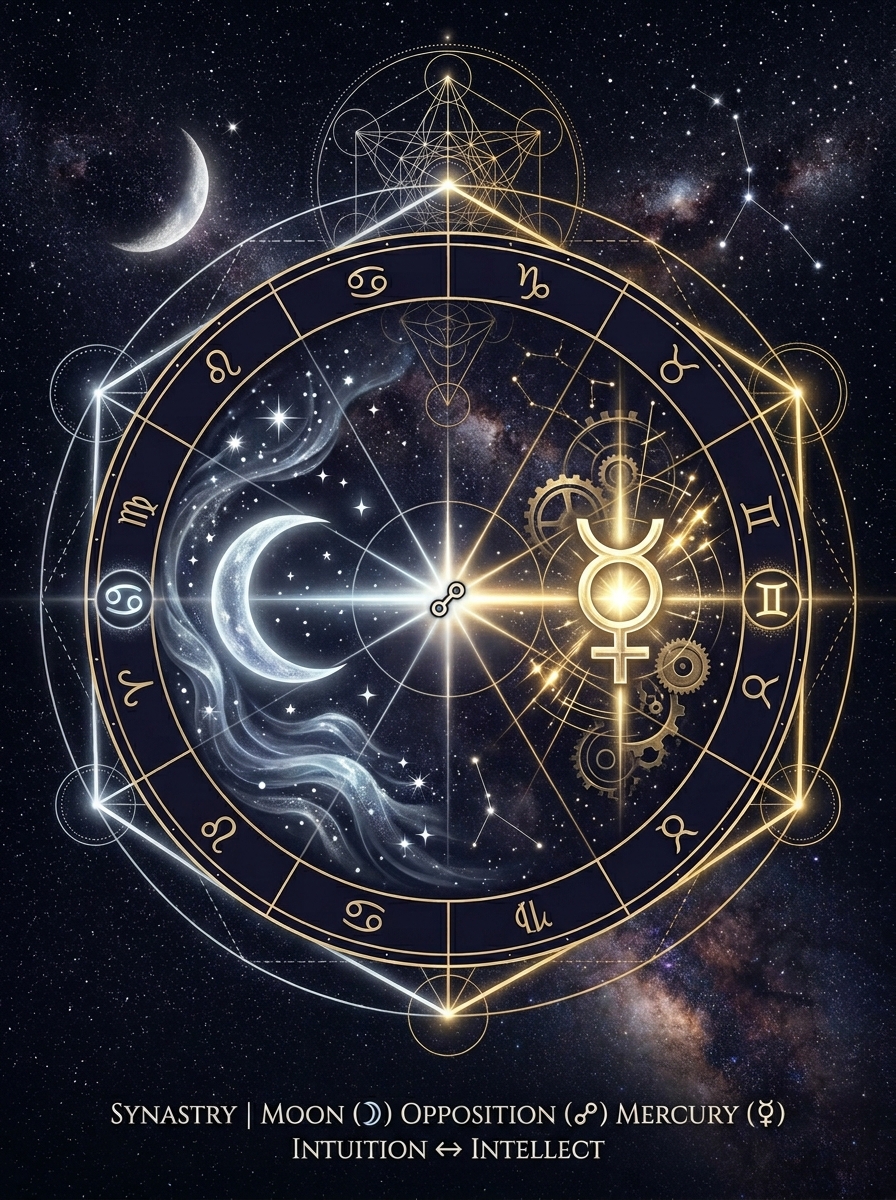
The Polarity of Feeling and Thinking
Moon opposite Mercury in synastry sets two different kinds of truth against each other. The Moon holds emotional memory, instinctive mood, and the need for safety before analysis. Mercury holds language, logic, and the drive to name and order experience. The opposition—a 180° aspect—does not blend these functions; it polarizes them. Each partner becomes the other’s missing half and their most reliable irritant.
The attraction is often immediate and cognitive before it is romantic. The Mercury person feels mentally alive around the Moon person, whose emotional density seems like a riddle worth solving. The Moon person feels seen in a way words alone cannot explain, as if the other can give shape to feelings that usually stay interior. This is the initial pull: each one offers what the other lacks. But the same polarity that sparks fascination also produces chronic misattunement. The Moon person may experience Mercury’s questions as interrogations, while Mercury experiences the Moon’s silences as withholding. Neither is wrong—they are reading the same event from opposite sides of the aspect.
The astrological opposition is a mirror that separates in order to reveal. In synastry, this mirror shows each person their own blind spot. The Moon person sees that they rely on feeling as a private language and must learn to translate. The Mercury person sees that their clarity can wound before it informs. This is not a disagreement about facts; it is a disagreement about what constitutes truth. For a fuller map of how this fits into relationship dynamics, exploring synastry aspects provides context: some contacts smooth, some inflame, and some teach by resistance.
The tone is the message
The core friction does not announce itself in dramatic declarations. It lives in tone, timing, and subtext. Mercury believes that directness is kindness, so they speak plainly—and the Moon hears bluntness as dismissal. Moon tries to protect the emotional atmosphere by hinting or withholding, and Mercury hears vagueness as evasion. Each person’s coping style triggers the other’s nervous system.
The disagreement is rarely about the surface topic—plans, money, family—but about the emotional climate surrounding the talk. The Moon wants containment before naming; Mercury wants naming before containment. When the opposition is active, every exchange becomes a negotiation between two valid but incompatible rhythms. The Moon may say, “I need you to just listen,” and Mercury attempts to fix, analyze, or clarify—missing the point entirely. This is where the relationship can get stuck in loops: the same argument, the same hurt, the same feeling of being unheard. The loop only breaks when each side realizes the other is not failing but operating on a different logic of connection. For a deeper understanding of Mercury itself as an archetype, see Mercury in astrology: language is not only information but orientation and survival.
Where the Friction Actually Lives
Moon opposite Mercury is not a communication problem in the ordinary sense. It is a translation problem between two kinds of intelligence. The friction appears in small, repeated moments that accumulate into a story of “we don’t understand each other.”
Questions can feel like cross-examinations
Mercury asks questions to connect, to clarify, to show interest. “Why do you feel that way?” “What happened before you got upset?” The Moon often hears these as cross-examinations—as if feelings need a defense attorney. The Moon person may shut down or become defensive, which frustrates Mercury, who only wanted to help. The pattern: Mercury pushes for explanation; the Moon retreats into silence or mood; Mercury pushes harder; the Moon feels trapped. The cycle is predictable unless one person recognizes the dynamic and reframes their approach.
Conversely, the Moon may speak in implications, expecting Mercury to read between the lines. When Mercury fails to decode the subtext, the Moon feels unseen. Mercury feels confused. This is not a failure of love but a failure of language styles. The Moon’s indirectness is a request for attunement; Mercury’s directness is a request for clarity. Neither is wrong, but the gap can feel like a chasm. When the relationship is under stress from other factors—such as a Mercury retrograde period that amplifies inner revision—these misreadings become more frequent and more painful.
The emotional script: “Say it better” vs “Feel it better”
Each side often demands the other translate reality in a way that feels natural to them. The Moon person accuses Mercury of being cold, glib, rationalizing. Mercury accuses the Moon of being overly sensitive, vague, or impossible to talk with. Both accusations contain a seed of truth and a heap of projected expectation. The deeper work is to stop demanding the other convert to your language and start learning to meet halfway.
The opposition softens if one person’s Mercury is in a water sign (Cancer, Scorpio, Pisces) or a receptive house (4th, 8th, 12th), or if the Moon person has strong air or earth influence. But even then, the polarity remains real. The relationship only suffers when either partner insists their own mental or emotional style is the universal standard. A supportive contact like Moon-Venus synastry can sweeten the field enough that hard talk lands softly. Similarly, Sun-Moon synastry provides foundational recognition that eases the sting of misunderstandings.
The Hidden Gift: Forcing Emotional Literacy
A strong synastry aspect is rarely there just to create comfort. Moon opposite Mercury can become one of the most psychologically productive contacts in a relationship because it forces each person to develop the function they usually outsource. When both partners commit to the work, the relationship becomes a laboratory for emotional intelligence.
The Moon learns to articulate without betraying feeling
For the Moon person, this relationship is a school in verbal self-trust. Many Moon types know they feel something before they can name it. In contact with Mercury, they are challenged to give shape to that interior intelligence—to translate sensation into language. This is frustrating at first because it feels reductive. But the reward is profound: the Moon discovers that naming a feeling does not imprison it. It clarifies it. A feeling can be true and also incomplete; naming it opens the door to shared understanding rather than solitary suffering.
The Moon learns to separate old pain from present reality. Not every emotional reaction is a verdict on the relationship—sometimes it is a memory triggered by a tone of voice. Mercury’s insistence on verbal precision, when offered with patience, helps the Moon discriminate between the past and the current moment. This is a subtle but life-changing skill that benefits every future relationship.
Mercury learns that thought is relational, not abstract
The Mercury person comes to understand that communication is not just data transfer. Words alter the emotional field. Timing matters. The body listens as much as the ears. Mercury learns to ask: What is the emotional function of what I am about to say? Am I helping the connection or proving a point? This is especially hard for Mercury types used to solving problems through speed or cleverness. The Moon will not be won over by brilliance if the brilliance arrives without attunement.
When the relationship works well, Mercury discovers that tenderness is not an obstacle to truth but its container. The opposition tests whether truth can be offered without stripping it of warmth. If Mercury can slow down and check the emotional temperature before speaking, the bond deepens. For a broader look at how house overlays influence this dynamic, see synastry house overlays: the placement of the Moon and Mercury in one another’s charts determines where the friction and growth actually land in daily life.
When it goes shadow: staying stuck in the loop
The shadow of this aspect is chronic defensiveness. The Moon person refuses to articulate, insisting that “if you loved me, you’d just know.” The Mercury person refuses to slow down, insisting that “if you were rational, you’d see I’m right.” Both positions are walls. The relationship becomes a series of unfought wars where neither side learns anything. The loop continues until one person breaks the pattern—often through therapy, a wake-up call, or a painful breakup that forces reflection.
When the opposition matures, both partners learn to hold the tension without trying to eliminate it. They accept that they will never fully understand each other the way they understand themselves, and that is the point. The bond becomes a bridge between inner weather and spoken meaning.
How the Aspect Expresses Across Life
The Moon opposite Mercury dynamic is not confined to romantic partnerships. It appears in close friendships, business collaborations, and family bonds. The same polarity shows up in any relationship where one person leads with feeling and the other with thought. In love, it can produce a chemistry that feels fated—electric conversations alternating with painful misunderstandings. In work, it creates a team where one person tracks morale and the other tracks logistics; they can complement each other brilliantly if they honor the difference, or sabotage each other if they dismiss it.
The key is recognizing that this aspect does not have to be “fixed.” It is a relationship style, not a flaw. The most successful couples with this opposition learn to schedule conversations when both are emotionally regulated, use “I feel” statements without expecting the other to decode them, and accept that some topics will never be resolved—only revisited with greater skill. The relationship becomes a practice in the art of hearing feeling without flattening it, and of speaking truth without stripping it of warmth.
For a comprehensive guide to how all these dynamics fit together, astrological synastry offers the full framework: two charts do not merge, they negotiate. The Moon opposite Mercury negotiation is among the most demanding and rewarding—if both are willing to learn each other’s native tongue.
Comments
Loading comments…