Moon Opposite Mars in Synastry: Desire, Friction, and the Pulse of Attraction
The Core Dynamic: One Nervous System Meets Another
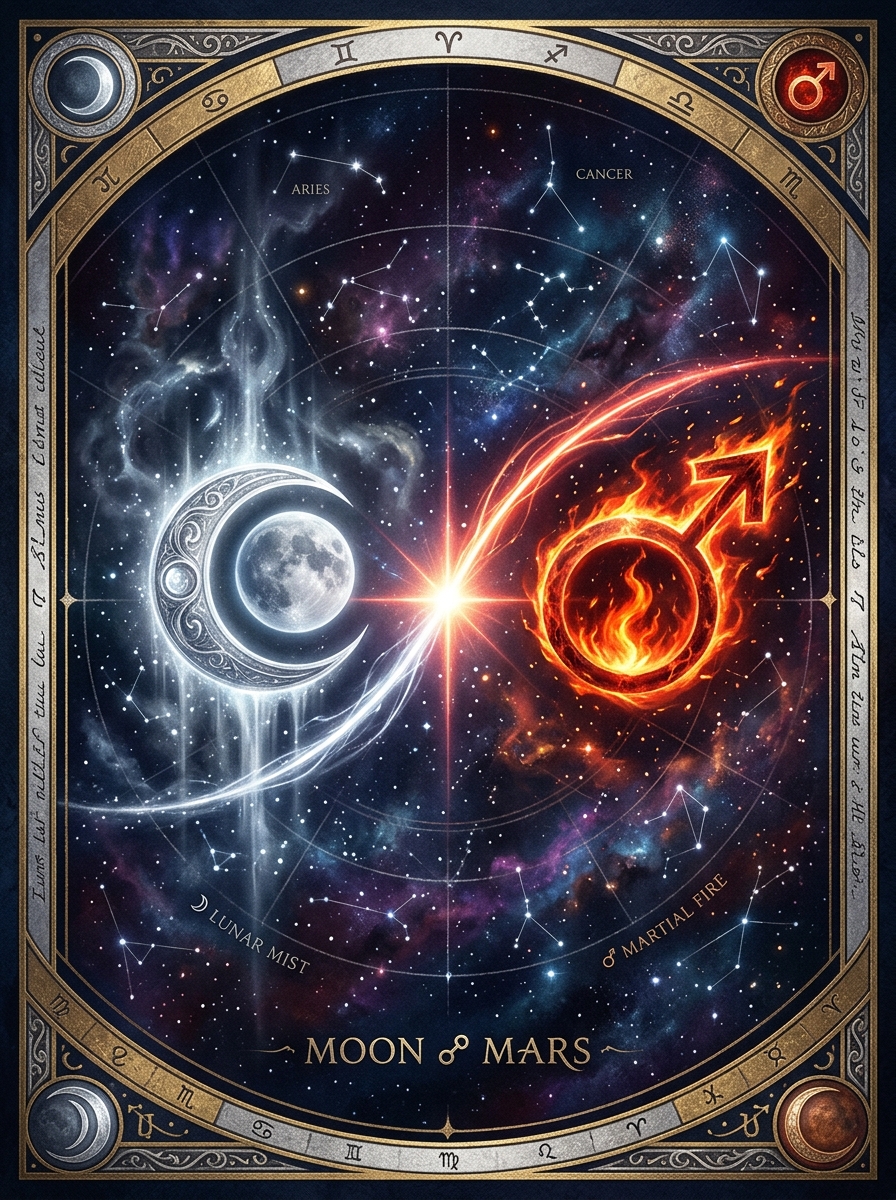
When one person’s Moon opposes the other’s Mars, the relationship does not begin with a conversation. It begins with a charge — a direct hit to two ancient circuits: the need for safety and the urge to act. The Moon person shows up with a body that already knows how to feel, absorb, and remember; the Mars person arrives with a body that wants to move, initiate, and press. The opposition aspect locks these two into a seesaw: the more the Moon softens, the more Mars bristles to protect or provoke; the more Mars asserts, the more the Moon withdraws or defends. Neither is wrong, but neither can stop being themselves.
This is not a “bad” aspect. It is a relationship engine that runs on tension. In synastry, the Moon-Mars opposition constellates the most raw polarity between emotional receptivity and instinctive action. One partner becomes the mirror for what the other has not yet integrated — the silent anger behind the caretaker, the unmet need behind the warrior. And because the opposition format creates a line of sight between two points, the dynamic is immediate, unavoidable, and rarely polite. For a deeper look at how this aspect pattern shapes all encounters, see the opposition aspect in synastry.
Why Desire Feels Like Irritation
The attraction between Moon and Mars is almost always physical and fast. The Moon person may feel “seen” at a level they cannot articulate; the Mars person may feel “alive” in a way that no other contact provides. But this same immediacy is also the source of friction. The Moon’s instinct is to wait, check the emotional tone, and only then engage; Mars does not wait. When Mars moves toward the Moon with directness, the Moon person can feel invaded, even if the intention is affection. When the Moon person hesitates or asks for a moment, Mars reads it as rejection. The result is a loop: desire becomes provocation, provocation proves desire.
This loop is what gives the aspect its erotic charge. It is not a gentle attraction — it is a polarized attraction that keeps both partners on edge. The Mars person’s pursuit wakes the Moon person out of emotional drowsiness; the Moon person’s vulnerability gives Mars something to fight for, not just chase. But the loop can also become exhausting. If neither partner learns to break the sequence, the relationship turns into a script where every warm moment is followed by a cold snap, and every fight ends in a physical reunion that resets the tension without resolving it. This is the paradox of Moon opposite Mars: the chemistry is undeniable, but it can masquerade as intimacy while actually being a stress pattern with good lighting.
The Argument Beneath the Argument
Couples with this aspect often discover that the surface conflict is never the real conflict. A fight over arriving late to dinner may actually be about whether the Moon person’s emotional labor is seen. A conflict about how much to share with friends may mask the Mars person’s fear of being controlled. The Moon opposite Mars dynamic forces each partner to encounter the shadow of their own planet. The Moon person may have to admit that beneath their softness lies a current of rage they have never expressed; the Mars person may have to confront the loneliness that drives their assertiveness.
In Jungian terms, this aspect activates the shadow in the relational field. The Moon person projects their own unmet assertiveness onto Mars, then resents it; the Mars person projects their own unacknowledged vulnerability onto the Moon, then dismisses it. To move past this pattern, both need to recognize that the other is not the enemy — the unintegrated part of themselves is. The Moon must learn to speak its need directly, even if that feels aggressive; Mars must learn to pause, even if that feels passive. This is the deeper work of the opposition: it insists that feeling and force are not opposites but different dialects of the same instinct to survive. For a broader framework on how synastry aspects create psychological tension, see the guide to synastry aspects.
Sexual Polarity and the Risk of Repetition
Sexually, Moon opposite Mars can be incendiary. The tension between the two planets creates a natural polarity of active and passive, pursuer and pursued, that many bodies recognize as primal. The Mars partner often initiates with a heat that the Moon partner finds both arousing and unsettling; the Moon partner’s emotional resonance deepens the encounter beyond pure sensation, giving Mars a taste of vulnerability it rarely seeks on its own. When this works, the result is lovemaking that is both physically intense and emotionally honest — a rare synthesis of drive and receptivity.
But the same polarity can become a trap. Couples can get addicted to the cycle of friction → release → friction, mistaking repeated conflict for passion. This is especially likely when one or both partners carry unresolved wounds around Mars (anger, coercion, sexual shame) or Moon (abandonment, emotional neglect, maternal enmeshment). The relationship then becomes a stage for reenactment rather than growth. A Moon opposite Mars in a chart that also contains strong soothing aspects — like a supportive Sun-Moon synastry or a warm Moon-Venus synastry — can use the opposition as spiciness rather than poison. Without those counters, the polarity can calcify into resentment.
Making the Opposition Workable
A functional Moon opposite Mars bond does not eliminate friction. It builds a container for it. The container includes three things: timing, honesty, and a willingness to let the other be wrong without the relationship ending. The Moon person needs to learn that directness from Mars is not automatically a threat — sometimes it is just Mars showing up. The Mars person needs to learn that the Moon’s emotional reaction is not always a manipulation — sometimes it is a real response to the energetic weight of the interaction.
Signs and houses refine the whole mechanism. A Moon in Cancer opposing Mars in Capricorn will clash over emotional caretaking versus practical control; a Moon in Aries opposing Mars in Libra will feud over autonomy versus harmony. The house overlay determines where the friction lands in daily life — the 4th house (home, family, old wounds), the 7th (partnership, legal bonds), the 8th (sex, shared resources, trust), or the 10th (career, public image). A Mars in the 8th house opposing the Moon, for instance, can deepen the sexual pull but also intensify jealousy and power struggles. To understand where your specific opposition plays out, consult synastry house overlays.
Ultimately, this aspect cannot be judged in isolation. Its meaning depends on the entire synastry chart. If the couple also has strong supportive contacts — a soft Venus aspect, a harmonious Sun connection — the opposition becomes a forge where both partners are sharpened into their full expression. If the chart is predominantly hard aspects, the opposition may simply wear the couple down. The question is not whether the sparks will fly. The question is whether the relationship has enough other architecture — psychological safety, shared values, and a willingness to grow — to turn those sparks into a steady fire rather than a series of burns. For the full relational map, see astrological synastry: the complete guide.
Related
- Synastry: Sun Opposition Mars — Attraction at the Edge of Friction
- Moon Square Mars in Synastry: Desire That Knows How to Wound and Warm
- Moon Conjunct Mars in Synastry: Heat, Instinct, and Emotional Collision
- Synastry Mars Opposite Mars: Desire, Collision, and the Chemistry of Equal Fire
- Sun Opposite Moon in Synastry: The Magnetic Fault Line
Comments
Loading comments…