Venus Trine Mars: Grace, Desire, and the Clean Current Between Love and Will
The Shape of an Unforced Alliance
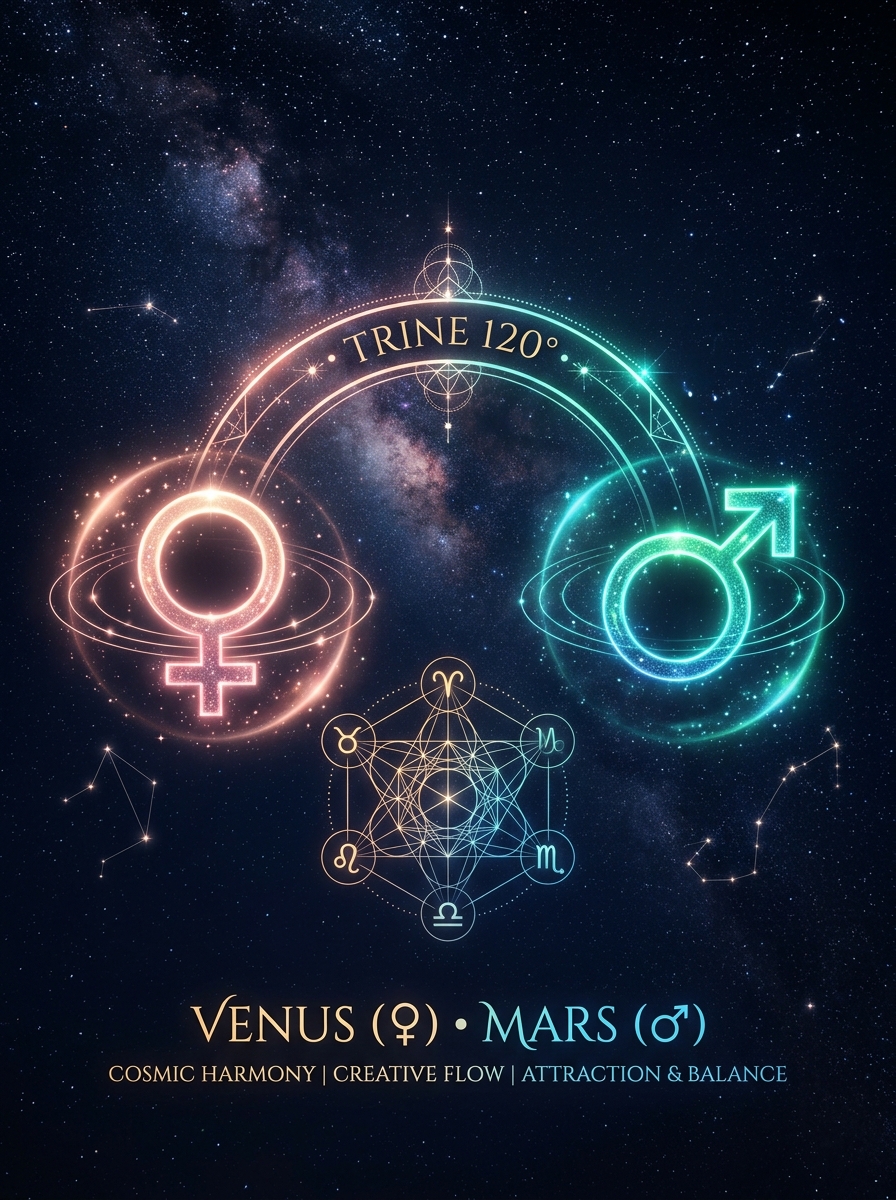
Venus trine Mars describes a chart where the two drives that most often war in human experience — the wish to connect and the will to pursue — speak the same element and therefore the same language. There is no détente; there is cooperation. Venus brings discernment, beauty, and the instinct for proportion; Mars brings heat, urgency, and the courage to reach. In a 120-degree alignment, these planets exchange energy without the static of opposition or the friction of a square. The native does not have to choose between being desirable and being desirous. The two states fuse.
This is not passivity. A trine aspect is harmonic, but harmony is a conduit, not a dimmer. The person often moves through social and romantic life with an untaught rhythm — advancing when the moment opens, yielding when it closes, seldom fumbling the timing. The psyche has built a reliable bridge between appetite and aesthetics, so wanting does not feel shameful, and acting does not feel like a betrayal of connection. That internal architecture is the real gift, not any single talent.
The Psychological Architecture
The reason this aspect forms such a clean current lies in how the two planets relate in the psyche. Venus governs valuation: what you deem worthy of your time, touch, and affection. Mars governs direction: the vector of your energy toward a target. In a trine, valuation and direction align. The person does not waste desire on what they do not truly value, nor do they hoard value without acting on it. This creates a kind of erotic efficiency — not cold, but economical in the way a well-trained body is economical.
The shadow, however, is not conflict but inertia. Because the flow is easy, the native may never test it. They can coast on natural magnetism, assuming chemistry will always be available. The Grand Trine literature warns of this trap: talent without friction can flatten into pleasant habit. A person with Venus trine Mars may appear effortlessly charming while privately feeling that their relationships lack depth. The problem is not that they cannot act; it is that they have never had to act against resistance, and so the will is not tempered by choice. The aspect asks for conscious refinement, not just enjoyment.
The Elemental Dialect
The exact texture of the trine depends on which element hosts both planets. Fire trines (Aries, Leo, Sagittarius) produce a bold, theatrical charm — the person pursues openly, flirts with confidence, and treats desire as a creative act. Earth trines (Taurus, Virgo, Capricorn) are slower and more sensual: attraction builds through touch, routine, and physical presence. Wanting becomes a kind of building. Air trines (Gemini, Libra, Aquarius) favor wit, flirtation, and the erotic charge of conversation — the body is less central than the exchange of ideas. Water trines (Cancer, Scorpio, Pisces) make desire intuitive, porous, and almost psychic; the person may feel another’s longing before it is spoken.
Each dialect is native, not borrowed. The person does not have to learn a foreign script for romance or ambition. But the elemental signature also sets a limitation: a Fire trine may lack patience, an Earth trine may lack spontaneity, an Air trine may avoid embodiment, a Water trine may drown in emotional atmosphere. The developmental task is to supplement the element’s blind side without losing its fluency.
How It Matures
Maturity for Venus trine Mars means turning a natural ease into a conscious craft. The person must learn to welcome friction — not for its own sake, but because desire gains definition only when it meets resistance. Without disagreement or delay, the current becomes a lazy river. The native may then equate harmony with health and mistake comfort for intimacy. They may postpone necessary confrontations, letting Venus’s politeness suffocate Mars’s honesty.
The aspect’s higher expression emerges when the person stops relying on charm as a shortcut. They begin to use Mars to say no cleanly, and Venus to keep that no from becoming cruelty. They understand that the cleanest attraction is one that includes the possibility of refusal. A placement like Mars in Scorpio or Mars in Capricorn elsewhere in the chart can provide the backbone this aspect sometimes lacks — the willingness to sit in emotional truth rather than social grace.
Psychologically, the deepest work is to keep the current alive without mistaking it for depth. The gift is access; depth is what the person does with that access over time. The aspect does not promise lasting intimacy; it promises a clean start. What follows is a matter of character.
Living the Aspect
In love and desire, Venus trine Mars tends to produce relationships that begin with mutual recognition. The native often prefers partners who meet warmth with initiative and initiative with warmth — a dance, not a pursuit. The sexual dynamic benefits from this feedback loop: being wanted and wanting feel like the same event. For a relational lens, compare this to Venus-Mars synastry: the natal aspect gives the person an internal version of that alchemy, so they can generate it without a partner mirroring it back. But sustaining intimacy still requires the willingness to tolerate moods and conflicts that are less graceful than desire.
In craft and career, the person often excels where polish and propulsion must coexist — design, performance, negotiation, any field where aesthetics support strategy and vice versa. A Mars in the 10th House signature can sharpen this into public authority; the person moves through professional spaces with a sense of timing that looks like instinct but is actually the trine’s internal calibration. A Mars in the 5th House pours the same energy into creative play or romance, making the work itself erotic.
The erotic self-concept is one of the aspect’s quietest strengths. Because wanting and being wanted are not split, the body is less afraid of its own yes. The person may feel desirable precisely because they are willing to desire — a loop that stabilizes self-esteem. But that loop can become fragile if it depends on external validation. The aspect does not guarantee a healthy relationship with rejection; it only guarantees that the initial approach feels natural. The real work is learning to hold the current when the room does not respond.
In the end, the trine is a clean vessel. What fills it — presence or habit, courage or comfort, curiosity or repetition — is up to the native. Its grace is real, but grace without accountability is just a pretty inertia. The chart’s sharp edges, its squares and oppositions, are what keep the water moving.
Related
- Venus Trine Mars in Synastry: The Ease of Mutual Desire
- Mars Trine Mars Synastry: Shared Fire, Clean Friction, and the Art of Mutual Momentum
- Venus Sextile Mars: The Easeful Marriage of Desire and Affection
- Venus Trine Venus in Synastry: Shared Taste, Easy Affection, and the Hidden Cost of Too Much Ease
- Venus Conjunct Mars: Desire That Knows Its Own Name
Comments
Loading comments…