Moon Square Mars in Synastry: Desire That Knows How to Wound and Warm
The core dynamic: emotional instinct meets pressure
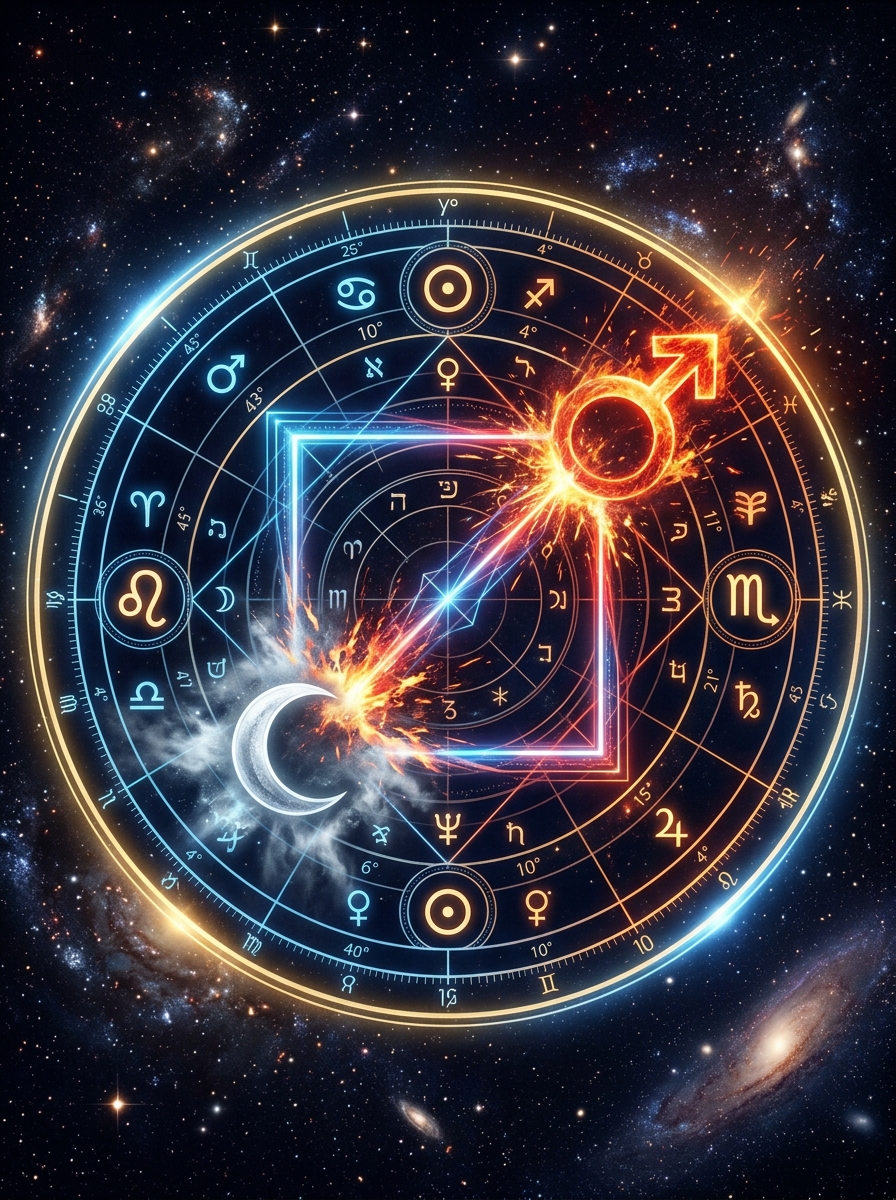
In synastry, Moon square Mars is the contact that makes emotional need and instinctive action collide at a ninety-degree angle. The Moon in one chart seeks safety, rhythm, and attunement; the Mars in the other seeks impact, pursuit, and relief through action. The square aspect ensures they do not naturally agree — not because either is wrong, but because their internal tempos are mismatched. The Moon person may read Mars as too fast or too blunt; the Mars person may experience the Moon as slippery, touchy, or impossible to read. That mismatch is rarely neutral. It can feel like chemistry, irritation, erotic charge, protectiveness, or all four at once.
This is not the soft compatibility of Moon-Venus synastry, where feeling and affection flow easily, nor the reassuring identity harmony of Sun-Moon synastry. Moon square Mars is a live wire — the bond's heat comes directly from the tension that would undermine it if left untended. The essential point: this is a relationship that becomes a training ground for timing, consent, and emotional self-regulation. The attraction is real, but it arrives with defensiveness baked in.
Why the attraction is real even when the contact is sharp
The mismatch generates charge
The Moon wants to feel safe; Mars wants to make something happen. In a square, these two drives do not share a language, but that very dissonance creates a magnetic field. The Moon person feels energized, pursued, sometimes awakened in ways no easy partnership ever could; the Mars person feels challenged, magnetized, compelled to prove itself. The body knows something is there before the nervous system agrees. That is why this aspect so often appears in relationships that are physically compelling long before they are emotionally secure.
For the Moon person, the Mars partner can feel like a force that both protects and threatens. For the Mars person, the Moon partner can feel like a climate that both nourishes and frustrates. The attraction is not the calm recognition of a kindred soul; it is the alert interest of a creature that senses another creature with a different survival strategy. That alertness is itself erotic.
Desire often arrives with defensiveness
One of the strangest qualities of Moon square Mars is that attraction and irritation can be indistinguishable at first. A remark lands as criticism when it was intended as honesty; a bid for closeness feels like pressure; a request for space sounds like rejection. Because Mars is a planet of directness and the Moon is a planet of vulnerability, each person's reflex is to armor up exactly when the other is reaching out. Many couples report a recognizable cycle: pursuit, spark, misunderstanding, flare-up, repair, repeat. The bond gains heat from the very fact that it is not effortless — but that heat can burn or forge, depending on how the fire is contained.
The deeper psychological truth is that the square activates each person's early emotional programming. The Moon brings old attachment patterns; Mars brings the impulse to act before the feeling is understood. This is why the conflict is rarely about the surface issue. A delay in texting may conceal a fear of abandonment; a sharp tone may cover a sense of disrespect. Couples with this aspect often need to learn translation as much as compromise. The Moon is not “too sensitive,” and Mars is not “too aggressive” by default. Each is carrying a different survival strategy. For a wider understanding of how this dynamic fits into the larger relational chart, the synastry aspects guide shows how hard contacts like the square differ from trines and sextiles.
Where the aspect becomes erotic, and where it becomes corrosive
Sexual chemistry is built into the friction
Moon square Mars can be intensely sexual because the same tension that produces irritation can also produce aliveness. The Moon person's emotional availability may excite Mars more than polished charm ever could; Mars's decisiveness may make the Moon feel claimed, desired, or vividly seen. This is not the gentle courtship of Venus and Mars synastry, where desire often feels mutual and aesthetically balanced. Here, desire is more volcanic — it erupts from the very discomfort of being seen and challenged.
In healthy expression, the relationship becomes a place where people learn to name arousal without converting it into conflict. The attraction is real, but it must be handled with the respect due any force of nature. That requires something rare: the ability to feel urgency without acting on it, and to feel vulnerability without retreating.
When the pattern turns toxic
The shadow side appears when anger becomes the main language of intimacy. Then the couple may unconsciously use friction to confirm that the bond is still alive — provocation, sulking, accusation, withdrawal — because stillness feels emptier than conflict. Over time, the relationship can become a rehearsal for mutual injury. This is not doom, but it is unforgiving of contempt. Mars must not bully the Moon into compliance; the Moon must not manipulate Mars through guilt or emotional withholding.
The aspect's danger is not the square itself but the habits it can calcify into. When a couple repeatedly repeats the same fight without learning, the aspect hardens into a repetitive loop that drains the original attraction. Understanding the broader geometry of multiple hard contacts — as in a T-square — clarifies why one square can be useful ignition while unresolved chronic tension becomes a pattern of siege.
What improves it: timing, containment, and honest heat
The remedy is not softness, but precision
A Moon square Mars relationship does not improve when both people merely “try to be nicer.” It improves when they become more precise. The Moon person needs to learn the difference between being triggered and being harmed; the Mars person needs to learn the difference between directness and impact. Both need timing: when to speak, when to pause, when to return, when to cool down. The most useful skill here is not emotional agreeableness but emotional containment — naming the feeling before the action escalates, stating the need before it mutates into accusation.
A square wants friction. But friction can refine rather than scorch. The couple must learn to hold the tension without discharging it onto each other. That means developing the capacity to tolerate discomfort while staying present — a capacity that, once built, creates remarkable loyalty. The bond does not become easy, but it becomes durable because it has survived contact with real human weather.
House overlay and sign flavor change the arena
The sign of the square tells the style of the tension, but the house overlay shows where it lives. If one person's Mars falls into the other's 4th house, the conflict may attach to family history, domestic control, or the fear of being unsafe at home. In the 7th, partnership itself becomes the arena. In the 8th, it can become entangled with sex, trust, jealousy, and power — a particularly intense overlay that requires conscious handling. For a detailed view of how such house placements shape the dynamic, the synastry house overlays guide is indispensable.
Signs alter the flavor of the fire. A Mars in Aries squaring a Moon in Cancer does not feel like Mars in Pisces squaring a Moon in Virgo. The first is overtly combative versus protective; the second is more likely to express as diffuse irritation, caregiving fatigue, or a sense of being emotionally cornered by practical demands. Mars in Capricorn brings control and endurance; Mars in Scorpio intensifies everything and makes the square more erotic, more suspicious, and harder to discharge. When Mars is retrograde, the conflict can turn inward before it turns outward, producing delayed anger or a strange sense of unfinished business.
The deeper evolutionary meaning of the bond
A relationship that teaches agency without cruelty
At its best, Moon square Mars pushes both people toward a more adult form of power. The Moon learns it can assert needs without collapsing into pleading or martyrdom; Mars learns it can pursue desire without violating the relational field. Together, they discover that tenderness is not the opposite of strength, and that firmness does not require emotional carelessness.
This is why the aspect can feel strangely fated. It does not merely bring two people together; it reveals where each one still confuses urgency with truth. The relationship becomes a crucible for individuated feeling — not punishment, but evolutionary pressure. The couple is not just trying to “get along.” They are learning how to carry fire without burning the house down.
If the square is lived consciously, it produces loyalty born of fire-tested trust. If it is not, it becomes a cycle of provocation that exhausts both bodies and buries the original attraction under resentment. The plain truth: Moon square Mars is never dull, and it is rarely simple. It is the aspect of being deeply affected by someone who also reliably pushes your buttons. That is the risk. It is also the invitation. For a complete framework on how this aspect fits into the larger relationship pattern, the astrological synastry guide offers the full context.
Related
- Synastry Sun Square Mars: Desire, Defiance, and the Spark That Won’t Sit Still
- Synastry Mars Square Mars: Desire Under Pressure
- Moon Conjunct Mars in Synastry: Heat, Instinct, and Emotional Collision
- Moon Square Mars: The Heart Under Pressure
- Moon Opposite Mars in Synastry: Desire, Friction, and the Pulse of Attraction
Comments
Loading comments…