Moon Conjunct Mars in Synastry: Heat, Instinct, and Emotional Collision
The Core Dynamic: Instinct Meets Will
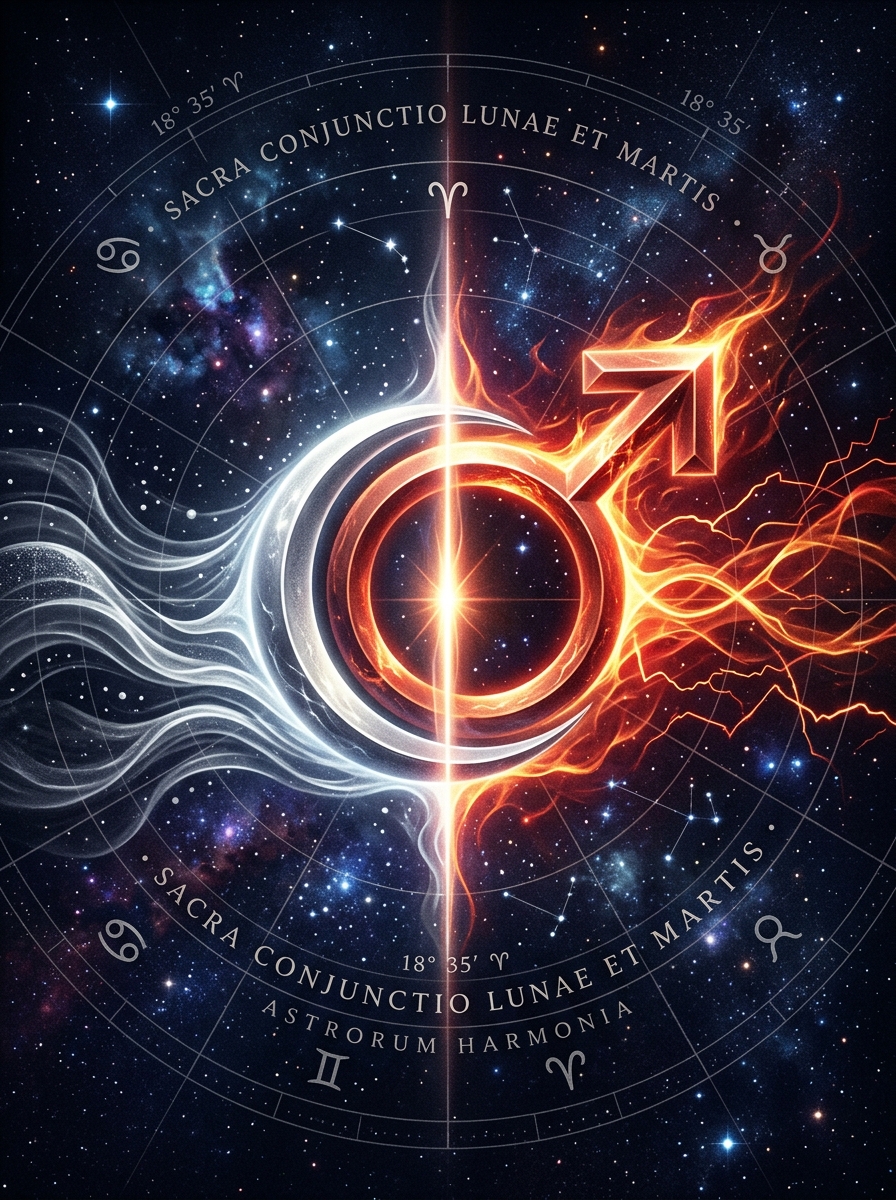
In synastry, the Moon conjunct Mars contact bypasses the mind and lands directly in the body. One person’s emotional need—the Moon—fuses with the other’s drive, appetite, and initiative—Mars. There is no polite distance here. The Moon person feels the Mars person as an activator: a presence that stirs feeling before thought. The Mars person experiences the Moon person as an immediate target for desire, protection, or provocation. Together they generate a current that is rarely neutral.
This is not a compatibility aspect in any comfortable sense. It does not promise ease. It promises contact, and contact of a particular kind: raw, quick, and undeniably alive. Where softer aspects like Moon-Venus synastry create a steady warmth of affection, Moon conjunct Mars is the heat of ignition. The nervous system registers the other person as relevant at once. Couples often describe an instant sense of urgency—as if the meeting had already begun before either spoke.
The core thesis is simple: the Moon person’s feeling life fuses with the Mars person’s will. What the Moon needs, Mars wants to act on. What Mars initiates, the Moon responds to viscerally. This fusion is what makes the aspect so physiologically immediate. It is also what makes it volatile. The same connection that produces fierce loyalty can produce friction that no amount of talk can smooth, because the conflict is not in words—it is in timing and pacing.
The Psychological Roots: Why This Wires So Deep
To understand why this conjunction feels so primal, look to what each planet represents. The Moon is the repository of emotional habit, the body’s memory of safety and threat from early life. Mars is the planet of assertion, anger, and the instinct to move toward or against something. When these two meet by conjunction in synastry, the Mars person touches the Moon person’s deepest emotional material—and does so through action, not words.
The Moon person may find that the Mars person provokes feelings they thought were buried: old protectiveness, old wounds, old hunger for someone who would not hesitate. The Mars person, in turn, discovers that the Moon person makes them care in a way that bypasses their usual emotional reserve. They feel compelled to do something—protect, seduce, challenge, fix—and the impulse feels almost involuntary.
This is where the aspect connects to the wider field of astrological synastry. It is not a static label but a dynamic that activates whatever is already present in each person’s natal chart. The Moon person’s history with nurturance, the Mars person’s relationship to anger and desire—these enter the relationship through this one point of fusion. Psychologically, the conjunction can feel like a shortcut to intimacy: two people touching each other’s core drives before they have built the trust to handle them.
When the contact is conscious, it can heal old wounds around assertiveness and vulnerability. A Moon person who has learned to suppress need may finally feel permission to want directly. A Mars person who has used force as a shield may learn to channel drive into care. But when the contact is unconscious, the same dynamic repeats the past: one lunges, the other recoils; one pursues, the other withdraws. The aspect does not create these patterns—it wakes them up.
The Healthy Form: Fierce Loyalty and Protective Action
In its mature expression, Moon conjunct Mars becomes a bond of remarkable vitality. The Moon person feels safe to express need because the Mars person responds with direct, embodied care—not verbal reassurance but tangible action: showing up, making the call, opening the door, defending without being asked. The Mars person feels valued because their initiative is met not with resistance but with emotional engagement. The Moon does not dampen Mars; it gives Mars a meaningful target.
This partnership often shows resilience under pressure. When something difficult arises, the couple acts quickly. They do not get stuck in analysis; they move. The conjunction creates a low tolerance for dishonesty or passive aggression, which paradoxically makes the relationship cleaner than many others. There is little room for pretending when one person’s feeling body is wired to the other’s action body.
The health of this expression depends heavily on the surrounding chart. A conjunction in a supportive house—such as the 1st, 5th, or 7th—and with harmonious aspects to Saturn or Jupiter can provide the containment that Moon-Mars needs. Without such containment, the heat may flare without a vessel. For understanding how the house overlay shapes the experience, synastry house overlays offer the necessary geography. The contact that lands in the 4th house feels very different from one in the 10th or 12th.
The Shadow: Reactive Loops and Bruised Bonding
The shadow of Moon conjunct Mars emerges when the immediate reactivity of the aspect is not held consciously. The same speed that makes the bond feel alive can turn into a cycle of provocation and defense. The Moon person feels exposed by Mars’s directness and responds with hurt or withdrawal. The Mars person, sensing rejection, pushes harder or grows frustrated. Each reaction confirms the other’s fear: that their need is too much or that their desire is unwelcome.
This can become an addiction to intensity. The couple may fight and reconcile in a pattern that feels passionate but actually reinforces a loop of emotional dysregulation. Beneath the drama lies a vulnerable desire for connection, but the delivery system—too fast, too blunt, too reactive—keeps true intimacy at a distance. The Moon person may use tears or silence as a form of control; the Mars person may use anger or pursuit as a form of domination. Neither is acting in bad faith; both are reacting from survival programs that the conjunction has now made central to the relationship.
A particular danger is when the Mars person assumes that emotional access implies consent to intervene. The Moon does not like to be rushed; it opens only when safe. The Mars person may confuse the Moon’s responsiveness with an invitation to press harder. This misunderstanding can turn the conjunction from passionate to pressurized. The same instinct that made the Moon feel protected now feels invasive.
For couples stuck in this shadow, it helps to examine the natal condition of the Mars person’s Mars. A retrograde or debilitated Mars (as explored in Mars retrograde) may add layers of inward frustration, turning overt conflict into suppressed resentment. The conjunction then expresses not as open fire but as passive resistance or sudden explosions after long silences. Conscious work—especially around timing and explicit consent—is essential to break the loop.
The Conjunction in Context: Sign, House, and Dignity
The same conjunction does not look the same in every relationship. The sign changes the flavor of the fuse. Moon conjunct Mars in Aries or Leo is direct, proud, quick to flare and quick to forgive; in Cancer or Pisces it is more defensive, submerged, tidal, and easily bruised. In Taurus or Capricorn, the heat builds slowly but holds stubbornly; in Gemini or Aquarius, it expresses through words, debate, and restless mental stimulation. The contact in Scorpio can become the most intense, fusing sexuality with power dynamics and a reluctance to let go.
The house where the conjunction falls determines the life area where the fusion plays out. In the 1st house, the Mars person energizes the Moon person’s very identity; the relationship feels immediately embodied. In the 4th house, it stirs domestic heat, family triggers, and the need for a sanctuary that can hold both tenderness and conflict. In the 7th house, the aspect becomes explicitly relational and often highly visible to others. In the 8th house, it deepens psychological and sexual bonds but also raises issues of jealousy and control. The synastry aspects that accompany the conjunction—especially squares from Saturn or Pluto—can amplify the friction or add structure.
Finally, the dignity of Mars matters. A Mars in its own sign (Aries, Scorpio) or exalted (Capricorn) expresses the conjunction with more confidence and less hidden agenda. A Mars in fall (Cancer) or detriment (Libra, Taurus) may manifest the conjunction through indirectness, defensiveness, or a tendency to feel attacked. The same applies to the Moon: a Moon in Cancer or Taurus handles the conjunction differently than a Moon in Capricorn or Scorpio. For detailed portraits of specific Mars placements, the guides to Mars in Aries and Mars in Cancer show how radically the archetype shifts.
Working with the Aspect: Timing and Containment
The art of handling Moon conjunct Mars well lies in separating urgency from truth. Not every surge of feeling requires immediate action; not every hurt needs to become a verdict. The Moon person can learn to name a need before it curdles into resentment—saying “I need a moment” rather than “You always push me.” The Mars person can learn to ask before assuming—saying “Are you open to talking?” rather than “Let’s settle this now.”
This is the whole discipline of the aspect: to slow the fuse without smothering the fire. The relationship needs a container—a shared understanding that intensity is not the same as danger, and that the connection can survive a pause. In practice, this means building rituals of check-in, honoring the Moon person’s need for pacing, and rewarding the Mars person for initiating with care rather than force.
The couple that masters this finds that the conjunction becomes a source of deep loyalty. They trust each other’s reflexes because they have seen them soften. The Mars person learns that protecting the Moon’s vulnerability is not submission but strength. The Moon person learns that receiving Mars’s directness is not invasion but presence. The bond becomes a forge, not a battlefield.
For the broader relational map, synastry step by step shows how this conjunction interacts with other contacts, while sun-moon synastry reveals the core identity-emotion axis that Moon-Mars both supports and disrupts. Moon conjunct Mars is not the whole story—but it is often the chapter that makes the story worth reading.
Related
- Moon Square Mars in Synastry: Desire That Knows How to Wound and Warm
- Mars Conjunct Mars in Synastry: Shared Fire, Shared Fault Lines
- Moon Conjunct Mars: When Feeling Strikes Back
- Moon Opposite Mars in Synastry: Desire, Friction, and the Pulse of Attraction
- Moon Sextile Mars Synastry: The Warmth That Knows How to Move
Comments
Loading comments…