Synastry Mercury Square Mercury: The Spark, the Snag, and the Mind Games of Love
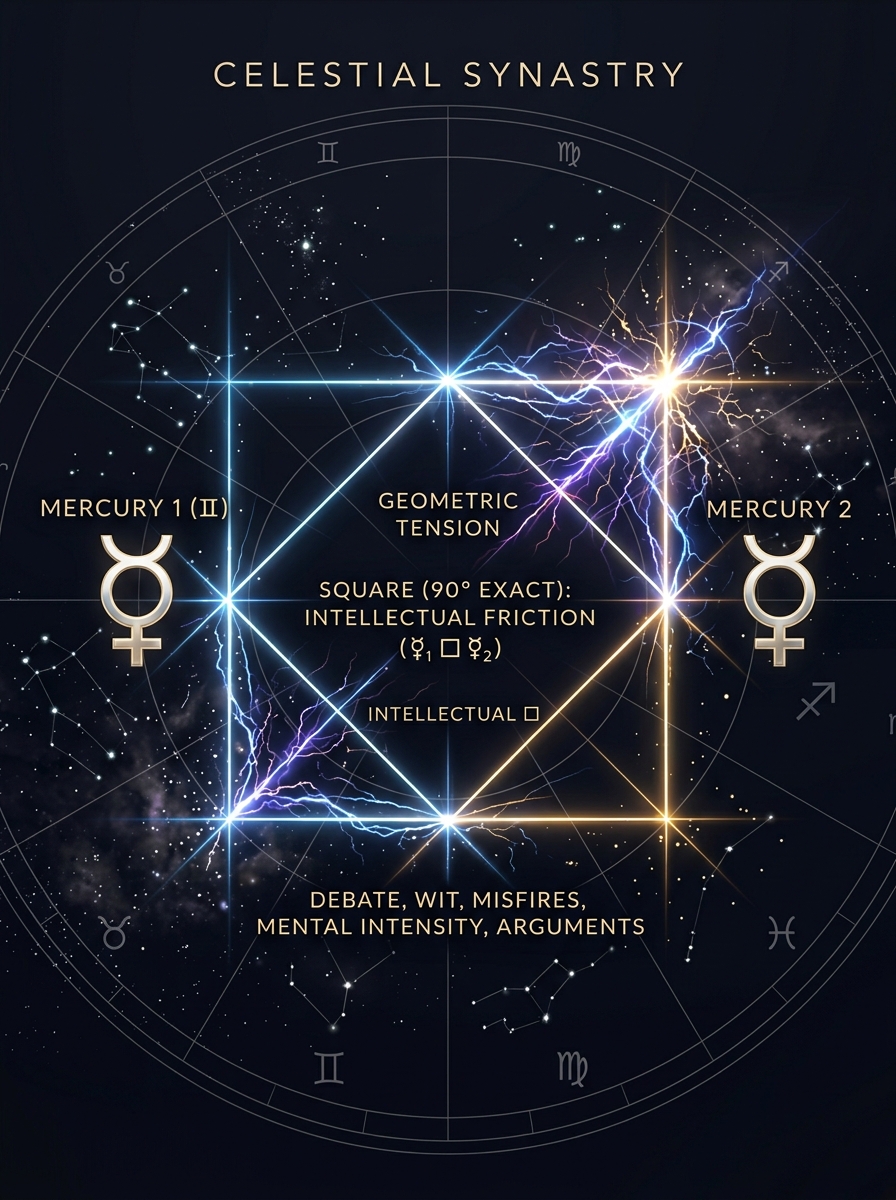
The Core Dynamic: Attraction Through Cognitive Friction
Mercury square Mercury in synastry is not a “bad communication” signature. It is a mismatch of mental momentum that creates heat. One person thinks in snapshots, the other in spirals. One seeks conclusions, the other keeps the inquiry open. The attraction often sparks from that very friction: each person feels sharpened, challenged, awake in a way smooth synastry rarely provides. This is the square’s paradox—what jars also animates. For the broader principle of how tension can catalyze rather than block, see the square aspect.
The contact is not primarily emotional or sexual friction. It is friction of interpretation. Two people may admire each other’s intelligence while repeatedly missing each other’s intent. They argue about facts but are really arguing about tone, timing, priority, meaning. Mercury is the messenger, but here the messenger works under translation strain. The relationship feels like two dialects of the same language colliding at the level of grammar.
What makes this square feel alive
Mercury governs how we notice, classify, and connect. When one Mercury squares another, the synastry produces instant mental activity: more texting, more debate, more analysis, more spontaneous commentary. The other person is not passive; they provoke thought. They may even provoke self-awareness exactly where thinking has become habitual. That stimulation is the engine of the bond—and also the trap. Because square aspects seek adjustment but do not supply it, the pair can become fascinated by the problem itself. The conversation circles; the same misunderstanding reappears in different costumes. If you want to place this dynamic inside the larger architecture of relationship chart overlay, astrological synastry provides the full context.
Psychological Roots: The Mind Defends Its Territory
Mercury square Mercury reveals itself through tempo, framing, and rhetorical style before it shows up in content. One person may process in snapshots; the other in spirals. One prefers bluntness, the other nuance. Even when both are intelligent and well-intentioned, each unconsciously treats the other’s style as evidence of flawed thinking.
The Modality Divide
The square can become especially combustible when the two Mercuries differ by modality—even if their signs seem compatible on paper. A fixed Mercury wants conceptual stability; a cardinal Mercury wants movement; a mutable Mercury wants flexibility. A mutable thinker paired with a fixed thinker produces a pattern where one improvises and the other insists on coherence. A cardinal thinker with a fixed one experiences obstruction where the other sees patience. These are not just preferences; they are cognitive survival strategies. Each person defends a way of making sense of the world, and the square makes those defenses collide.
The Sign Accent
Each sign adds its own accent to the friction. Mercury in Aries fires off quick assertions; Mercury in Capricorn requires demonstrated evidence. Mercury in Gemini proliferates connections; Mercury in Virgo edits them. Mercury in Libra seeks relational balance; Mercury in Scorpio seeks psychological penetration. None is wrong. But in a square, each may feel the other is missing the point by design. For deeper insight into how a specific sign shapes the voice, the series on Mercury in each sign—like Mercury in Aries or Mercury in Gemini—can clarify the accent work.
The Invisible Insult
The most common injury in this synastry is not disagreement but miscalibration. A comment meant as efficiency lands as dismissal. A question meant as curiosity lands as interrogation. An attempt to clarify feels like being corrected. Mercury square Mercury is acutely sensitive to pacing—who speaks first, who interrupts, who needs silence. The square turns ordinary conversational differences into morally charged events because both people are defending cognitive territory. When house overlays involve the 3rd, 7th, 10th, or 11th houses, the dialogue becomes even more public, social, or identity-driven. Synastry house overlays explains how the stage of life amplifies the mental dynamic.
The Shadow and the Mature Path
Mercury square Mercury does not want to be flattened into “just compromise.” Compromise is useful, but the deeper work is learning to hear difference without converting it into hierarchy. The point is not to make two Mercuries identical. It is to let each mind keep its genius while becoming bilingual enough to reach the other.
The Recursive Trap
When the square becomes the relationship’s only music, every conversation is a contest. Every correction is a wound. The pair circles the same argument—same misunderstanding, same frustration, slightly different surface topic. This is the aspect’s shadow: it recruits the whole personality into a small exchange. A guarded Mercury grows sharper; a quick-fire Mercury grows more performative. Without other supporting aspects—like warm Venus or Moon contacts—the mental tension can exhaust the bond. If the pattern intensifies into a larger knot of squares, the T-square aspect pattern shows how chronic pressure becomes a lifelong development theme.
The Art of Translation
The mature expression of this square is not peace; it is precision with tolerance. The relationship learns that two minds can be different without one being defective. That shift moves the pair from defensiveness into discernment, from reflex into interpretation. In practice, both people must become explicit about process: “I need time to think before answering.” “I’m not disagreeing; I’m refining.” “I’m hearing your conclusion but not your path to it.” These are not relationship hacks; they are acts of psychological respect. Mercury square Mercury thrives on meta-communication—talking about how you talk—before the conversation becomes a referendum on character.
This is where the contact can become surprisingly affectionate. Translation creates tenderness. When someone learns your tempo, your syntax, your way of arriving at meaning, they are loving the architecture of your mind. That is a real form of intimacy, often absent in smoother pairings that never have to learn it. For a broader view of how synastry aspects function as relational grammar, synastry aspects places this square among the whole set.
How the Square Unfolds in Life
The core dynamic—cognitive friction that feels alive—manifests differently depending on the arena. But the underlying mechanism is the same: two minds in productive tension.
In Romantic Relationships
Romantic partners with Mercury square Mercury often report that they argue best and laugh hardest when they stop trying to agree and start trying to understand. The chemistry is unmistakable: dates turn into debates, and those debates deepen the bond faster than small talk ever could. The danger is when the argument becomes the only shared language. But when supported by strong Moon or Venus contacts—like those described in moon-venus synastry—the mental friction softens into a stimulating rhythm. These couples become brilliant companions: the people who refine each other’s ideas for years.
In Professional Settings
At work, the square translates into creative friction. Two colleagues or co-founders may push each other toward sharper thinking: one challenges the assumptions, the other forces the follow-through. The bond is rarely comfortable, but it can be extraordinarily productive. The key is to keep the disagreement focused on the problem, not the person. When one Mercury is in Mercury in the 7th house (the house of one-on-one partnerships), the professional relationship can feel like a strategic alliance where every conversation is a negotiation—but also an opportunity for mutual refinement.
In Close Friendships
Friends with this aspect often describe the connection as intellectually honest. They do not let each other get away with sloppy reasoning, but they also learn to apologize for the tone. The friendship becomes a training ground for self-awareness: each person learns to recognize when they are defending style instead of substance. The longevity of such friendships depends on the capacity for meta-communication. If both can say, “I think we’re having a Mercury square moment,” the bond deepens.
The Higher Use: Becoming Bilingual
The alarm bell in this synastry is not the friction itself; it is the inability to step back and see your own mind from the other’s perspective. Mercury square Mercury asks for curiosity that survives irritation. It asks for enough self-knowledge to notice when you are defending a habitual style rather than an essential truth. It asks for the humility to realize that being misunderstood is not always a sign of failure—sometimes it is simply what happens when two languages meet at speed.
In the best cases, the square becomes a shared discipline: sharper listening, better timing, cleaner language, less vanity about being “right.” The relationship does not eliminate the tension; it leverages it. When two people learn to hold their own mental style lightly while honoring the other’s, they move from defensive reactivity into conscious dialogue. That shift is the aspect’s real gift—the kind of relational intelligence that no easy synastry can teach.
If the pattern includes a wider configuration of squares, the T-square birth chart article explains how repeated tension becomes a lifelong development theme rather than a permanent irritation. But for most pairs, the most portable lesson is this: Mercury square Mercury is the sign that two people may be most compelling precisely where they are least fluent. Attraction by way of revision. Friction by way of fascination. The mind meets its own edge in another mind—and if the relationship is strong enough, both people leave a little less certain, a little more intelligent, and far more alive.
Related
- Sun Square Mercury in Synastry: The Spark That Argues with Itself
- Moon Square Mercury Synastry: When Feeling and Thought Refuse Easy Peace
- Venus Square Mercury in Synastry: Desire Meets Debate
- Synastry Mars Square Mercury: When Desire Argues With the Mind
- Mercury Opposite Mercury in Synastry: The Electric Rift of Two Minds
Comments
Loading comments…