Sun Trine Mercury: The Clear Flame of Self and Speech
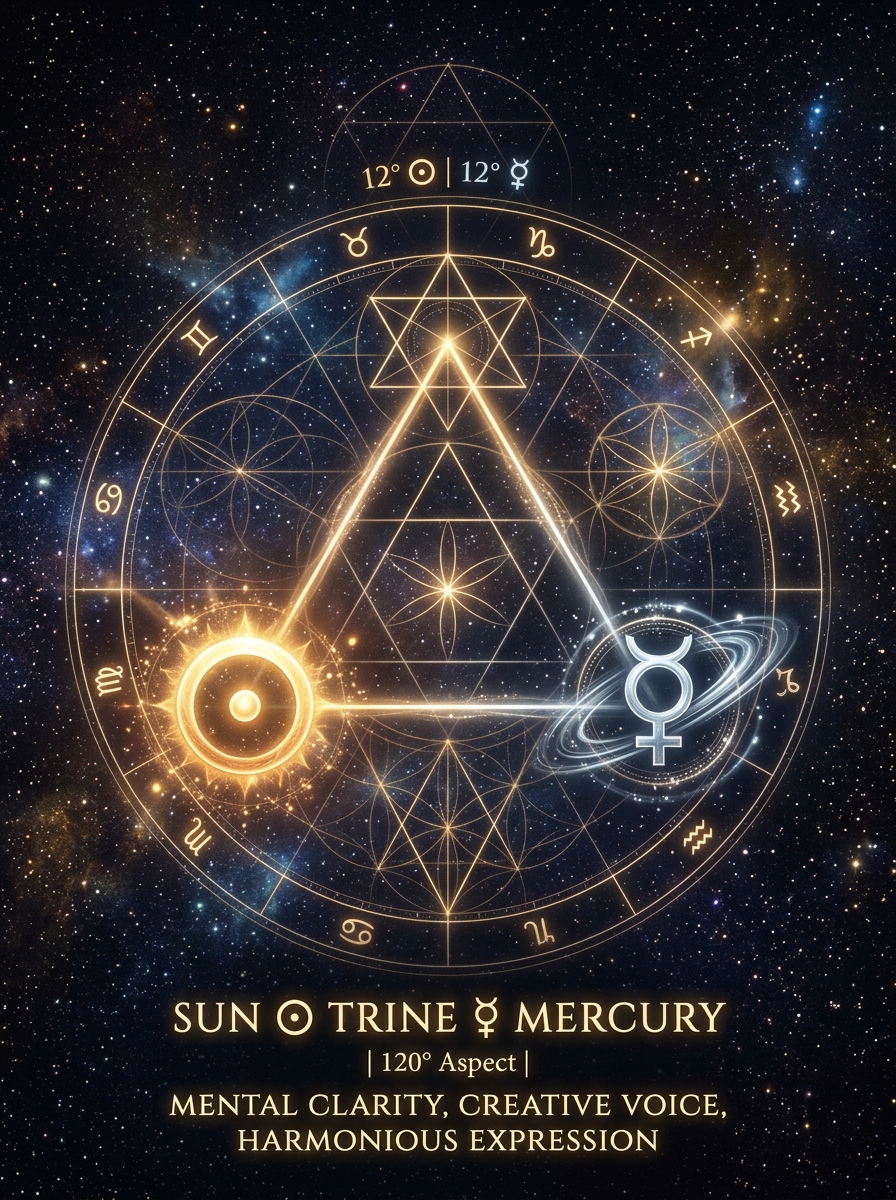
The Core Dynamic: Identity and Thought in the Same Current
Sun trine Mercury is the natal chart’s cleanest signature of inner coherence — a marriage of will and mind that asks for no translation. The Sun radiates identity, purpose, and the instinct to organize life around a center. Mercury sorts, connects, and names. When these two form a trine, the dialogue between them feels native. The person does not need to rehearse before they speak; they think while they speak and speak while they remain themselves. Language is not a costume but an extension of the self.
This harmony matters because Sun and Mercury are not doing the same job. The Sun says I am; Mercury asks what does this mean? In a tense aspect, the two can spar — the ego insists, the mind doubts. Here they cooperate. The result is not necessarily genius, but a rare kind of lucidity: the individual tends to know what they mean and mean what they say. They make complexity legible without condescension and opinion without aggression. If you want the geometry of this ease, the trine aspect itself describes a channel of elemental fluency: the water flows without dam or rapids.
Psychological Roots: The Integrated Self That Thinks Without Splitting
A mind that lives near the core
The deepest psychological effect of Sun trine Mercury is integration. The person’s opinions are not alien to their identity, and their identity does not feel mute. They can translate private insight into public speech with unusual efficiency — not because they are always right, but because the apparatus for checking, naming, and presenting thought sits close to the personality’s center. In childhood, this often shows as precocious verbal confidence: the child who explains moods, mediates arguments, or makes meaning where adults leave silence. That role builds competence, but it can also wire the psyche to believe that understanding is its job.
Because the Mercury archetype — the messenger — walks beside the solar core, the learning style is naturally synthetic. Information does not sit in isolation; it organizes around a central axis of self-definition. A person with this aspect may excel at turning lived experience into narrative. They can often distinguish signal from noise without drama. This is one reason the aspect appears in charts of teachers, writers, journalists, strategists, and anyone whose work depends on the clean transfer of meaning.
The shadow of self-sufficient fluency
Ease, however, is not depth. A trine can produce a mental style so efficient it skips the friction that forces genuine reflection. The person may unconsciously prune away ambiguity too quickly, preferring coherence over contradiction. Their story about themselves can become elegant — and slightly too tidy. This is the psychological root of the shadow: mental self-sufficiency that mistakes fluency for truth. The mind that always has an answer may stop listening for better questions.
Mature Expression vs. Shadow Fluency
Authority without overexertion
In conversation, Sun trine Mercury often sounds composed. The person can frame a point, present evidence, and summarize with crispness. Because the Sun lends presence, the voice carries weight even when the native is casual. People listen because the speech feels inhabited. This is not the brilliance of a hard aspect, where thought and ego spar for dominance; it is the quiet authority of someone who knows what they think and thinks what they know.
The mature expression of this placement is articulate centeredness. The person does not need to dominate a meeting or perform wit. They simply bring order to discourse. When Mercury lands in a compatible sign — say, Mercury in Virgo or Mercury in Gemini — the precision sharpens further. In a more dramatic placement like Mercury in Leo, the voice becomes theatrical but still coherent. The trine adapts to the sign without losing its essential marriage of identity and expression.
The shadow: performative certainty
The shadow side is a temptation toward performative certainty. Because the native can usually speak clearly, others assume the thought is finished when it is merely well phrased. The person themselves may also confuse expressiveness with finality. A polished explanation can hide an unexamined assumption. Under pressure — criticism, deadlines, emotional strain — the easy integration can curdle into defensiveness. The native may talk too much to control perception, or defend a position before they have absorbed it. This is not intellectual weakness; it is the belief that fluency equals truth.
If the rest of the chart is nervous or defensive, the aspect can become a clever shell. The person can articulate their way out of self-scrutiny. That is why Sun trine Mercury requires a deliberate practice of revision: the willingness to let the first draft be wrong.
How It Plays Out in a Life
Work, relationships, and creativity as applications of one dynamic
Because the core dynamic is already established, we can trace its expression across domains without re-explaining it.
In work, the person thrives where understanding must become language: editing, teaching, advocacy, negotiation, branding, research synthesis, law. They learn by organizing. Instinctively, they outline a problem, name the moving parts, and identify the next step. This makes them reliable in collaborative settings — they can explain why a decision was made and make the logic hold. When Mercury occupies a house that focuses its energy — for example, Mercury in the 5th house turns the voice toward performance and play; Mercury in the 10th house puts it into the public sphere — the aspect’s gifts become vocational.
In relationships, the person is often clear and direct. They do not hide behind vagueness, and they can listen without immediately needing to be right. Others trust them because they communicate without hidden agendas. But the shadow can surface here, too: the native may explain their partner’s feelings back to them with such precision that the partner feels diagnosed rather than met. The skill of articulation must be tempered with the humility to stay in the question.
In creativity, the trine enables a fluent translation from inner vision to outer form. The writer can get the sentences down without agonizing over each word; the musician can describe the theory behind the improvisation. This ease can accelerate craft, but it can also discourage the messy experimentation that produces genuine surprise. The person may need to intentionally court confusion — to write without an outline, to let the mind wander into what it does not yet understand.
House and sign placement as amplifiers
The trine’s expression is modified by where Mercury and Sun live. A Sun in Pisces with Mercury in Capricorn, for example, still benefits from the trine’s cooperation even if the elements are different — the integration happens through complementary action rather than elemental harmony. Placements like Mercury in Aquarius or Mercury in Sagittarius push the mind toward the future or the horizon; the trine gives those visions a grounded voice. When Mercury in the 8th house meets this aspect, the articulation turns toward the psychological, the hidden, the taboo — the lucid mind becomes a probe into the depths.
The Question of Depth: When Ease Becomes a Ceiling
A trine is a gift, but gifts can become ceilings if they are never challenged. The smooth current of Sun trine Mercury can lull the native into thinking they have finished understanding themselves. They may stop seeking perspectives that contradict their own, because their own perspective feels so natural. This is not a flaw of the aspect — it is a trap of the trine’s geometry. The ease must be counterbalanced by discipline: the habit of inviting what is hard to say, the practice of sitting with what cannot yet be named.
The highest expression of this placement is not eloquence. It is the ability to speak from a centered life — and to revise what you say when life moves the center. The mind that is truly integrated does not need to be right; it needs to be real. Sun trine Mercury gives the instrument. The rest is up to the musician.
Comments
Loading comments…