Sun Trine Moon: The Soul in Agreement With Itself
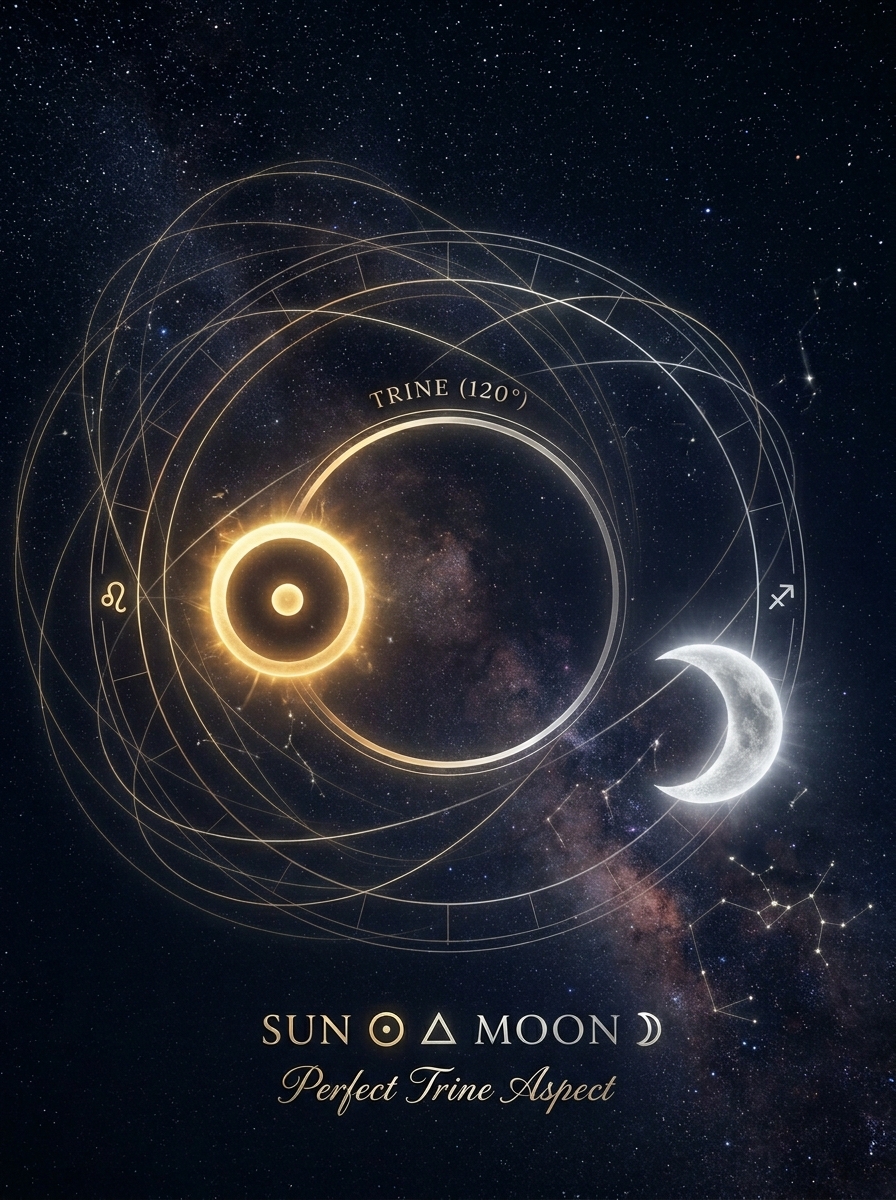
The Core Alignment: When Will and Instinct Speak the Same Language
Sun trine Moon is not a guarantee of an easy life. It is a guarantee that the psyche’s two sovereigns — the Sun (conscious purpose, identity, the story you choose) and the Moon (instinct, emotional memory, the body’s sense of safety) — are not at war. In a trine, they operate on the same frequency. The person rarely has to choose between what they want and what they need, because those two things tend to rhyme.
This is rarer than it sounds. Most charts carry some friction between the luminaries — a square that pits ambition against comfort, an opposition that splits the self into public and private selves. With a trine, the default state is cooperation. The will does not override the feelings; the feelings do not sabotage the will. Instead, each lends the other its strength. The Sun gives the Moon a direction to move toward; the Moon gives the Sun a gut check on whether the direction is actually sustainable. The result is a person who can want and feel in the same breath.
But ease is a channel, not a destination. The trine aspect itself is neutral — it only amplifies whatever is already flowing. If the channel is empty, the person coasts. If it carries genuine substance, the person moves with unusual grace. The question is whether the water is moving or simply sitting.
How It Forms: The Psychological Architecture of Inner Consent
The harmony of Sun trine Moon does not appear from nowhere. It usually reflects a developmental environment where the child’s core identity was not chronically undermined by their caretakers’ emotional needs. The Moon records early conditioning — the temperature of the home, the reliability of comfort, the permission to feel. When that conditioning aligns with the Sun’s emerging sense of self, the person internalizes the message: who I am is welcome here. This produces a kind of primal trust in one’s own legitimacy.
Contrast this with a chart where the luminaries are in hard aspect, such as Cancer Sun, Scorpio Moon. There, the conscious self may want softness and safety, but the emotional body runs on intensity and suspicion — the two drives pull in opposite directions, forcing the person to develop depth through wounding. With Sun trine Moon, the developmental arc is different. The person does not need to fight for coherence; they inherit it. The risk is that they may never learn how to fight, which becomes relevant when life inevitably demands it.
The psychological effect of this alignment is a low internal static. The person can usually tell what they want without sifting through contradictory impulses. Their habits, preferences, and self-image line up naturally. They are not shallow — they are transparent. This transparency often makes them trustworthy to others, because there is no hidden agenda between what they feel and what they express.
The Body as Ally
Because the Moon governs the body’s instinctual rhythms — sleep, appetite, pacing — a trine to the Sun means the body is rarely an adversary. The person’s vitality is strongest when their life is humane: regular meals, adequate rest, emotional consistency. They do not thrive on chaos. They thrive on alignment. This does not make them fragile; it makes them efficient. They conserve energy that others burn on internal friction.
The Shadow of Ease: When Harmony Becomes Inertia
Every flowing aspect carries a shadow. For Sun trine Moon, the shadow is not laziness but over-adaptation to comfort. Because the inner world already feels coherent, the person may not feel the normal pressure to stretch. They mistake equilibrium for fulfillment. The psyche settles for a pleasant enough life rather than a fully activated one.
The structural risk is described in the Grand Trine: when all three elements of a configuration are in harmony, the native can appear frictionless from the outside while remaining underdeveloped within. Sun trine Moon is a single-channel version of the same trap. The person may default to habits that preserve peace but foreclose growth. They avoid relationships that would test them, careers that would demand more than their comfort zone, and decisions that would force them to renegotiate their identity.
This shows up most clearly when life asks for a larger scale than the person has chosen so far. The trine’s gift is recovery speed — the person bounces back from setbacks quickly — but its limitation is that they may not put themselves in a position to be set back in the first place. They prefer the known over the risky, because the known feels like an extension of themselves. The challenge is to expand the known rather than defend it.
Over-Adaptation to Safety
The Moon also carries the memory of early emotional safety. In a trine with the Sun, that memory becomes a template for how life should be. When reality violates that template — through betrayal, loss, or environments that demand hard adaptation — the person may react with surprise rather than resilience. They are less practiced at navigating inner division. The lesson is not to become cynical but to learn that integrity can survive strain. The partnership of Sun and Moon is stronger when it has been tested.
Living the Trine: The Gift of Instinctive Timing and Coherence
The signature expression of Sun trine Moon is instinctive timing. The person knows when to speak, when to wait, when to comfort, and when to leave well enough alone. This timing is not calculated; it emerges from the fact that their emotional reading and their conscious decision-making are wired together. They can sense the mood of a room and act on it without overthinking. This makes them natural mediators, steady leaders, and partners who do not need to be dragged toward intimacy.
In relationships, they prefer partners who reinforce rather than challenge their sense of self. That can be a strength — they bring consistency and warmth — but it can also become a weakness if it leads them to avoid necessary friction. Healthy partnership for the Sun trine Moon native means keeping the warmth while developing discernment. They must learn that love is not only comfort; it is also the willingness to let the other person’s difference sharpen them.
At work, they thrive where competence can unfold in a humane environment. They dislike chaos for its own sake. They are often drawn to roles that require continuity and morale — teaching, therapy, long-term projects, leadership that feels protective rather than performative. When they lead, people trust them because they do not project a mask. The Capricorn Sun, Taurus Moon combination, for example, dramatizes this stability on a monumental scale: the will to build and the need for security reinforce each other, producing a person whose work and life feel like one solid structure.
The Life Arc
The real accomplishment of this aspect is not that the person never struggles. It is that they possess an inner home — a place of psychological coherence that most people must construct through years of trial. That home can become a sanctuary or a holding pattern. The difference is whether they keep growing into it. The chart’s promise is coherence; its task is to make coherence large enough to contain destiny.
A symbolic mirror for this dynamic appears in the Moon and Sun tarot combination: illumination and feeling no longer stand apart but reveal one another. In the natal chart, Sun trine Moon suggests that the soul has fewer civil wars than most — and therefore a greater responsibility to do something meaningful with its peace. The ease is not a reward; it is capital. The question is what the person builds with it.
Related
- Synastry Sun Trine Moon: The Quiet Chemistry of Being Felt
- Sun Sextile Moon: The Inner Accord
- Synastry Moon Trine Moon: The Quiet River of Emotional Compatibility
- Sun Conjunct Moon: When Will and Feeling Speak With One Voice
- Synastry: Sun Trine Sun — Shared Fire, Easy Recognition, and the Art of Not Taking It for Granted
Comments
Loading comments…