Sun Sextile Moon: The Inner Accord
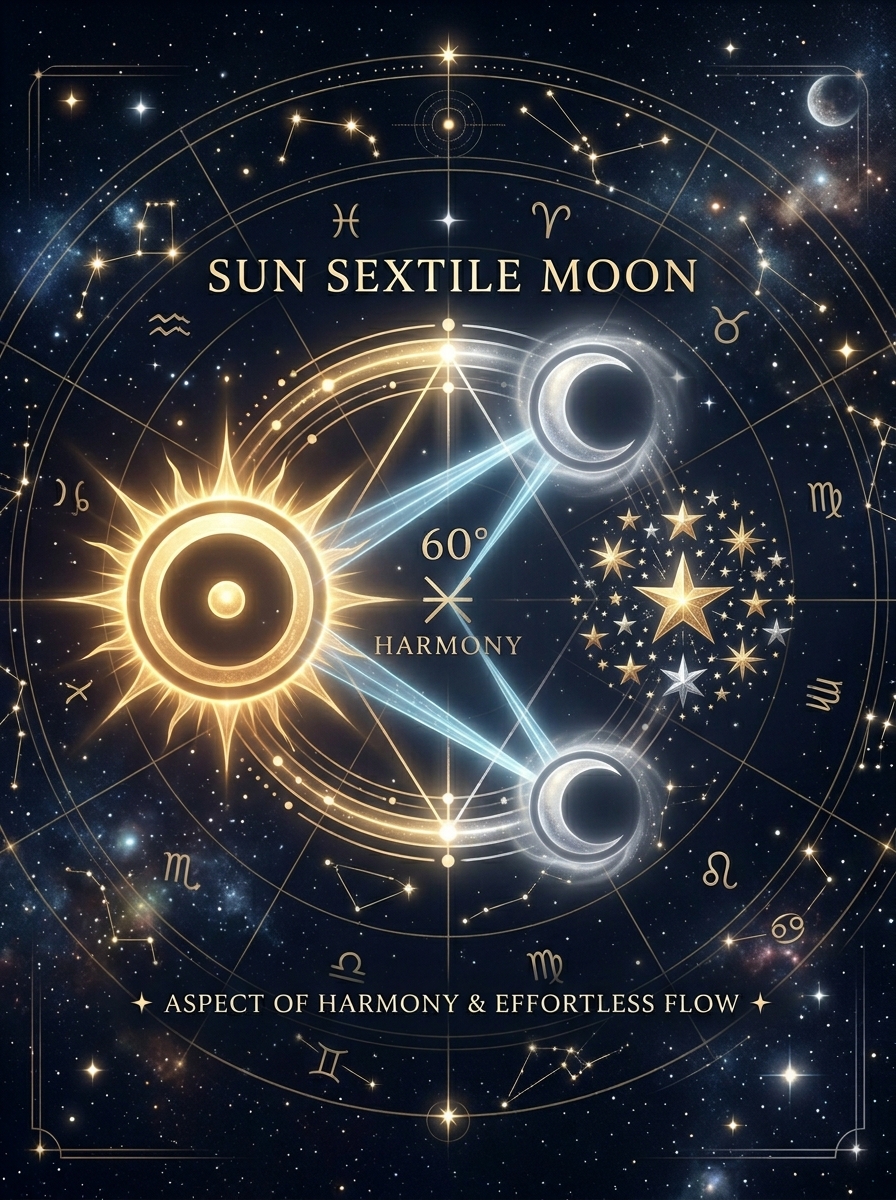
The Sun sextile Moon is a natal aspect of usable peace. The conscious will and the instinctive life are not identical, but they have a working relationship. Where a square forces growth through pressure, and an opposition demands negotiation across a divide, the sextile offers a natural channel between identity and feeling. The Sun can act without repeatedly betraying the Moon; the Moon can respond without needing to sabotage the Sun. This is why many people with this aspect come across as composed — not because life is easy, but because their inner weather is less likely to turn into civil war.
The core thesis is simple: this aspect makes integration available. It does not guarantee maturity, but it reduces the cost of becoming oneself. The psyche can inhale and exhale in the same rhythm. That is not a small advantage. For a fuller look at the geometry at work, the astrology of the sextile aspect explains why it functions as a bridge between distinct energies rather than a battleground.
The Architecture of Inner Accord
A sextile is an aspect of opportunity, not compulsion. The Sun wants coherence, agency, and a life lived from the center outward. The Moon wants rhythm, belonging, and felt safety. In hard aspect, those drives can feel like rival governments. In Sun sextile Moon, they are more like adjacent ministries with a working memo system. The motivations of the native are legible to themselves. They usually know why they are doing what they are doing, and their emotions often support rather than obscure that knowledge. They can choose a direction without immediately feeling exiled from their own heart.
This is one reason the sextile differs so sharply from the more delicate semi-sextile. The semi-sextile asks for subtle adaptation at the edges — a constant fine-tuning between planets that do not naturally share a language. The sextile, by contrast, offers easy circulation through the center. If you want to feel the difference in practice, the semi-sextile aspect in astrology describes a psyche that must learn cooperation through repeated minor adjustments rather than innate compatibility.
The emotional tone of the Sun sextile Moon is settling rather than thrilling. Others may trust the native quickly because they seem internally consistent. Even when private, they rarely feel incoherent. Their feelings may be deep, but they are less likely to be theatrical for the sake of discharge. The Moon is not muzzled here; it is integrated enough to be useful.
How the Psyche Uses the Bridge
The lived expression appears in timing, judgment, and recovery. People with this aspect often know how to pick up the thread after disruption. They can be the person in a room who senses what is needed and then does it without fanfare. That is not glamour; it is functional intelligence. The chart often belongs to someone who can translate feeling into action with unusually little friction.
The deeper gift is coordination. The native can build a life whose outer structures do not betray the inner climate. Many charts succeed in one realm by sacrificing another; Sun sextile Moon tends to dislike that bargain. This is why such natives frequently have a talent for environments where competence and care must coexist — they are not necessarily flashy, but they can hold both the spreadsheet and the mood in the room.
There is a resonance here with the tarot pair of The Moon and The Sun, which describes a passage from obscurity into clarity without denying the value of the dream world left behind. Sun sextile Moon lives in that same register: clarity that does not kill sensitivity.
The gist in practice
- emotional realism without cynicism
- self-respect without brittle egoism
- responsiveness without reactivity
- steadiness under pressure
- the ability to make personal choices that still feel humane
These are not automatic; they are the result of using the channel the aspect provides. The native must still choose to act on what the sextile offers.
The Shadow of Ease
Every benefic aspect has a shadow, and here it is complacency. A person with Sun sextile Moon may assume harmony is automatic and therefore postpone difficult self-inquiry. They can become too quick to reconcile, too eager to smooth over the tension that would actually reveal what they want. In extreme cases, the person develops a charming diplomacy that keeps life pleasant while postponing essential conflict.
There is also the possibility of emotional habit. Because the inner exchange is relatively easy, the native may not notice when they have begun living from convention rather than desire. The psyche has less incentive to stage a rebellion. That means the person may need conscious provocation from life — travel, challenge, creativity, intimacy, or honest solitude — to discover what lies beyond their default coherence.
Compare this with a more conflicted pairing, such as Gemini Sun, Capricorn Moon, where thought and feeling must negotiate across a formal boundary. The tension there forces growth through friction. The Sun sextile Moon native must learn to grow through consent rather than crisis. That is easier in the short term but risks stagnation in the long term if the person never tests the limits of their own ease.
Where the Accord Becomes Visible
The sextile is never abstract. Its flavor depends on the signs and houses of the luminaries. A Cancer Sun sextile Taurus Moon produces emotional containment and practical caretaking; an Aquarius Sun sextile Aries Moon yields initiative, wit, and social momentum. The aspect supplies the bridge; the signs determine what crosses it.
In houses, the sextile shows where the inner accord becomes visible in daily life. If the Sun and Moon are sextile across career and family houses, the person may find that vocation and private life reinforce one another. If they span friendship and intimacy houses, the native becomes skilled at making belonging portable. If they land in houses of service and authority, the person may become a natural manager of people and processes.
A concrete example of how a different aspect changes the temperament: contrast the ease of Sun sextile Moon with the opposition in Leo Sun, Aquarius Moon. In that opposition, self-expression and collective needs feel like public tension; with a sextile, those same needs would alternate fluently rather than clash. The aspect reshapes the entire psychological landscape.
The life applications (briefly)
In relationships, the native offers emotional presence without overidentification. They can be there for another without losing themselves. In work, they show reliable follow-through — they finish what they start because the inner weather supports consistency. In family dynamics, they often become the stabilizers, the ones who can speak to more than one side without collapsing into either. These are not separate sections requiring re-explanation of the dynamic; they are concrete expressions of the same coordinated psyche.
Growing the Gift
The most important thing to understand about Sun sextile Moon is that it does not do the work for you. It offers a channel, not a finished bridge. Some people with this aspect become skillful because they use the ease. Others become stagnant because they mistake ease for completion. The difference is activation.
A sextile often needs a conscious act of use. That can mean saying the thing that keeps the peace honest instead of merely polished. It can mean choosing a path that respects both ambition and emotional truth. It can mean refusing the false prestige of inner division — the idea that real depth must be painful to count. This is simply not true. Some of the deepest forms of maturity are quiet, iterative, and structurally graceful.
This aspect tends to improve with age if the person learns not to over-rely on inertia. Young people may experience the aspect as natural charm or emotional intelligence; later in life, it can become wisdom. The reason is simple: the more a person tests life, the more they see that the self does not have to be at war with itself to be serious. There is often something quietly solar-lunar about aging itself — the Sun clarifies identity while the Moon deepens memory, and a sextile helps those processes remain cooperative. The native may become more themselves over time, not less.
For those studying aspect dynamics further, the semi-sextile offers a useful contrast in how it demands a different kind of integration — more frictional, less innate. The semi-sextile meaning and evolution explores that path. And pairing this aspect with a specific sign combination like Pisces Sun, Capricorn Moon shows how even a sextile can be tested when the elements are earth and water — the accord becomes practical mysticism.
The sign that the aspect is working
You know this aspect is functioning well when the person can make choices that feel both true and livable. Not impulsive, not dutiful in a deadened sense — just congruent. They tend to know when to push and when to yield. They can feel without drowning, act without hardening, and commit without self-betrayal. That is not a small achievement; it is the architecture of a decent life.
The long-term promise of Sun sextile Moon is a temperament that can keep faith with itself. The person is often able to move through relationships, work, and private evolution without the chronic sensation of being split in two. When stressed, they may still seek peace too quickly. When mature, they become a model of congruence: not perfect, not static, but reliable in the deepest sense.
This is the aspect of someone who can build a life that actually holds their soul. The heavens do not only show us exceptional intensity; they also show us the forms of coherence that make a human life sustainable. Sun sextile Moon belongs to that latter category: a quiet treaty between the sovereign and the receptive, the visible self and the private one, the thing done and the thing felt. Used well, it produces people who can be both warm and effective, both self-directed and relationally intelligent. It is the aspect of inner citizenship — of a psyche that, more often than not, manages to govern itself without tyranny.
Comments
Loading comments…