Lepidolite Meaning: Calm, Boundaries, and the Alchemy of Nervous Exhaustion
The core dynamic: regulated surrender
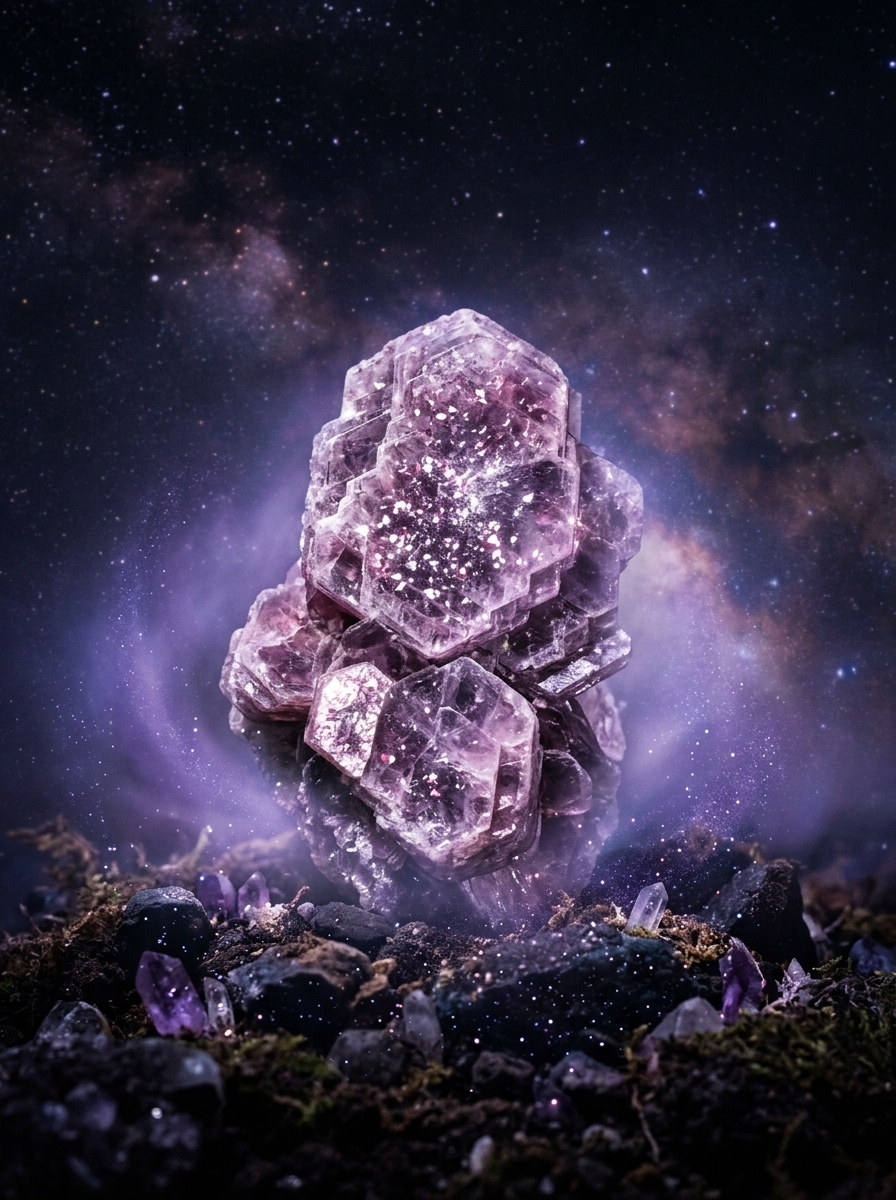
Lepidolite is not a stone that promises transcendence. It promises decongestion. Its metaphysical signature is nervous-system relief so precise that clear sight becomes possible again—not by dulling perception, but by lowering the internal volume that keeps drowning it out. Mineralogically, lepidolite is a lithium-bearing mica, and that chemistry underwrites its reputation as a soothing agent. Metaphysically, the stone feels like a boundary you can trust: soft in texture, strong in function.
The central thesis of lepidolite meaning is that equilibrium comes through gentle separation, the way moonlight separates objects without altering them. The stone does not ask you to abandon your feelings; it asks you to stop gripping every branch on the way down. That distinction matters because many calming crystals operate as numbing agents. Lepidolite does not numb. It restores enough distance to see where attachment has become fusion, and where vigilance has replaced love.
This makes lepidolite especially useful when life is overdetermined—when the mind has more data than it can process, the heart more charge than it can hold. The stone’s presence is a hand on the shoulder at the exact moment you are about to spiral. It favors stabilization, not escape. In that sense it pairs naturally with the psychological work of individuation, the slow move from unconscious merging to deliberate selfhood. That arc is also the domain of the North Node, which maps where the soul is being asked to grow rather than repeat.
The psychological interrupt: from rumination to boundary
Where lepidolite does its deepest work is in the gap between sensation and panic. Most anxiety is not a response to the present moment but a feedback loop in which the mind rehearses catastrophe so often that the body begins to live there. Lepidolite interrupts that loop. It does not erase the concern; it prevents concern from becoming a closed system. The stone’s effect is often described as “anti-rumination,” and that is accurate as far as it goes. More precisely, lepidolite helps the user notice thought as thought rather than thought as fate. That is a profound shift, and it is the psychological root of the stone’s reputation for calming overthinking, insomnia, and emotional reactivity.
Rumination and the third eye
The third eye chakra is the seat of pattern recognition, but when the mind is inflamed, pattern recognition turns into paranoid forecasting. Lepidolite placed at the third eye quiets the noise so that intuition can distinguish itself from anxiety. The stone does not make the mind blank; it makes the mind available. Practitioners report that meditation with lepidolite feels less like entering silence and more like discovering that the silence was already there, underneath the chatter.
Boundaries and the heart
For the heart chakra, lepidolite offers a different kind of relief. Many people who are prone to people-pleasing, codependency, or emotional caretaking have learned that boundaries feel like cruelty. Lepidolite supports boundaries that are compassionate rather than punitive. It helps a person recognize that they can be kind without absorbing everything. This is why the stone is so often used in grief work and recovery from chronic stress: it allows the heart to remain open without over-identifying with the suffering it encounters. The stone’s lesson is that you can feel deeply and still hold your shape.
The psychological work lepidolite enables is essentially the work of individuation—separating from unconscious fusion with others, from inherited emotional patterns, from the stories that no longer fit. That developmental pressure is also visible in the astrological Sun sign, which describes the ego’s journey toward a center that can genuinely hold experience. Lepidolite is what steadies that center when the journey becomes turbulent.
Symbolic anatomy: chakras and zodiac
Lepidolite maps onto the symbolic body in ways that clarify its function. It is most commonly associated with the third eye, crown, and heart chakras—a triad that bridges perception, trust, and compassion. Each placement reveals a different facet of the stone’s medicine.
Chakra correspondences
At the third eye, lepidolite quiets mental static so that intuitive sight can emerge. This is not about fantasy; it is about pattern recognition informed by inner stillness. At the crown chakra, the stone supports surrender to a larger order, especially when control has already failed. Surrender here does not mean passivity; it means recognizing that some forms of healing require trust before action. At the heart chakra, lepidolite helps release emotional armor that was once necessary but has become burdensome. Together, these placements create a circuit: the mind stops gripping, the heart softens, and the spirit opens to guidance.
Zodiac resonance
In zodiacal terms, Lepidolite resonates most strongly with Libra and Pisces, and to a lesser extent Aquarius. Libra’s connection is obvious: the stone is a balancer, restoring proportion where the scales have tipped toward over-accommodation or indecision. Pisces, the sign of porous boundaries and deep sensitivity, finds in lepidolite a filtration system that does not require emotional shutdown. Aquarius resonance emerges from the stone’s capacity for cool, humane perspective—the ability to step back from emotional entanglement and see the larger pattern.
These associations are not merely decorative. They anchor the stone’s meaning within the broader symbolic framework of the zodiac, where each sign represents a distinct way of organizing experience. If you are working with lepidolite to support Libra’s need for relational harmony or Pisces’ need for energetic hygiene, you are using the stone in alignment with its deepest signature.
Working with lepidolite: precision and placement
Because lepidolite is a regulator rather than a spectacle, its best use is consistent and understated. The stone responds well to intention-setting that is specific without being forced. You do not need elaborate ritual; you need placement and repetition.
Meditation and sleep
In meditation, hold lepidolite in the receiving hand or rest it near the crown or third eye. Use it when your practice is being interrupted by planning, dread, or self-monitoring. The stone can serve as a tactile cue to return from mental narration to immediate presence. If you work with breath awareness, lepidolite helps you stay with the exhale—the body’s own signal of release.
For sleep, keep the stone close but not demanding: a bedside table, a dresser, a windowsill. The point is not proximity alone but the message the stone carries into the room: the day is over, and vigilance can stand down. Many practitioners place a piece under the pillow or in the bedding to ease the transition into rest, especially during periods of insomnia driven by emotional strain.
Rituals for boundaries and transition
Because lepidolite is fundamentally a boundary stone, it responds well to intentional rituals around limits. Cleanse it briefly with smoke or moonlight, hold it, and name one place in your life where you are overextended. Then state a boundary in the present tense: “I return what is not mine,” or “My attention belongs to me.” The stone’s energy supports the follow-through, not as a demand but as a practice.
This makes lepidolite especially potent during life transitions—leaving a job, ending a relationship pattern, stepping away from an identity that has become too tight. Its effect is subtle, like the sextile aspect in astrology: supportive rather than confrontational, a gentle activation of latent potential rather than a crisis. If you are navigating multiple intense themes at once, the stellium page offers insight into why certain life areas feel louder than others—and why a stone like lepidolite can be the steadying influence that keeps you from burning out.
Care and pairing
Lepidolite is a soft stone; it can chip or flake with rough handling. Cleanse it with smoke, sound, or moonlight rather than water. This gentleness is appropriate—the stone does not ask to be wrestled into usefulness. Pair it with other calming or clarifying allies such as amethyst, rose quartz, or clear quartz in layouts, grids, or desk talismans. The combination reinforces the same message: you can be present without being inflamed.
In the end, lepidolite meaning is not about becoming less alive. It is about becoming less inflamed—the capacity to stay present when the mind wants to scatter, to feel without flooding, and to choose a boundary without hardening the heart. That is a different kind of power, and it is the one this stone quietly offers.
Related
- Howlite Meaning & Healing Properties: The Stone of Quiet Authority
- Prehnite Meaning & Healing Properties: The Stone of Quiet Knowing
- Labradorite Meaning: The Stone of Hidden Fire and Clear Sight
- Angelite Meaning & Healing Properties: The Stone of Clear Communion
- Peridot Meaning: The Green Fire of Renewal
Comments
Loading comments…