Howlite Meaning & Healing Properties: The Stone of Quiet Authority
Howlite’s core dynamic: coherence over sedation
Howlite does not numb. The most frequent mistake in metaphysical writing is to call it a “calming stone” and leave the description there, as if stillness were a single flavor. In fact, Howlite’s signature is a particular kind of mental coherence—the capacity to hold emotion without being flooded by it, to think while feeling, to pause before speaking. It is the mineral analogue of quiet authority: the authority that does not need to raise its voice because it has already clarified what matters.
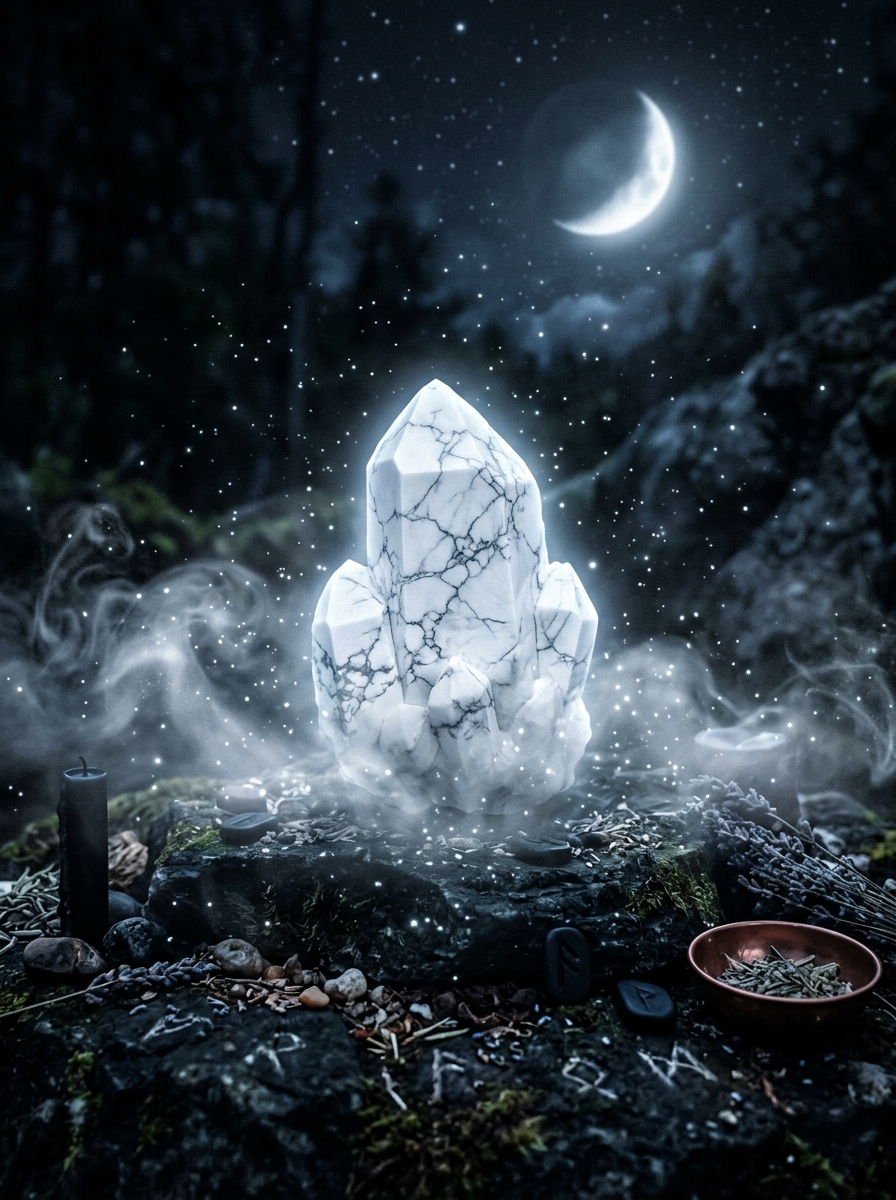
The stone’s chalk-white body, veined with gray like thought tracing itself across a blank page, mirrors this function. It gives form to diffuse mental energy. In metaphysical terms, Howlite is a boundary made of softness: it does not harden the heart but prevents it from being overwhelmed. This is why it resonates so naturally with the symbolic grammar of the zodiac—each sign is a different way of organizing consciousness, and Howlite helps any temperament become less reactive, more readable to itself. The core thesis is simple: Howlite is for people who need to hear their own thoughts without being bullied by them.
How it works on the nervous system and psyche
The healing reputation of Howlite begins where agitation lives. Crystal healers reach for it with stress, insomnia, irritability, and the kind of mental looping that replays unfinished conversations long after the room is empty. But its mechanism is not suppression. It lowers internal volume until what remains can be addressed directly. This makes it especially precise for people who intellectualize distress—who spiral into analysis because feeling seems more dangerous than thinking. Howlite supports a different sequence: sensation, naming, response.
In Jungian terms, the stone encourages contact with what has been split off from awareness without dramatizing the encounter. It is an ally for shadow work when the shadow is not dramatic darkness but ordinary depletion: resentment, impatience, the fatigue of overcontrol. Because it works by making the inner world coherent rather than quiet, Howlite acts as a sextile in mineral form—an aspect that does not force change but makes it available through cooperation, not crisis. For the astrological logic behind such supportive activation, the sextile aspect explains how latent potential becomes usable when the conditions are right.
Emotional patterning and impulse control
Anger that has nowhere clean to go—not explosive rage but chronic irritation, defensive speech, the sensation of being internally jostled—finds a counter in Howlite. The stone cools impulsivity, which is why it often appears in practices aimed at breaking reactive habits. It is especially fitting when a person is trying to pause before answering, or to stop carrying yesterday’s tension into today’s conversation. This is not repression; it is the creation of a gap between stimulus and response, and in that gap, judgment becomes possible.
Maturation versus shadow: when Howlite becomes useful
The shadow side of Howlite is not a danger of its own but a misuse: using it to avoid feeling altogether. Because its energy is so cool and clarifying, a person can mistake detachment for wisdom. The stone does not reward numbness; it rewards clarity. Maturation with Howlite means learning to sit with discomfort long enough to understand its shape. The shadow version reaches for the stone to shut down emotion entirely, treating the mineral as an anesthetic rather than a lens.
This distinction mirrors the difference between a North Node trajectory and a Saturnian freeze. The North Node describes growth through development—moving toward what stretches us. Howlite, when used maturely, supports that stretch by keeping the nervous system from overwhelming the psyche. It does not make the difficult path easy; it makes it walkable. The shadow version uses the stone to stay small, to avoid the friction that growth requires. The test is simple: if Howlite helps you act with more honesty and less haste, it is serving its mature function. If it helps you withdraw into a false peace, it is being misused.
Rest, sleep, and the threshold of surrender
Insomnia that is mental rather than physical—the mind that becomes more articulate after midnight—is one of Howlite’s most specific targets. Metaphysically, the stone guards the threshold between waking control and dream-time surrender. It does not sedate; it keeps the mind from trespassing all night on its own unfinished business. Placed on the nightstand or under the pillow, Howlite tells the psyche: You have thought enough. Now let the body do its work.
How it plays out in a life: study, speech, boundaries
Because Howlite’s energy is subtle, it is best met with consistency rather than theatrical ritual. The stone rewards intention. Carry it when you need to stay measured in emotionally charged settings—a difficult meeting, a family gathering, a conversation where you want to listen more than you want to win. Hold it in the nondominant hand while breathing slowly and naming what you are actually feeling, not what you think you should feel. That simple practice trains the psyche to register sensation before interpretation, which is the foundation of emotional literacy.
Howlite is unusually good for situations that require clean language. If you tend to speak before you know what you mean, keep the stone nearby when writing emails, preparing for hard conversations, or studying. It supports the pause between stimulus and response. This makes it especially valuable in workplaces, classrooms, and family systems where emotional heat is mistaken for truth. The stone can be placed at the boundary of spaces—on a nightstand, beside a notebook, in a pocket during travel—as a physical reminder that not every signal deserves immediate participation.
Practical pairings with other practices
Howlite pairs naturally with meditation, breath counting, journaling, and any ritual that needs less intensity and more consistency. It also complements structured astrological work. If you are examining a stellium, for example—a concentration of planets in one house or sign—the stone can help distinguish concentrated psychic energy from mental congestion. The stellium can feel like brilliance or burden depending on whether the person has enough inner room to metabolize it. Howlite creates a little more room.
For readers who use tarot, Howlite resonates most cleanly with cards that emphasize discipline, clarity, and mastery over impulse. It feels at home beside the symbolic territory of The Emperor and The Sun—one card governing structure and sovereignty, the other radiant selfhood. The Emperor and The Sun together ask the person to inhabit both authority and vitality without sacrificing either. Howlite helps the self remain composed enough to do that.
Chakra and zodiac associations: where Howlite fits in the symbolic body
Howlite is most commonly associated with the crown chakra and, secondarily, the third eye. The crown governs connection to something larger than the personal ego; Howlite supports that opening by reducing inner noise. It does not force transcendence; it makes room for it. If the crown is a receiving dish, Howlite clears the surface. The third-eye correspondence is for discernment, not vision—it helps distinguish intuition from panic and insight from compulsion.
Howlite has no traditional astrological rulership, but it resonates strongly with three signs by temperament. Virgo values order and refinement; Howlite assists the sorting of mental clutter. Gemini thrives on information but can become scattered; Howlite lends a thread of coherence. Aquarius seeks perspective and cool intelligence; Howlite matches that detached clarity without becoming emotionally vacant. The Sun sign describes the conscious core that may need calming or containment; Howlite can be especially helpful when a person’s solar style is overextended—too much output, too little containment. It does not change who you are; it helps your nature become usable.
Planetary resonances: Moon and Saturn
The stone is sometimes linked with the Moon for its reflective, cooling quality, and with Saturn because it teaches patience, discipline, and measure. That pairing is telling. Moon energy needs holding; Saturn energy needs gentleness. Howlite sits between them like a white bridge. It helps feeling become contained enough to be understood and structure become soft enough to be lived inside. This balance also makes it useful in readings that involve responsibility without burnout. For the larger map of where such discipline surfaces in life, the astrological houses show the arenas—work, relationship, home, the hidden interior—where Howlite’s quiet authority can be most felt.
Related
- Celestite Meaning & Healing Properties
- Prehnite Meaning & Healing Properties: The Stone of Quiet Knowing
- Amethyst Meaning & Healing Properties: Clear Mind, Quiet Spirit
- Amazonite Meaning & Healing Properties: The Stone of Clear Boundaries
- Lepidolite Meaning: Calm, Boundaries, and the Alchemy of Nervous Exhaustion
Comments
Loading comments…