Labradorite Meaning: The Stone of Hidden Fire and Clear Sight
The core dynamic of labradorite
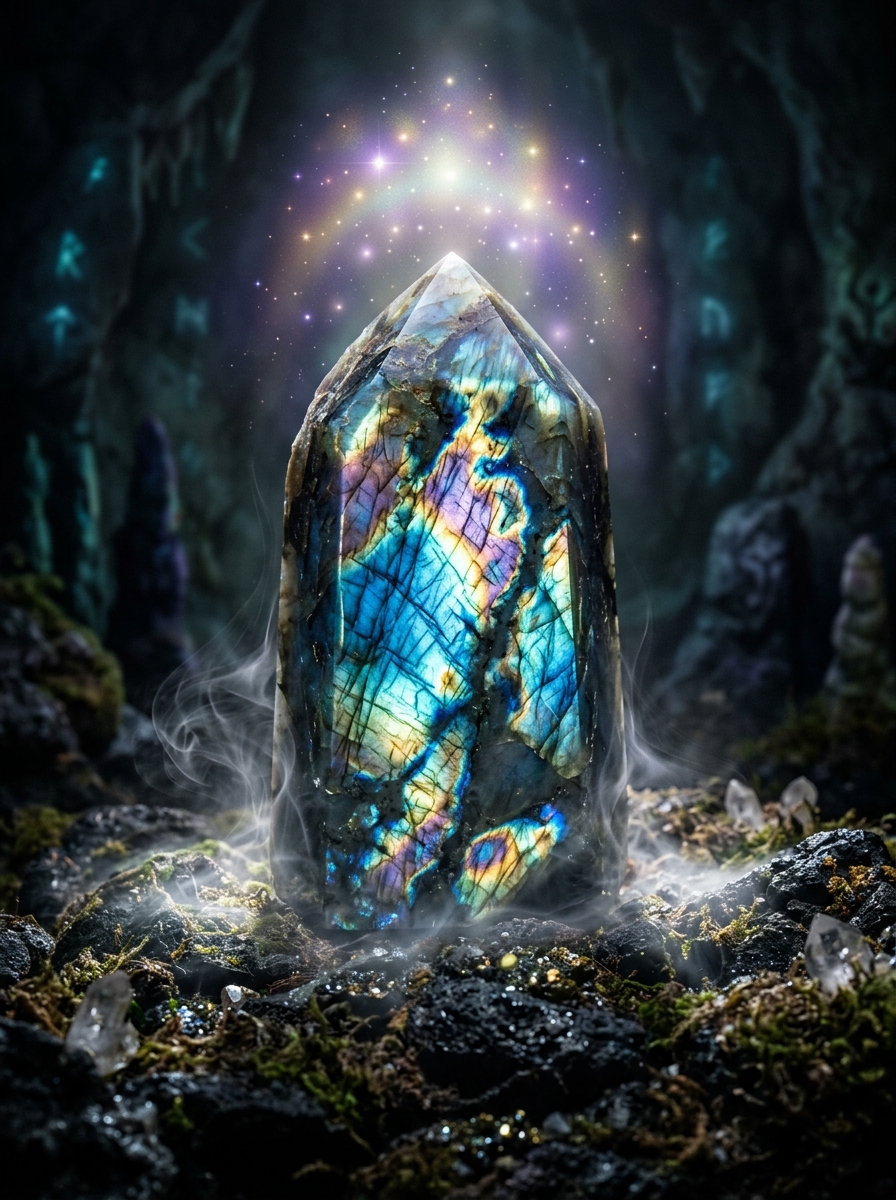
Labradorite is a stone of threshold awareness: it helps you sense what is forming before it is visible, and it strengthens the self that can tolerate not knowing. Its shimmer—the blue, green, gold, or violet flash called labradorescence—is not mere decoration but the mineral expression of liminality itself. Light caught between layers, perception changing as you move. In metaphysical terms, that makes labradorite meaning inseparable from intuition, psychic discrimination, and the courage to cross from one version of the self into another without losing coherence.
This is why labradorite is often called a “stone of magic,” though that phrase becomes useful only when read psychologically. Magic here is not escapism; it is the capacity to notice pattern, timing, signal, and symbol. The stone does not replace judgment—it sharpens it. If moonstone is the soft witness and obsidian the hard boundary, labradorite is the lucid intermediary: reflective, mobile, and difficult to fool.
The stone’s most recognizable visual effect mirrors its symbolic function. Labradorescence appears only when light strikes at the right angle, making labradorite a natural emblem for hidden capacities that emerge under pressure, attention, or transition. In that sense, it belongs with the astrology of becoming: the moment when latent potential is activated not by force but by alignment—the same kind of movement explored in the sextile aspect, where opportunity becomes available if you can respond to it.
How labradorite forms its effect: the psychological and energetic mechanism
Labradorite is prized for shielding the sensitive mind without numbing it. That distinction matters. Some protective stones feel like a closed door; labradorite feels more like intelligent permeability. It is used when a person needs discernment around other people’s moods, demands, projections, or drama—especially if they habitually absorb what is not theirs. For empaths, healers, readers, and anyone doing emotionally porous work, the stone can function as a boundary with memory: it reminds you that awareness does not require absorption.
Psychic protection without psychic numbing
The protective quality of labradorite is subtle and responsive. It does not create a force field; it creates a sorting function. When you hold it while naming what is yours and what is not, the practice becomes psychological as well as metaphysical. This is why the stone is often paired with ritual, journaling, or meditation rather than treated as a talisman that works in isolation. Its support is contextual—it helps you stay open to what matters and closed to what drains, a distinction that cannot be automated.
The threshold mind and dream life
Labradorite is strongly associated with intuition because it favors the in-between state: twilight, hypnagogia, meditation, trance, and the fertile edge of sleep. If amethyst often stabilizes spiritual consciousness, labradorite opens the corridor through which symbols arrive. It is useful for dream recall, symbolic interpretation, and any practice that relies on subtle pattern registration before language catches up.
From a Jungian angle, the stone belongs to the psyche’s imaginal faculty: the part of the mind that speaks in image, gesture, and mood before it speaks in conclusions. If you are doing shadow work, creative incubation, or oracle reading, labradorite helps you remain receptive without becoming flooded. It does not create clairvoyance out of nowhere; it makes room for the material already trying to surface. For readers who like to situate a stone inside a broader symbolic framework, the logic resembles the Sun in a chart—not in the sense that labradorite is solar, but because it can support individuation by helping the core self remain visible amid psychic weather. That relationship is worth exploring alongside Sun sign meaning and the deeper journey of the solar center.
The energetic support during identity revision
On the emotional level, labradorite is valued for calming scattered attention and helping the nervous system reorient after overstimulation. It is not usually described as a heart stone in the rosy, sentimental sense; its gift is cooler and more exacting. It steadies the person who has become overidentified with external noise. Many practitioners use labradorite during transitions that require identity revision—career changes, endings, spiritual initiation, relocation, or the recovery of creative confidence after depletion. When life becomes unfamiliar, the ego often overcompensates by clinging to old definitions. Labradorite encourages flexibility without collapse. It helps the psyche say, “I do not yet know who I am becoming, but I can remain present to the process.” This pull toward unfamiliar growth is precisely what the North Node describes: both the node and the stone orient you toward what is spiritually necessary but not yet comfortable.
When labradorite matures and when it goes shadow
Used well, labradorite refines intuition into discernment. It does not inflate the ego with a sense of special access; instead, it demands accountability. You must parse your own projections from genuine pattern recognition. The mature use of labradorite involves humility—accepting that not every flash of insight is accurate, and that the stone’s gift is to make you more aware, not more certain.
The shadow side of labradorite appears when it is used as a substitute for grounded action or relational integrity. Because it amplifies the sense of being “in the know,” a person can mistake subjective feeling for objective truth, or use the stone to avoid hard conversations by claiming they “already know” what someone else feels. This is spiritual bypass—the stone becomes a seduction rather than a tool of clarity. The antidote is to pair labradorite with practices that keep it accountable: journaling what you perceive and checking it against real-world feedback, or using it alongside the disciplined center of The Emperor and The Sun, where structure and radiance must cooperate rather than dominate one another.
How labradorite plays out in a life: love, work, and creative practice
One of the most common questions about labradorite is how it actually shows up in daily experience. Because its core dynamic is about noticing rather than performing, its applications are varied but follow a consistent logic: it helps you hold your own signal while navigating other people’s weather.
In relationships and creative work
In romantic or close relationships, labradorite is useful for empaths who tend to lose themselves in a partner’s emotional state. It does not counsel detachment; it supports the ability to stay present without merging. When you wear or hold it during difficult conversations, it can help you distinguish between compassion and complicity, between understanding another’s pain and carrying it. In creative work, labradorite is ideal during the incubation phase—when you have fragments of an idea but no form yet. Place it near drafts, sketches, or a vision board when you are trying to move from scattered impressions to coherent expression. Its usefulness lies in transition: it helps a half-seen thing become legible.
In career and discernment
For therapists, readers, teachers, managers, and any professional who holds space for others, labradorite is a practical tool for maintaining energetic boundaries while staying present. Wearing it near the throat or chest during sessions can remind you that your job is to witness, not to absorb. In decision-making, the stone favors the kind of knowing that comes from pattern recognition rather than linear analysis—useful when you are choosing between options that look equally good on paper. The astrological houses describe the arenas where such discernment plays out; labradorite often shows up wherever inner knowing must enter visible action.
The link to zodiac resonance
Labradorite is especially resonant with Leo, Scorpio, Sagittarius, and Aquarius, though no sign “owns” it. Leo connects through sovereignty and the radiance of the authentic self; Scorpio through depth and transformation; Sagittarius through vision and meaning; Aquarius through pattern and future orientation. These correspondences are useful because they describe how the stone operates, not just who likes it. If you want a broader framework for sign symbolism, the zodiac mechanics page can help situate those affinities. The stone also pairs with the stellium astrology dynamic—when multiple planets converge in one sign, the need for discernment and integration becomes acute, and labradorite can support the sorting function.
How to use labradorite in real practice
Wear it when you need discernment in motion
Labradorite is especially effective as jewelry because its magic is contextual. A ring, pendant, or bracelet keeps the stone in the field of ordinary life, where discernment is actually tested: in meetings, transit, social settings, and family dynamics. Wearing labradorite can be useful if you need to remain open without becoming impressionable. If you wear it on the upper body, many people prefer it near the throat or heart line so its presence feels immediate when conversation or emotional complexity begins to build.
Use it in meditation and creative incubation
In meditation, labradorite works best with a question, not a vague hope. Ask what pattern is repeating, what perception you have avoided, or what boundary needs reinforcement. Then sit with the stone and let images come without forcing them into meaning too quickly. For creative work, keep it near your workspace when you are trying to move from scattered impressions to coherent form. The stone’s energy is subtle and responsive; it rewards patience and intention.
Cleanse, charge, and place with intention
Labradorite benefits from regular clearing because its use is often energetic and relational. Smoke, sound, moonlight, or a short resting period away from active spaces are all appropriate. Avoid harsh treatment; the stone’s surface and internal structure deserve care. Placement matters: keep it near your desk when you need focus with permeability, near your bedside when dreams are active, or near an entryway if you want a symbolic boundary between the inner world and outside demands. The broader principle is simple: labradorite works best when asked to help you notice, not when asked to perform. It supports the kind of consciousness that can move from intuition to action without losing the thread. If the psyche is a map of potentials, this stone is a reminder that the right path often appears only when you are already paying attention.
Related
- Topaz Meaning & Healing Properties: Clarity, Fire, and Steady Power
- Smoky Quartz Meaning: Grounding, Protection, and Clear Sight
- Lepidolite Meaning: Calm, Boundaries, and the Alchemy of Nervous Exhaustion
- Amazonite Meaning & Healing Properties: The Stone of Clear Boundaries
- Howlite Meaning & Healing Properties: The Stone of Quiet Authority
- Fluorite Meaning & Healing Properties: The Crystal of Clear Thought
Comments
Loading comments…