Prehnite Meaning & Healing Properties: The Stone of Quiet Knowing
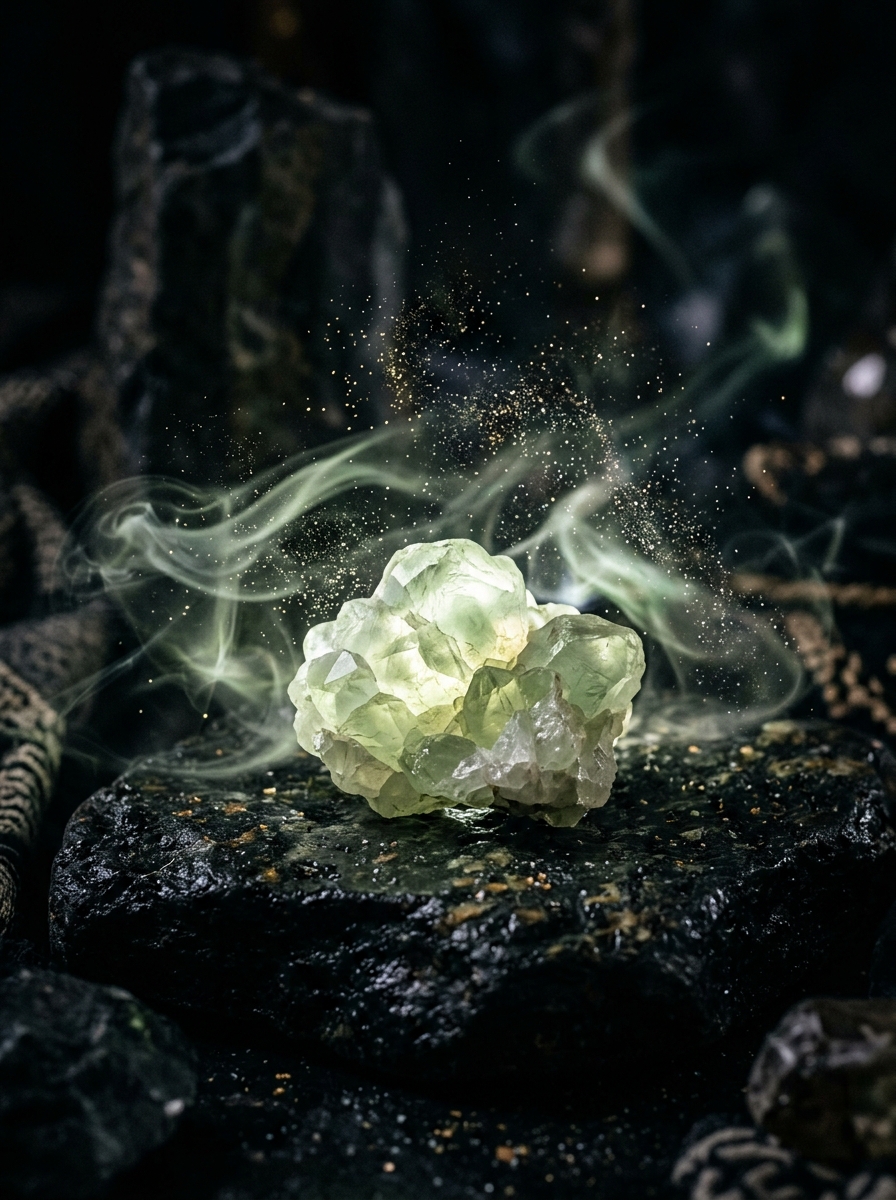
Prehnite is the stone that knows before words
Prehnite is not a stone of dramatic intervention. Its color—pale, translucent green, sometimes shot through with white or yellow—suggests something held back, something that waits. And that is the first thing to understand about it: prehnite’s meaning is tied to a quiet form of knowledge that arrives ahead of conscious thought. It is the crystal that helps you sense what is true before you can prove it, and what is false before you have to suffer through it.
In the language of symbolic astrology, prehnite behaves like a coherent Sun—not the loud, performative version of the solar self, but the version that has integrated its will with its heart. It offers the kind of self-possession that does not need to announce itself. If you are working with the Sun sign as a symbol of individuation, prehnite is the companion that helps you inhabit that center without inflation. It makes the ego usable rather than ornamental.
This stone is often called “protective,” but that label misses the nuance. Prehnite does not build a wall; it builds a filter. It separates what belongs to you from what belongs to the room, the conversation, the other person’s mood. That is why it is especially valuable for empaths, healers, and anyone who leaves social spaces feeling overstuffed with psychic residue. Prehnite does not push the world away—it helps you stop mistaking the world for yourself.
Its emotional work is sorting, not soothing
The real function of emotional healing
When people reach for prehnite emotionally, they are usually not trying to feel better. They are trying to feel more clearly. The stone’s emotional healing property is not catharsis in the theatrical sense; it is an editing of the inner landscape. Think of it as a stone that addresses the afterimage—the replay of an argument, the lingering weight of a tense room, the sense of having given away more attention than you meant to. Prehnite helps the psyche return to itself without dramatizing the process.
The key distinction is between clearing and numbing. Prehnite clears by helping you discriminate: What belongs to grief, what belongs to fatigue, what belongs to intuition, and what belongs to old conditioning? It supports the kind of sorting that makes healing possible. Without discrimination, emotional work can become a loop—same feelings, same interpretations, same conclusions. Prehnite introduces a pause. It asks, Is this yours?
This has a direct tie to the heart chakra, though not in the sentimental way the term often implies. The heart chakra, when healthy, does not dissolve boundaries; it discerns. Prehnite teaches the heart to remain open without leaking. It also engages the solar plexus chakra, especially for people who know what they need but struggle to act on it. A soft, over-accommodating heart needs the spine of the solar plexus to say a clean yes and a clean no. Prehnite bridges that gap.
How it supports the root of overfunctioning
Many people use prehnite when they realize they are carrying obligations, fears, or relational patterns that were never theirs to hold. The stone’s signature is that it makes this realization feel obvious rather than punishing. It does not ask you to fight your way out of a pattern; it helps you notice that the pattern is already exhausting itself. That is a gentler but more lasting form of change.
If you are exploring the zodiac as a map of inner tendencies, prehnite resonates with the refining impulse of Virgo, the balancing instinct of Libra, and the protective tenderness of Cancer. In Virgo, it becomes a tool for eliminating what is extraneous. In Libra, it supports relational fairness without self-erasure. In Cancer, it protects vulnerability by organizing it—not by walling it in. These resonances are not official rulerships, but they help explain why the stone can feel so different in different hands.
Spiritual intuition without the noise
Clean reception
Prehnite is often described as a stone of enhanced intuition, but that phrase usually conjures images of psychic fireworks—sudden downloads, vivid visions, dramatic signs. Prehnite’s intuition is subtler. It is pattern recognition: the sense that something fits together even when you cannot articulate why. It is the kind of knowing that arrives in a dream, a passing thought, or a quiet certainty that does not insist on itself.
In meditation, prehnite does not amplify; it clarifies. It reduces the static of the chattering mind so that the quieter signals can surface. That makes it an excellent stone for any practice that involves holding an open question—divination, reflective journaling, or simply sitting with an unresolved situation. The stone does not give answers. It helps the mind stop producing commentary long enough to hear the answer that is already there.
Astrological resonance with growth
This clarity makes prehnite a natural partner for the North Node, the point in a birth chart that marks the direction of soul growth. Where the North Node can feel abstract or intimidating—a future self you cannot yet inhabit—prehnite makes the edge feel accessible. It does not tell you your destiny. It helps you become quiet enough to sense which burdens are simply not part of the path.
Similarly, it resonates with the logic of a sextile: a gentle opening that rewards participation but does not force it. Prehnite does not pressure. It makes space for latent potential to activate through willing attention. If the sextile is the soft green light of encouragement, prehnite is the stone that keeps that light steady.
Working with prehnite as practice
In stillness and sleep
To use prehnite in meditation, hold it at the heart or rest it nearby while breathing slowly and asking one exact question: What am I carrying that is not mine? The precision of the question matters. Prehnite does not do well with vague emotional sprawl; it favors clean attention. If you sit long enough with the stone, you may notice that the answer arrives not as a thought but as a release—a subtle letting go in the chest or throat.
For dreamwork, place prehnite on the bedside table or slip it under a pillow if that feels comfortable. Its influence is often protective during sleep, but the deeper gift is discrimination: it helps the dreamer sense which dream-images are symbolic openings and which are simply residue. Not every dream is an instruction. Prehnite reduces the static so the real signal can register.
In the home and on the body
As a home stone, prehnite belongs in spaces where overstimulation collects: a desk, a reading nook, an entryway, a therapy room, a corner where arguments tend to linger. It does not clean the room in the dramatic sense of clearing crystals like selenite or black tourmaline. Instead, it introduces a soft order. If the room feels emotionally loud, prehnite acts as a gentle boundary—not a wall, but a reminder that the room’s energy does not have to become yours.
Worn as jewelry, prehnite is most effective near the chest or throat. Near the heart, it supports emotional regulation by reinforcing the heart’s job: to love without absorbing. Near the throat, it encourages speech that answers feeling rather than disguises it. The stone’s effect deepens when paired with a clear intention. This is not superstition; it is symbolic consistency. Symbolic consistency is how the psyche learns to cooperate.
For ritual work that involves pruning—cutting cords in a psychological sense, simplifying commitments, choosing one true engagement over several half-dead ones—prehnite is an excellent companion. It helps the process feel like clarification rather than loss. It is particularly useful for people who want to clean up the energetic architecture of their lives without turning the process into self-punishment.
Complementary correspondences
If you work with astrology or tarot alongside crystals, prehnite pairs well with archetypes that reinforce discernment through structure. The energy of a healthy stellium—a concentration of planets in one house or sign—can become overwhelming without a grounding principle. Prehnite provides that principle: it helps you work the concentration without drowning in it. It asks which of those concentrated energies are truly yours to develop now.
The symbolism of The Emperor and The Sun also resonates here: structure animated by vitality, authority that protects rather than dominates. Prehnite does not create that structure by itself, but it can support the psychic conditions that allow it to emerge. When the inner world is clear, the outer world becomes easier to organize.
The deeper lesson: boundaries are not coldness
The most accurate way to understand prehnite is not as a comfort stone, though it can be comforting, or as a protection stone, though it can protect. Its deepest teaching is that discernment is a compassionate act. To know what is not yours is not to become hard; it is to stop mistaking surplus for love.
This lesson is especially relevant in a culture that rewards saturation—more input, more emotional labor, more relational overfunctioning. Prehnite offers a different ethic: less volume, more accuracy. Less performance, more alignment. It does not ask you to become distant. It asks you to become present enough to know when you are full.
In the language of the astrological houses, prehnite mirrors the function of a well-integrated life: each arena has its proper scope, and when every part of life is doing every other part’s job, exhaustion is inevitable. Prehnite helps the psyche return to scale. For the person who keeps absorbing, it offers relief. For the person who keeps postponing, it offers focus. For the person who is spiritually hungry but mentally crowded, it offers a clean bowl.
That may be its most healing property of all: it makes room for what is real to arrive without having to fight through everything false first.
Comments
Loading comments…