Understanding the Stellium in Astrology: Meaning, Psychological Complexes, and Balancing the Axis
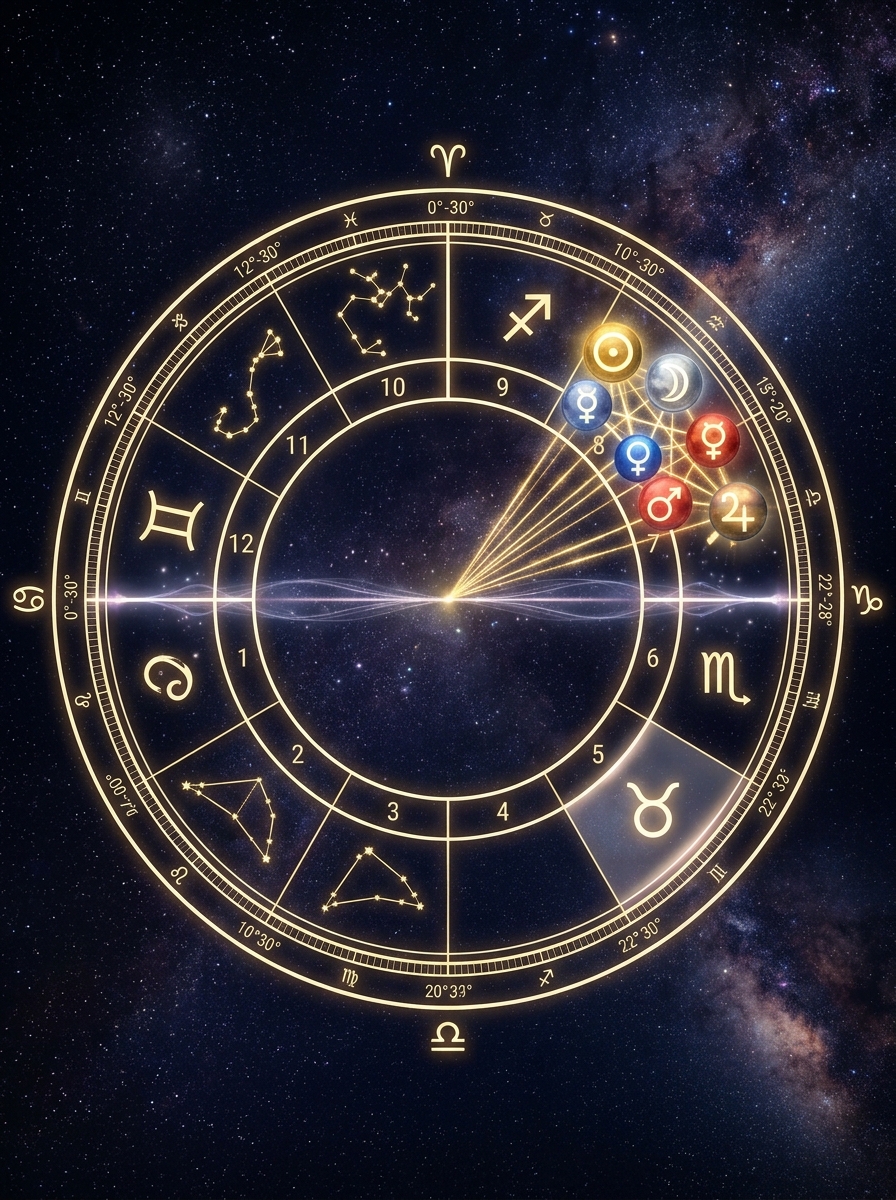
Understanding the Stellium: The Conclave of the Gods
When we look at a natal chart, we are looking at a map of the human psyche, symbolized by the positions of the heavens at the exact moment of our first breath. In most birth charts, the planets are distributed in a relatively balanced pattern, representing a diverse array of psychological needs, challenges, and arenas of life. However, occasionally we encounter a chart where three or more planets are grouped together in a single zodiac sign or astrological house. This configuration is known as a stellium. Historically referred to by some esoteric astrologers as a "Conclave of the Gods," a stellium functions as a super-conjunction—a high-concentration point of celestial energy that behaves like a psychological gravitational well or a highly focused laser beam.
The Anatomy of a Super-Conjunction
To grasp the mechanics of a stellium, we must first understand the nature of the astrological conjunction. A conjunction occurs when two planets are within a close orb of one another, blending their archetypal energies so thoroughly that it becomes difficult to separate them. In a stellium, this blending is magnified exponentially. With three, four, or sometimes even five or six planets gathered in the same sector of the zodiac, their individual boundaries dissolve. They are forced to operate as a single, massive psychological unit.
This is not a simple addition of forces; it is a chemical reaction. The planets within a stellium are constantly reacting to one another, feeding off each other's energies, and magnifying the expression of the sign or house they occupy. For instance, if Mercury, Venus, and Mars are all conjunct in the same sign, the native does not experience their intellect (Mercury), their desires (Venus), and their drive (Mars) as separate functions. Instead, their thoughts are instantly colored by their desires, and their desires are immediately translated into action. The speed and intensity of this internal processing can be staggering, leading to a highly focused, almost obsessive mental state.
The Gravitational Well of the Chart
Because a stellium concentrates so much planetary mass in one area, it creates a powerful gravitational pull that influences the entire chart. Every transit, every progression, and every aspect to other planets is filtered through the lens of this dominant cluster. The stellium acts as a lens through which the rest of the world is perceived and through which the individual projects their primary energy.
This concentration can be so intense that it frequently overshadows the Sun sign, the Moon sign, and the Ascendant. An individual with a Sun in Libra—a sign known for diplomacy, relationship-focus, and a desire for peace—might possess a massive stellium in Scorpio. In this case, the typical lighthearted, cooperative nature of the Libra Sun is pulled down into the deep, investigative, and emotionally intense waters of Scorpio. The person may identify far more with the Plutonian qualities of secrecy, crisis-resolution, and psychological depth than they do with the airy, social grace of Libra. The stellium, in essence, becomes the primary engine of the personality.
Breaking the Rules of the Birth Chart
A birth chart is designed to represent a balanced life path, but a stellium disrupts this equilibrium. It demands that the individual dedicate an enormous amount of time, energy, and consciousness to a single set of themes. This can feel like a profound gift, granting the native an innate genius, a singular focus, and an extraordinary drive to master a specific field of study or psychological state. Many world-class artists, scientists, and leaders possess stelliums, as their concentrated energy allows them to dive deeper into their work than those with more balanced charts.
However, this breakdown of balance is also the stellium's greatest danger. The high-voltage energy of a super-conjunction can burn out the physical and emotional systems if not managed carefully. The native may struggle with obsessive tendencies, a total lack of perspective, and an inability to disconnect from the themes of the stellium. The challenge is not to dismantle this power, but to build structures within the psyche that can safely contain and direct it.
Stellium in Sign vs. Stellium in House: Character vs. Arena
In analyzing a stellium, one of the most critical distinctions we must make is whether the configuration is defined primarily by its zodiac sign or by its astrological house. While many stelliums occupy both the same sign and the same house, they can sometimes straddle house cusps or bring different signs together under the roof of a single house. Differentiating between these two dynamics helps us separate who the person is (their character) from where they are called to act (their life arena).
The Sign-Based Stellium: Archetypal Saturation
A sign-based stellium occurs when three or more planets occupy the same zodiac sign, regardless of whether they span across different houses. This represents a saturation of a specific elemental and modal energy. The individual becomes a walking embodiment of that sign's archetype. Their emotional responses, intellectual processes, and physical actions are all tinted by the color of this single sign.
For example, a stellium in Leo, spanning the Ninth and Tenth houses, will infuse the individual's entire life with the need for creative self-expression, recognition, and personal authority. Whether they are exploring philosophical concepts (Ninth House) or building a career (Tenth House), they will do so with the dramatic flair, generosity, and pride of the Lion. The sign-based stellium represents a deep-seated stylistic preference that the native cannot escape. It is their psychological default setting, their way of processing reality, and their signature way of expressing themselves to the world.
The House-Based Stellium: The Arena of Experience
A house-based stellium, on the other hand, occurs when three or more planets occupy the same astrological house, even if they are in different signs. Here, the focus shifts from a specific character style to a concentrated arena of experience. The universe has concentrated a massive amount of psychic capital in one department of life, demanding that the individual confront the challenges and opportunities of that house.
Consider a stellium in the Sixth House, containing planets in both Sagittarius and Capricorn. The individual's character may be split between the optimistic, freedom-loving nature of Sagittarius and the disciplined, cautious style of Capricorn. However, all of this energy is funneled directly into the Sixth House themes of daily routines, physical health, service, work environments, and skill development. This person's life will revolve around finding order, managing crises, and perfecting their craft. The external circumstances of their life will repeatedly pull them back to this arena, forcing them to become experts in the themes of that house.
The Out-of-Sign Stellium: Bridging Two Worlds
Sometimes, we encounter a stellium that spans across two different signs while remaining within the same house, or vice versa. These out-of-sign configurations are particularly complex because they require the native to bridge two very different elemental or modal energies within a single area of life.
For instance, a stellium in the Fourth House that starts in late Gemini and ends in early Cancer forces the individual to navigate the intellectual, detached, and communicative nature of Gemini alongside the emotional, protective, and subjective nature of Cancer, all within the private domain of home, family, and inner foundations. This can feel like an internal tug-of-war. The key to integrating an out-of-sign stellium is to recognize that the earlier sign often acts as the initiating energy, while the later sign provides the emotional or structural completion. By learning to transition smoothly between these archetypes, the native can utilize the strengths of both to master the experiences of the house they share.
The Psychological Complex: A Jungian Lens on the Stellium
To truly appreciate the internal experience of living with a stellium, we can look through the lens of analytical psychology, developed by Carl Jung. Jung introduced the concept of the psychological complex—an organized group of feelings, thoughts, and memories that has a distinct associative theme and behaves like an autonomous subpersonality within the larger psyche. In modern psychological astrology, a stellium is understood to be the structural map of such a complex.
Carl Jung and the Splinter Psyche
Jung observed that the human psyche is not a single, unified consciousness, but rather a collection of "splinter psyches" or autonomous parts. These complexes can remain dormant until triggered by an external event, at which point they rise to the surface and take control of the individual's consciousness, often overriding the rational ego.
In a birth chart, a stellium represents a highly charged, dense cluster of psychic energy that operates in precisely this manner. Because the planets are so closely linked, they act as a single, massive complex with its own desires, fears, and behaviors. When a person is operating from their stellium, they may feel as though they are possessed by a force larger than themselves. A person with an Eighth House stellium, for example, might find that in moments of crisis, their normal, polite personality vanishes, replaced by a hyper-focused, intensely protective, and psychologically piercing subpersonality that is determined to survive at all costs.
The Planetary Council: Who is in Charge?
Within the stellium's complex, each planet represents a different voice in an internal council. Because they are all fused together, they must negotiate how they will express their collective energy. However, this negotiation is rarely peaceful. The planetary archetypes are often in direct conflict.
Imagine a stellium in Aries containing Venus, Mars, and Saturn. Here we have the principle of attraction and harmony (Venus) sitting next to the principle of assertion and drive (Mars), which is in turn bound to the principle of restriction, fear, and structure (Saturn). The individual's internal experience of relationships and action will be fraught with tension. When they want to move forward and assert themselves (Mars), Saturn steps in to freeze them with doubt, while Venus demands that they keep the peace. This creates an intense internal gridlock. The native must learn to sit with these conflicting voices, giving each planet its turn to speak and act, rather than allowing one dominant planet to suppress the others.
Integrating the Internal Committee
Integrating a stellium requires the native to develop a strong, objective ego container that can hold the tension of these conflicting forces. Psychological astrologers like Liz Greene emphasize that the goal is not to eliminate the complex, but to bring it into conscious relationship with the rest of the self.
Active imagination—a Jungian technique where one dialogues with the personified elements of the unconscious—can be an invaluable tool for those with stelliums. By visualising the planets in their stellium as characters sitting around a table, the individual can begin to understand what each archetype requires. Mercury might need to speak, Saturn might need to set boundaries, and Venus might need to find beauty. When the native consciously coordinates this internal committee, the stellium transforms from a disruptive, chaotic complex into a powerful, coordinated task force capable of extraordinary focus and achievement.
Internal Anatomy of a Stellium: Pioneer, Dispositor, and Synergy
A stellium is not a single, homogeneous blob of planetary energy. It has a specific, structured anatomy that must be carefully analyzed to understand how it functions in daily life. By looking at the degrees of the planets, their relationships of rulership, and the balance of personal versus outer planets, we can map the internal flow of energy within the super-conjunction.
The Pioneer Planet: The First Responder
The planet in the stellium with the lowest mathematical degree in the sign or house is known as the Pioneer, or the Lead Planet. This planet acts as the gateway or the first responder for the entire configuration. Whenever an outer planet transits through the zodiac and approaches the stellium, or when a progression moves through this area, it will make contact with the Pioneer first.
The Pioneer sets the initial tone for how the individual processes external stimuli that trigger the stellium. For example, if someone has a stellium in Capricorn, and the planet at the lowest degree is Mercury, they will analyze, categorize, and speak about any incoming challenge before they feel it or take action. If, however, the Pioneer is the Moon, the individual's first response will be deeply emotional, somatic, and protective. The Pioneer is the psychological front door of the stellium; understanding its needs and behaviors is key to managing how the entire complex is activated.
The Dispositor: The Secret Landlord
While the Pioneer leads the charge, the Dispositor (the planet that rules the sign of the stellium) acts as the secret landlord. The Dispositor holds the ultimate key to where the stellium's energy is channeled and how it can find constructive resolution. Even if the Dispositor is located in a completely different house and sign, its condition and placement will dictate the ultimate output of the stellium.
Let us trace an example: an individual has a stellium of four planets in Taurus in the Second House. The ruler of Taurus is Venus. To understand how this Taurus stellium operates, we must locate Venus in the chart. If Venus is placed in Gemini in the Third House, the material focus, need for security, and sensory desires of the Taurus stellium will be expressed through intellectual communication, writing, teaching, and local community interaction. The Dispositor acts as the outlet pipe for the reservoir of energy contained within the stellium. If the Dispositor is blocked, poorly aspected, or ignored, the energy of the stellium will stagnate, leading to frustration, inertia, and psychological blockages.
Inner vs. Outer Planetary Fusions
We must also evaluate the ratio of personal planets (Sun, Moon, Mercury, Venus, Mars) to outer, transpersonal planets (Jupiter, Saturn, Uranus, Neptune, Pluto) within the stellium. This balance determines how much of the stellium's drive is personal and conscious, versus how much is collective and unconscious.
When a stellium consists primarily of personal planets, the individual has a high degree of personal awareness and control over the energy. They experience it as a core part of their daily personality. However, when outer planets are mixed into the cluster, they inject transpersonal forces that can feel overwhelming to the personal ego. If Pluto is part of a stellium with the Moon and Mercury, the native's emotional security (Moon) and mental processes (Mercury) are permanently fused with the collective cycle of destruction, power struggles, and regeneration (Pluto). This can make the individual's inner life feel incredibly heavy, intense, and fated. They must learn to align their personal desires with these larger, collective currents, serving as a conscious channel for the outer planet's evolutionary work.
The Shadow of Excess and the Law of Polarity
The immense concentration of energy that makes a stellium so powerful also creates its greatest vulnerability: the shadow of excess. In the language of astrology, a stellium represents an extreme accumulation of yang or yin force, a hyper-focus on one specific set of tools and experiences. This concentration inevitably creates a massive energetic deficit on the opposite side of the natal chart.
The Danger of the Astrological Blind Spot
Every house and sign in astrology has an exact opposite partner, forming an axis of polarity. For example, the First House of self is balanced by the Seventh House of relationships; the sign of Virgo's detailed organization is balanced by Pisces' fluid surrender. When a stellium occupies one end of an axis, it pulls the center of gravity of the entire chart toward itself, creating a psychological blind spot on the opposite side.
An individual with a stellium in the Eleventh House (social groups, collective goals, networking) may become so consumed by their role in the community and their friendships that they completely neglect the opposite polarity: the Fifth House themes of personal joy, creative self-expression, romance, and the inner child. They may struggle to shine as an individual, feeling comfortable only when submerged in a group. This imbalance is the shadow of the stellium. The native becomes structurally lopsided, relying too heavily on their stellium's familiar tools while ignoring the vital developmental lessons of the empty opposite sector.
The Law of Polarity: The Empty Opposite House
To heal this imbalance, we must invoke the Law of Polarity. This esoteric law states that true psychological health and spiritual integration require us to unite the opposites. The empty house and sign directly opposite the stellium act as the anchor and the medicine for the stellium's excess.
If the stellium is the reservoir of power, the opposite house is the release valve. By consciously engaging with the themes of the opposite house, the native can relieve the pressure building up within the stellium. For example, a person with a stellium in Scorpio in the Eighth House must learn the lessons of the Second House in Taurus: simplicity, self-reliance, physical grounding, and finding value in the present moment. When they feel overwhelmed by the psychological complexity, power dynamics, and emotional storms of the Eighth House, stepping into the simple, nature-connected, sensory world of the Second House will bring them back to center.
Practical Techniques for Balancing the Polar Axis
Balancing a stellium is not about suppressing its energy; it is about creating a healthy flow across the polar axis. Here are several practical strategies for integrating the opposite polarity:
- Conscious Focus Allocation: Identify the opposite house and sign of your stellium. Dedicate specific times in your week to cultivate the habits of that house. If your stellium is in the Ninth House of philosophy and abstract belief, spend time in the Third House of practical, local details, active listening, and simple communication.
- Polarity Shadow Work: Write down the negative traits of your stellium's sign (e.g., Aries' impulsiveness or Scorpio's obsession). Then, look at the positive traits of the opposite sign (e.g., Libra's harmony or Taurus' patience) and contemplate how adopting these qualities can neutralize your stellium's shadow.
- Environmental Adjustments: Use physical spaces to anchor the opposite energy. If your stellium is in a fiery house, build a quiet, grounded, earthy space in your home that reflects the opposite sign's aesthetic to help calm your nervous system.
- Relational Mirrors: Often, we project our empty opposite house onto partners, friends, or enemies. Pay close attention to the people in your life who embody the traits of your opposite sign. Instead of resisting their approach, see them as teachers showing you how to balance your own energetic system.
Navigating Your Stellium: Practical Integration and Evolutionary Growth
In the evolutionary astrology tradition, championed by Steven Forrest and others, the natal chart is not a static map of fate, but a dynamic blueprint for the soul's growth. From this perspective, a stellium represents a deliberate evolutionary decision to specialize in a specific area of development. The soul has, in effect, chosen to skip the introductory courses and take an advanced, high-voltage seminar in the themes of the stellium's house and sign.
Evolutionary Astrology and the Soul's Focus
Having a stellium means that you have a specific destiny to fulfill, one that requires absolute dedication and focus. The universe does not give you this much energy for it to lie dormant. You are meant to achieve mastery, to become a lighthouse of wisdom, creativity, or structure in the domain of your stellium.
However, the path to this mastery is rarely smooth. The sheer volume of energy can feel like a heavy burden in the early part of life. The individual may experience intense crises, identity confusion, or a feeling of being locked in a room with a group of demanding teachers. The evolutionary goal is to move from the chaotic, unconscious expression of the stellium to its highest, most conscious manifestation. This involves shifting from using the stellium as a defensive shield to using it as a creative tool for the elevation of yourself and others.
The Domino Effect of Outer Planet Transits
One of the most intense experiences for anyone with a stellium is the passage of slower-moving outer planets (Saturn, Uranus, Neptune, and Pluto) through this sector of their chart. In a chart with scattered planets, a transit to one planet is felt, resolved, and then the native has time to rest before the next one occurs. In a stellium, a transit triggers a domino effect.
When a transiting planet conjoins the Pioneer planet of the stellium, it initiates a chain reaction. The energy ripples through the entire cluster, activating every planet in the stellium in rapid succession. This can result in a prolonged period of intense internal and external transformation, sometimes lasting several years. These transit windows can feel like a spiritual refinery, burning away the ego's attachments and forcing the native to rebuild their life on a more authentic foundation. By knowing the degrees of your stellium, you can prepare for these transits, viewing them not as threats, but as essential opportunities for rapid evolutionary upgrades.
Somatic and Psychological Integration Strategies
To handle the high-voltage currents of a stellium, especially during transits, the native must cultivate somatic and psychological practices that help stabilize their energy.
- Nervous System Regulation: The concentration of energy in a stellium can lead to chronic mental or physical tension. Practices like breathwork, yoga, grounding, and walking barefoot on the earth can help release excess energy from the body.
- Journaling the Subpersonalities: Write dialogues between the different planets in your stellium. Let the Moon speak, then let Saturn reply, and let Mars state its demands. This externalizes the internal conflict, allowing the conscious ego to mediate and find creative compromises.
- Aesthetic Expression: Channel the concentrated themes of the stellium into creative outlets. A stellium in the Third House can find release through writing, poetry, or podcasting; a Fifth House stellium must create art, perform, or play; a Twelfth House stellium requires solitude, meditation, and dream analysis.
- Therapeutic Support: Working with a psychologically oriented astrologer or a Jungian therapist can help you map the subconscious dynamics of your stellium complex, helping you transform unconscious projections into conscious awareness.
Frequently Asked Questions
What qualifies as a stellium in astrology?
In modern astrology, a stellium is defined as a grouping of three or more planets within a single zodiac sign or astrological house. Some traditional astrologers require four or more planets, particularly if the Sun or Moon is not included. However, most contemporary psychological and evolutionary astrologers agree that three planets conjunct within a reasonable orb (typically under 8 to 10 degrees of one another) constitute a functioning stellium. It is important to note that the inclusion of personal planets (the Sun, Moon, Mercury, Venus, and Mars) creates a much more noticeable, daily psychological effect than a grouping of outer planets (such as Uranus, Neptune, and Pluto), which represent collective, generational influences rather than personal character traits.
Can a stellium involve planets in different signs or houses?
Yes. A stellium can be sign-based, house-based, or both. A sign-based stellium occurs when the planets are all in the same zodiac sign, even if they cross the boundary into different houses. A house-based stellium occurs when the planets are all in the same astrological house, even if they reside in different zodiac signs. Additionally, there are "out-of-sign" or "bridge" stelliums, where the planets are grouped closely together across the border of two adjacent signs or houses. These out-of-sign stelliums are unique because they require the individual to integrate two distinct elements, modes, or areas of experience, often creating an internal bridge between different psychological styles.
How does a stellium affect my Sun sign?
A stellium can significantly modify, and sometimes completely overpower, the expression of your Sun sign. If your Sun sign is in Libra, but you have a four-planet stellium in Scorpio, the airy, harmonizing, and relational qualities of your Libra Sun will be colored by the deep, intense, secretive, and transformative dynamics of Scorpio. You may find that you do not relate to typical descriptions of your Sun sign. Instead, you function psychologically more like a Scorpio. The Sun represents your core identity and creative path, but the stellium acts as the primary engine and style through which you navigate the world.
What happens when a transit triggers my stellium?
When a transiting planet—especially a slow-moving outer planet like Saturn, Uranus, Neptune, or Pluto—approaches your stellium, it triggers a "domino effect." Because the planets in your stellium are clustered closely together, the transiting planet will aspect all of them in quick succession. Instead of experiencing a single, isolated transit, you will go through a prolonged, multi-year phase of intense developmental changes, internal pressure, and restructuring. While this can feel overwhelming and exhausting, it is also a highly concentrated period of accelerated personal evolution, clearing away stagnant patterns and forcing you to align with your true potential.
How do I balance a stellium without suppressing its power?
The key to balancing a stellium lies in the Law of Polarity. You must look directly across the birth chart to the empty house and sign opposite your stellium. This opposite sector acts as your psychological anchor and release valve. Balancing your stellium does not mean ignoring or shutting down its intense energy; it means consciously integrating the lessons of the opposite polarity to prevent burnout, obsession, and lopsidedness. By practicing the behaviors of the opposite house and sign, you create a healthy flow of energy across the chart's axis, allowing your stellium to express its remarkable power in a grounded, stable, and creative manner.
Is having a stellium considered good or bad in a birth chart?
In psychological and evolutionary astrology, no configuration is inherently good or bad; every placement has its unique gifts and challenges. A stellium represents a high concentration of psychic energy, granting the individual a natural genius, an extraordinary ability to focus, and a deep drive for mastery in a specific area of life. However, this same intensity can manifest as obsessive behavior, a lack of perspective, inner friction, and emotional burnout. The value of the stellium depends entirely on your level of consciousness and your willingness to do the inner work required to integrate and balance this powerful celestial conclave.
Comments
Loading comments…