Amethyst Meaning & Healing Properties: Clear Mind, Quiet Spirit
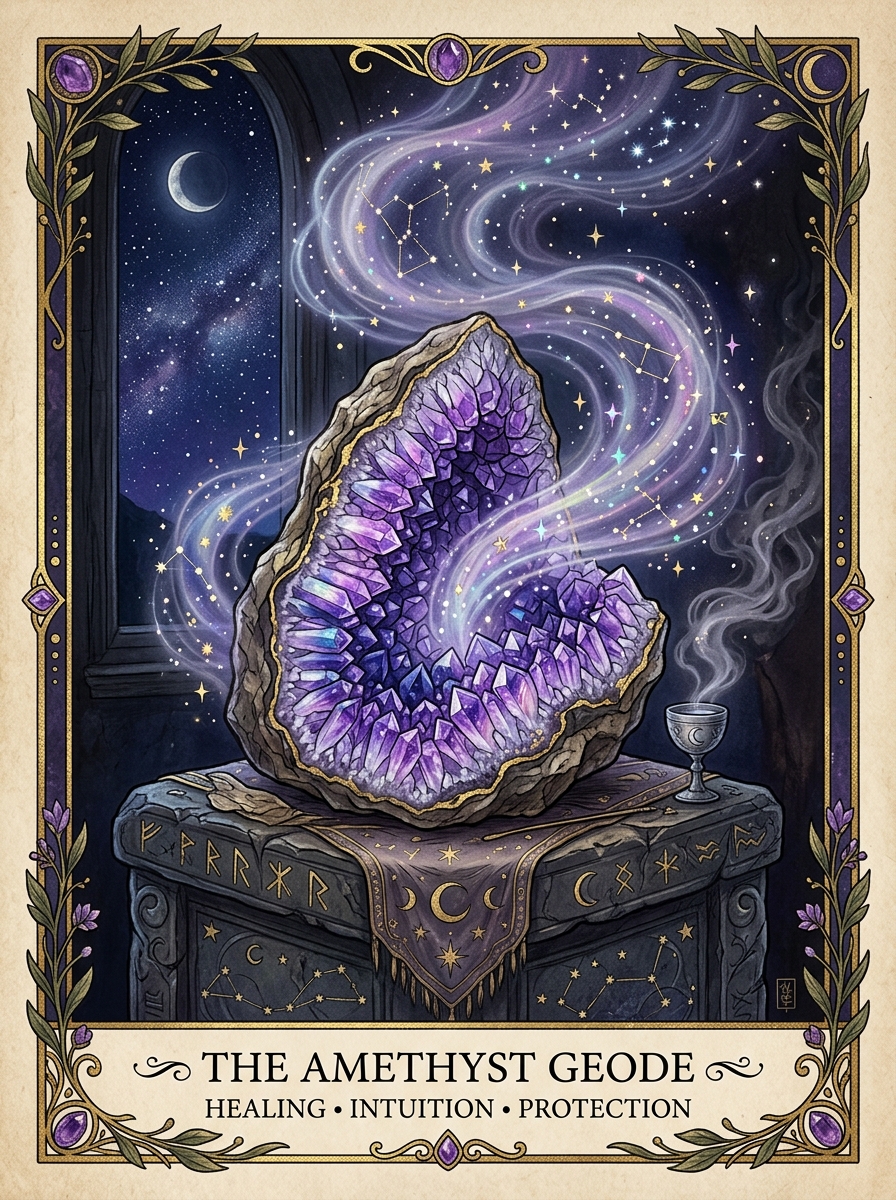
Amethyst is not a peace stone. It is a stone of lucid sovereignty.
The common description of amethyst as a “calming crystal” misses the point the way calling a surgeon “gentle” misses the precision. Amethyst does not anesthetize; it clarifies. Its metaphysical signature is discernment under pressure — the rare capacity to hold steady when the nervous system is loud, the intuition is blurred, or the mind has become its own weather system. People reach for it not to escape tension but to see through it.
The color alone encodes the dynamic. Purple sits between red and blue: the raw voltage of instinct and the cool distance of reflection. Amethyst is a mediator by composition. It does not amplify the way citrine does; it edits. It helps you notice the thought before you become the thought, the feeling before it takes the wheel. That is why it has been used for millennia in meditation, dream work, and spiritual protection — not to float free of the body, but to find a perch where perception stays accurate.
This is a stone for anyone who absorbs other people’s moods, over-identifies with responsibility, or loses clarity in relational intensity. Its protection is not a wall; it is an inner chamber with good acoustics. Useful information enters, but psychic noise does not dominate the room. If you want a broader framework for understanding how a planetary or archetypal symbol like amethyst functions, the mechanics of the zodiac provide a useful parallel: just as each sign mediates a specific quality of awareness, amethyst mediates between raw experience and coherent meaning.
How amethyst works: regulation, filtration, and the art of the pause
The word amethyst comes from the Greek amethystos, “not intoxicated” — a reference to the stone’s historic reputation for sobriety and self-command. That etymology is still the most precise description of its healing function. Whether “intoxication” means literal alcohol, emotional overstimulation, compulsive thinking, or spiritual grandiosity, amethyst speaks to states where judgment is compromised by excess. It introduces a pause — a gap between stimulus and reaction.
Emotional cooling that does not suppress
When people say amethyst calms anxiety, they are describing a felt shift from spiral to perspective. The stone works as a tactile cue: you hold it, you breathe more slowly, the escalation stops. But it does not numb. Grief, anger, insomnia, overthinking — these are legitimate energies; amethyst helps you be with them without being consumed. It is emotional regulation, not emotional avoidance.
Mental filtration, not blankness
Amethyst separates signal from static. Students, writers, therapists, and meditators use it when they need focus without hardening. It feels like turning down fluorescent noise and letting the room speak in a more human voice. The goal is not a vacant mind but a clean one. That calibration is reminiscent of the sextile in astrology — an aspect of easy activation that facilitates potential without forcing it. Amethyst works the same way: it opens the channel; it does not write the message. (For more on that kind of supportive exchange, see the sextile aspect.)
Spiritual protection by clarity
The protective quality of amethyst is subtle. It clears intrusive impressions and psychic fog without creating a brittle armor. Empaths, counselors, and healers often use it to keep the subtle body from over-identifying with the emotional residue of a room. The distinction matters: amethyst protects by discernment, not by defense. You do not become impermeable; you become better at knowing what is yours and what is not.
Chakra and zodiac correspondences as a map
Amethyst is most strongly associated with the crown chakra (spiritual coherence, perspective beyond the ego) and the third eye chakra (intuition, inner sight). These two energy centers work together: the third eye reads the data, the crown places it in context. Amethyst is especially helpful when insight has become either too vague or too rigid. It supports openness without dissolution — a clear channel, not a sieve.
In zodiac work, amethyst is commonly linked to Pisces (receptivity), Aquarius (visionary distance), Virgo (discernment), and Sagittarius (philosophical reach). Each sign translates the stone’s core dynamic differently. If you are studying a Sun sign as an expression of the soul’s orientation, amethyst can act as a counterweight or a supplement depending on the native’s natural bias.
Mature use vs. shadow use
Every crystal has a shadow — a way of being misused when its qualities are taken too far or applied in the wrong context. Amethyst is cooling, and that is precisely its danger: used defensively, it can become a tool for spiritual bypass. If someone reaches for the stone every time they feel anger or desire, they are not clarifying; they are suppressing. The stone rewards attention, not avoidance.
Mature use of amethyst means using its pause to choose, not to freeze. It supports the ego’s ability to remain in conversation with the unconscious without being flooded by it — a Jungian balance that is the mark of genuine individuation. In this sense, amethyst resonates with the North Node: the soul’s developmental edge where the old pattern must yield to a truer, less rehearsed life. (See North Node meaning for how that pressure shows up.) The stone does not push you toward transcendence; it pushes you toward integration.
Putting amethyst to work in a life
Because amethyst sharpens discernment, it is most effective when given a specific job. A crystal sitting anywhere is mostly décor; a stone placed with intention becomes a behavioral cue, a ritual object, a symbolic boundary. The applications are simple and repeatable.
Sleep and threshold states
If your nights are mentally crowded, place amethyst on a bedside table or under the bed — a few inches from the pillow, not directly under it. The goal is not mystical intensity; it is environmental instruction. You are teaching the psyche that the day has closed. People often report that it reduces “mental echo,” the feeling of the mind rerunning conversations or tasks. This makes sense symbolically: amethyst belongs to dusk, dream, contemplation, recovery.
Meditation and focused work
Hold amethyst during meditation or keep it within sight. It serves as a visual anchor for spacious attention. If your practice tends toward analysis, the stone keeps the mind from becoming performative. If it tends toward drifting, the stone keeps you tethered. On a desk, it supports concentrated thought and less reactive communication — especially useful when the work involves writing, analysis, or boundary-setting with clients or colleagues.
Altars, thresholds, and life transitions
On an altar, amethyst belongs near candles, texts, or images connected to prayer and inner guidance. In an entryway, it can mark the transition between public performance and private self. If your chart has a heavy emphasis on one area of life — say, a stellium in a particular astrological house — you can place amethyst with that theme in mind. It works best where there is psychic traffic and a need for order.
Ritual and question-based work
Because amethyst sharpens discernment, it is especially good for question-based practice. Before meditation or tarot, hold the stone and ask something precise: What am I not seeing? What boundary am I avoiding? What am I mistaking for intuition? This is not a stone for vague wishing. It responds to good questions.
If you need courage, momentum, or physical energy, amethyst may be too cooling for that moment. It is not the best choice for pushing through inertia. But when the problem is too much noise, too little clarity, or a boundary that needs to become kinder and stronger at once, it is one of the most disciplined allies in the mineral kingdom. The peace it offers is the kind that does not anesthetize the mind but makes it accurate enough to trust.
Related
- Amethyst in February: The Violet Stone of Clarity, Devotion, and Night Vision
- Amazonite Meaning & Healing Properties: The Stone of Clear Boundaries
- Smoky Quartz Meaning: Grounding, Protection, and Clear Sight
- Prehnite Meaning & Healing Properties: The Stone of Quiet Knowing
- Topaz Meaning & Healing Properties: Clarity, Fire, and Steady Power
Comments
Loading comments…