Ruby Meaning & Healing Properties: Fire, Blood, and the Will to Live
The core thesis: ruby as directed vitality
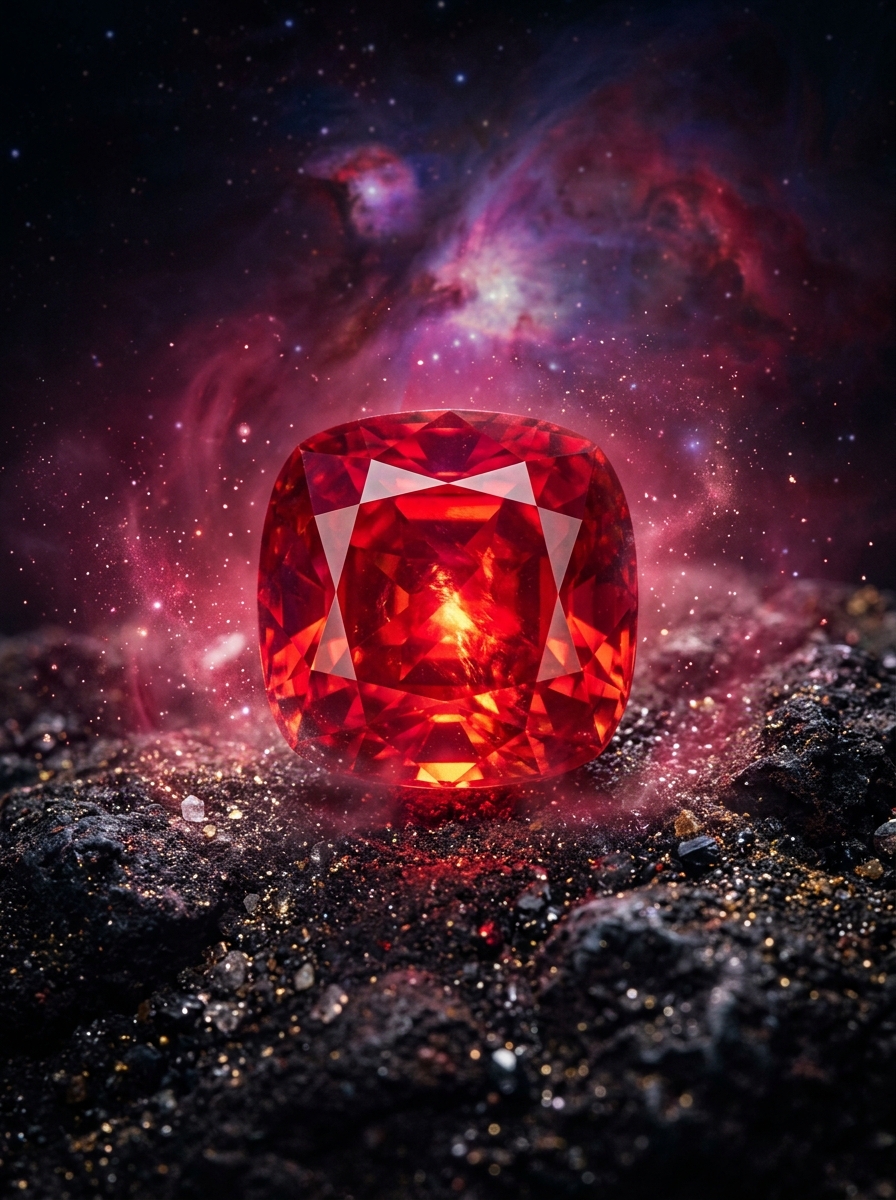
Ruby is the crystal of concentrated life-force — not decorative passion, not generic energy, but the will to live with intention. Its metaphysical meaning is often reduced to romantic love or prosperity, but that misses the deeper signature: ruby intensifies whatever is already true, especially the truest part of you that has been underfed, undernamed, or underprotected. It does not ask whether your desire is tidy; it asks whether it is alive.
This is why ruby feels different from other red stones. Carnelian is raw appetite; red jasper is grounded endurance; garnet is ember. Ruby is the sealed furnace — power with a direction. It belongs to the vocabulary of blood, heart, crown, and oath. Where some stones soothe, ruby charges. Where they diffuse, it condenses. Its job is to make commitment feel incandescent rather than dutiful, and to expose the places where your life-force has been leaking.
The shortest thesis: ruby calls you to inhabit your own body fully. That is not a metaphor for self-care; it is an ethical demand. If you are willing to meet it, the stone becomes a sovereign talisman rather than a decorative trinket.
The energetic signature: how ruby works on body, psyche, and boundaries
Metaphysically, ruby is associated with energizing, strengthening, and rekindling. But its action is precise: it supports stamina, circulation, and emotional self-worth by returning heat to the places where shame or resignation have cooled it. The stone does not cure anything in a medical sense; it reveals where vitality has been traded for approval, safety, or numbness.
Body and root
Ruby’s traditional link is to the root chakra, the seat of survival and embodiment. When the root is compromised in energetic models, people describe fear, dissociation, or a sense that they do not quite belong on the earth. Ruby symbolizes a return to firm ground — not as a fantasy of invulnerability, but as renewed trust in incarnation. It is especially useful when someone has been surviving by shrinking, and needs to reclaim the right to take up space.
Heart and boundary
At the same time, ruby bridges the root and the heart chakra. This is not soft sentimentality; it is eros aligned with devotion. The stone asks whether your affection has enough backbone to become a life — whether you can love without erasing yourself. Its emotional medicine is tied to self-worth and the courage to feel desire without shame. If the heart is armored, ruby may make the armor visible before it softens. If anger has been displaced into fatigue, ruby brings heat back into awareness.
In Jungian terms, the stone constellates the will as an active psychic force — especially in people who have learned to survive by overgiving, resentment, or a life structure that never quite fit. Ruby does not simply restore energy; it helps define what the energy is for.
Chakra and zodiac: where ruby belongs in the astrological architecture
The most important chakra association for ruby is the root chakra, because ruby is fundamentally about survival, embodiment, and the right to occupy the earth. But its reach extends upward: it can align the root with the heart, bringing desire into the field of devotion. This is one reason ruby is often perceived as a stone of passionate love — it does not separate eros from loyalty.
Leo and the solar core
Zodiacally, Leo is ruby’s most common match, and the correspondence is apt. Leo is not merely performance or pride; at its best, it is the sign of creative sovereignty, warm leadership, and the courage to be visible without becoming hollow. Ruby embodies that solar confidence. It says, “Do not merely exist; radiate.” This dovetails with what astrology calls the Sun sign — not ego display, but the core radiance that makes a person coherent.
Some traditions also emphasize Mars because of ruby’s heat, force, and protective instinct. That martial note is useful when the issue is not self-expression alone but the defense of vital energy. Ruby can help symbolize the clean edge needed to say no, stand your ground, or stop bleeding energy into obligations that no longer deserve it. For a fuller picture of how vitality is spent or reclaimed, the astrological houses show the specific life arenas where this dynamic plays out.
When ruby is especially resonant
Ruby tends to be most resonant when a person needs courage, leadership, or heartfelt momentum. It is especially apt for those with strong Leo, Aries, or Mars signatures, but it can support anyone whose chart shows too much caution and not enough ignition. In charts dense with interior complexity — such as a stellium — ruby can function as a clarifying heat: not a solution, but a distillation. It also pairs well with the developmental pull of the North Node, which asks where you need to grow toward life rather than away from fear.
Working with ruby: practical metaphysics for a focused will
To work with ruby effectively, treat it as a focus for intention, not a charm you outsource to. Its power is sharpened by clarity. The stone responds best when you know what you are trying to defend, awaken, or recommit to. A vague desire for “more energy” is less compelling than a defined aim: creative stamina, steadier self-trust, or the courage to pursue a genuine calling.
When to use — and when not to
Wear ruby in contexts where your energy needs to stay coherent rather than scattered. As jewelry, it works well near the heart or wrists, where it can serve as a symbolic reminder of commitment and circulation. On an altar, ruby can stand for the life-force itself — a red focal point for vows, recoveries, or the renewal of creative initiative. In timing work, ruby is often used when the question is whether to act decisively. It can pair well with periods when the Sun, Mars, or Leo are emphasized in your chart, or when a supportive sextile invites action without force.
Ruby is not the right stone for every mood. If your system is already overcharged — anxious, inflamed, irritable, or sleep-deprived — ruby may feel too hot, too insistent, too much like another demand. It is a tonic, not a sedative. Use it when you need enlivenment with structure, not stimulation for its own sake. And remember: ruby does not glorify appetite without discipline. It asks for a self capable of containing its own radiance — much as the Emperor and Sun tarot cards describe authority that is life-giving only when rightly aligned.
Ruby in the larger symbolic map: love, sovereignty, and chosen fate
The last thing to understand about ruby is that it is never only about attraction. Its most enduring meaning is sovereign aliveness — the condition in which love, ambition, sexuality, and purpose stop competing and begin to serve the same center. That is why ruby has remained a stone of kings, initiates, and lovers alike. It symbolizes a life that has been claimed.
In a spiritually mature reading, ruby does not promise endless passion. It asks whether passion can become devotion, whether survival can become purpose, and whether your presence can become unmistakable. That is close to the deeper function of the chart’s guiding thread, the North Node: not comfort, but direction. Ruby lends heat to that direction.
When you work with ruby well, you are not trying to become louder. You are trying to become more exact: more available to love, more disciplined in desire, more anchored in the body, and less willing to call depletion “normal.” That is the stone’s real gift. It returns the question to you with uncommon force: what would your life look like if your heart were not half-extinguished?
Related
- Ruby in July: The Birthstone of Fire, Blood, and Unblinking Desire
- Sunstone Meaning and Healing Properties: Solar Courage, Joy, and Clean Power
- Rose Quartz Meaning: The Soft Power of the Heart Stone
- Bloodstone Meaning: The Warrior Stone of Vitality, Courage, and Clean Boundaries
- Topaz Meaning & Healing Properties: Clarity, Fire, and Steady Power
Comments
Loading comments…