Venus Trine Uranus: The Grace of the Unpredictable Heart
The Core Dynamic: Affection That Refuses to Go Numb
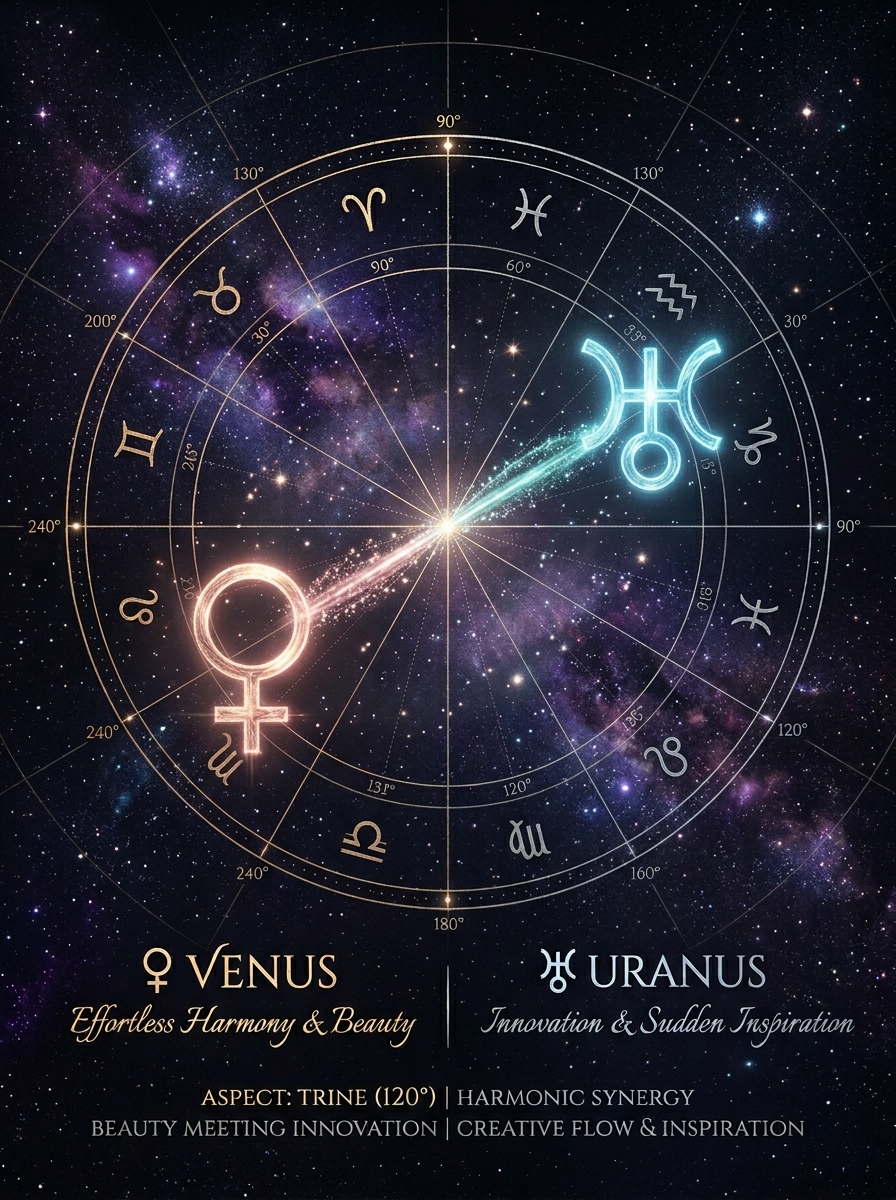
Venus trine Uranus is not a compromise between love and freedom. It is a collaboration. Venus — desire, pleasure, value, attraction — wants to enjoy. Uranus — awakening, originality, rupture — wants to wake up. When these two planets form a trine in the natal chart, the psyche discovers that aliveness and intimacy are not opposites but mutual conditions. The person does not need to choose between devotion and independence; they instinctively feel that a bond must breathe to be real, and that beauty must retain an edge to stay magnetic.
This is not the same as being “rebellious in relationships.” The trine grants ease, which means the unconventional is not a statement but a native language. These people are often magnetically charming without trying, socially graceful without pandering, and aesthetically refined without being precious. They sense what feels current before it becomes obvious — in art, in fashion, in conversation, in love. The gift is a kind of social quicksilver: they can read a room, break a stale mood, and make the unexpected seem natural. The cost is subtler. Because the trine flows so smoothly, the native can take freedom for granted, drift away when intimacy settles, and mistake novelty for the only proof that a bond is alive. For a deeper understanding of the geometry itself — both its gift and its hazard — see the trine aspect. It is a shape that promises ease but demands consciousness; otherwise, ease becomes inertia.
Psychological Roots: The Electric Nervous System
The trine does not live only in the mind. Uranus is an electric archetype, and Venus trine Uranus often signals a nervous system that is quick, responsive, and easily refreshed by change. These people do not need chaos, but they do need micro-novelty: a new route home, a different playlist, a conversation that surprises, a sudden shift in plans. Their psyche is wired to stay awake through variation, not through routine. When life becomes too regulated, desire can flatten — not because they are shallow, but because their vitality depends on a certain rhythm of discovery.
This is not instability. The trine provides enough internal coherence to make experimentation feel elegant rather than chaotic. At their best, these natives can hold paradox: they can be deeply affectionate while retaining private exits, utterly present yet unowned. The challenge is that their need for oxygen can be misinterpreted by partners as rejection, or by themselves as a sign that the connection has failed. In fact, the bond may simply have crossed from the thrill of discovery into the quieter substance of familiarity. Learning to find freshness inside continuity is the central psychological task of this aspect. The Uranus principle here is not about leaving; it is about remaining awake. When combined with a strong Uranus in the First House or Uranus in the 7th House, the need for individuation within relationship becomes even more explicit — partnership itself becomes a site of awakening, not surrender.
How It Matures — and How It Can Go Shadow
The highest expression of Venus trine Uranus is love without possession. These people often understand, instinctively, that attraction cannot be bullied into permanence and that beauty dies when it is overmanaged. They are generous with difference, drawn to partners outside their usual type, open to non-traditional arrangements, and capable of a friendship layer inside romance that keeps the bond alive across years. They can be deeply loyal — but their loyalty is to the living connection, not to a script.
The shadow emerges when the ease of the trine trains the person to live from thrill alone. Because novelty feels so natural, the native may unconsciously assume that good feelings should stay light and frictionless. When reality introduces repetition, compromise, or emotional weight, they may interpret it as deadness rather than depth. This can manifest as an idealize-then-detach cycle: a relationship begins with electricity and wit; then, once the other becomes known, the voltage drops and the native wonders whether the bond has “failed.” Sometimes it has — but more often it has simply moved into the territory of substance, where love requires tending rather than discovering.
A subtler cost is emotional insulation. These natives can be affectionate, even tender, while retaining a private exit strategy. They may seem easygoing, but others may feel they are always one half-step ahead of being claimed. This is space as defense, not as liberation. The aspect’s gift is autonomy without coldness; its trap is distance that looks like freedom. Understanding the line between the two is where the work lies. To see how this plays out when Uranus occupies a house that directly shapes daily life, look at Uranus in the 6th House — where the need for freedom meets work and routine — or Uranus in the 12th House, where the disruption moves into the subconscious and may be harder to integrate.
A Consolidated Life: Love, Work, and the Art of Staying Alive
Because the Venus trine Uranus dynamic is singular — affection that refuses to go numb — we do not need separate sections for love, career, and creativity. They are all expressions of the same core pattern.
In love and dating, chemistry is quick and hard to fake. Predictability is a turnoff; possessiveness is often lethal. These people are drawn to intelligence, originality, humor, and a flash of the unexpected. They often prefer bonds that begin through friendship, shared interests, or cultural scenes — contexts where the mind can spark before the body commits. Their erotic style is responsive to novelty, not necessarily loud, but sustained by the feeling of discovery. A partner who can surprise them mentally keeps the field alive longer than someone who simply performs intensity. This aspect shares a family resemblance with Venus in Aquarius and Venus in Gemini: connection through freshness of mind, not just physical appetite.
In creativity and taste, this is one of the most naturally inventive signatures in the chart. The person often has unusual taste — or at least a taste that develops ahead of the crowd. They can combine elements that others would not think to pair, producing style that feels alive rather than curated to death. This gift is not limited to fine art; it appears in how they decorate a home, dress their body, host a gathering, design a brand, or solve social problems. Venus knows proportion and pleasure; Uranus knows disruption and leap. The secret power is synthesis. When the 5th house is emphasized — for example, through Venus in the 5th House or Uranus in the 5th House — the creative drive becomes even more vivid, a playground for this electric aesthetic.
In work and social presence, these natives thrive where flexibility, aesthetic intelligence, or innovation matters. They can bring a fresh eye to branding, art direction, media, fashion, user experience, social strategy, or any field where human taste meets system design. They wilt under rigid routines without explanation. Money is often less about accumulation than circulation — an instinct to spend on experiences or objects that feel inspiring, not on security that grows inert. This is not frivolity; it is a refusal to let value freeze. When Uranus occupies the 2nd house, as in Uranus in the Second House, the relationship with self-worth becomes experimental, which amplifies the theme.
The one-sentence summary of this aspect is: the heart stays alive by keeping its edges unpolished. Venus trine Uranus does not ask you to choose between love and liberty. It asks you to let love become a form of liberty, and liberty a form of love. That is a rare and demanding grace — and one that, when met with awareness, produces a life that never stops surprising itself.
Related
- Venus Conjunct Uranus: Electric Love, Unruly Desire, and the Need to Stay Free
- Venus Sextile Uranus: The Elegant Shock of Love and Style
- Venus Square Uranus: The Voltage of Unruly Desire
- Venus Opposes Uranus: The Electric Heart and the Problem of Freedom
- Sun Trine Uranus: The Free Spirit With a Center
Comments
Loading comments…