Uranus in the Second House: Unconventional Wealth, Erratic Finances, and the Revolution of Self-Worth
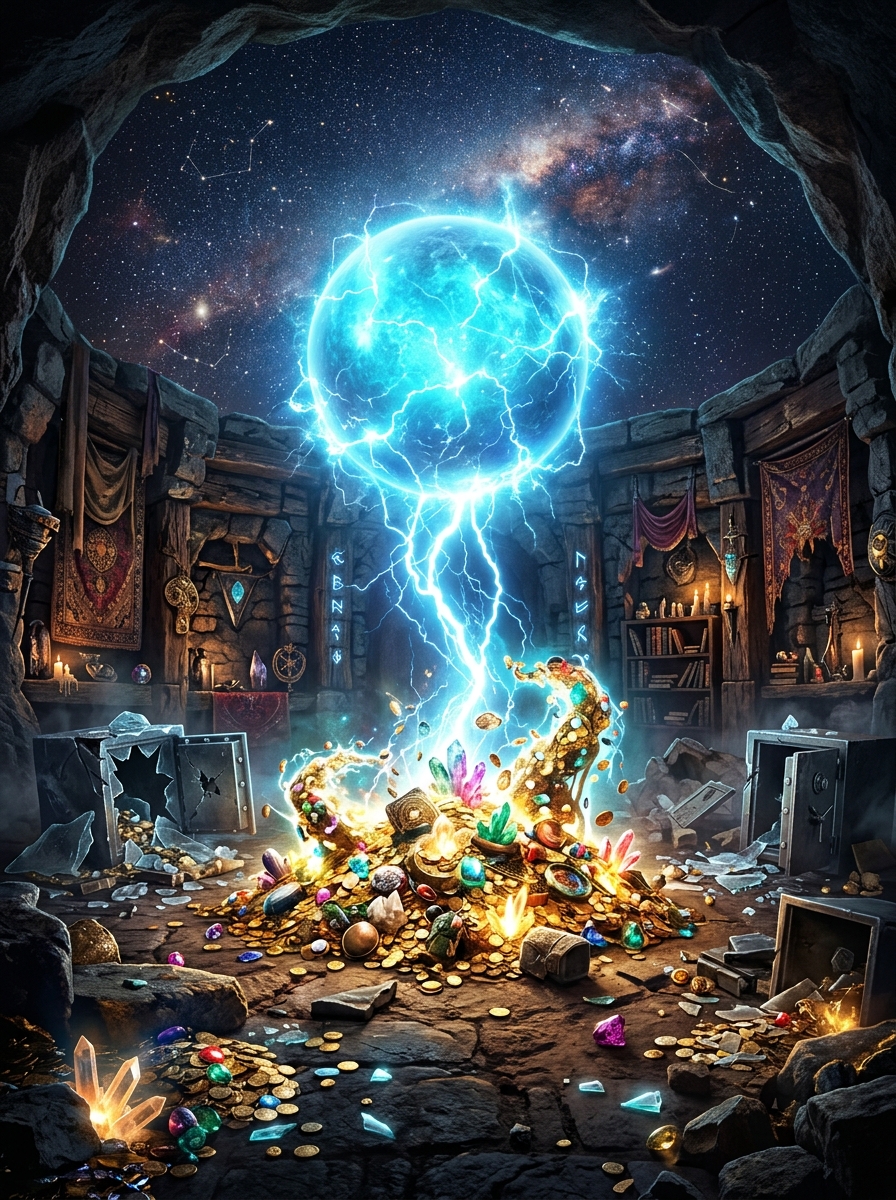
The Promethean Shock: Uranus in the Second House
When Uranus, the celestial agent of revolution, sudden awakening, and radical individuation, descends into the second house of the natal chart, it enters a territory that is inherently resistant to change. In the traditional wheel of the zodiac, the second house is the natural home of Taurus and its ruling planet, Venus. This is the domain of the material world: our physical resources, bank accounts, tangible possessions, and the foundational sense of survival security. It represents the soil in which we root ourselves to feel safe, the steady accumulation of assets, and the biological impulse to preserve and protect what is ours.
To place Uranus here is to introduce lightning into a garden. The Promethean fire of Uranus demands freedom, variation, and absolute autonomy, while the second house seeks stability, predictability, and comfort. This juxtaposition creates a lifelong psychic tension between the deep-seated human desire for material safety and the higher soul-necessity to liberate oneself from the suffocating shackles of conventional materialism. The resulting friction is not a design flaw of the birth chart; rather, it is a deliberate evolutionary crucible intended to forge a completely independent definition of security.
Liz Greene, in her seminal work on outer planets, often discusses how these transpersonal forces disrupt our personal spheres to align us with collective evolution. When Uranus occupies the second house, the individual is drafted into a cosmic experiment regarding the nature of value itself. You cannot simply build a white-picket-fence life, accumulating standard assets and resting on your laurels, because Uranus will consistently introduce unexpected elements to prevent stagnation.
This placement suggests that the traditional path of linear wealth accumulation is not only unavailable but spiritually counterproductive for the native. The soul is tasked with dismantling inherited parental and societal definitions of what is "valuable" and what constitutes "security." Instead of deriving safety from an external institution—like a traditional corporation, a pension plan, or a fixed piece of real estate—the Uranus in the second house native is forced to find security within their own capacity for innovation and resilience. The initial experience of this placement often feels like a series of shocks, where sudden shifts in resources force the individual to pivot, adapt, and look at wealth through a completely different lens.
Furthermore, this Promethean shock operates on a deeply physical level. The second house represents the body and our sensory experience of the material plane. With Uranus here, the nervous system itself is highly attuned to the fluctuations of the material world. The individual may experience physical anxiety when trying to conform to rigid financial systems, or conversely, a sense of electric vitality when they embark on an independent, albeit uncertain, financial venture. The body itself acts as a barometer, signaling when the soul is selling its freedom for the illusion of safety. It is a constant reminder that for this native, true health and prosperity are inextricably linked to personal liberation.
The Architecture of Security vs. The Lightning Bolt
In Jungian terms, the second house represents the ego’s physical container, the boundary of what we own and what owns us. When Uranus is present, this container is semi-permeable and highly sensitive to collective electric currents. The traditional architecture of security is built on predictability—knowing exactly what resources will be available tomorrow, next month, and next year. Uranus shatters this assumption not out of malice, but to demonstrate that attachment to the material plane is a psychological illusion. Steven Forrest describes Uranus as the "Great Awakener," the force that uses disruption to break our hypnotic sleep.
When the lightning bolt strikes the second house, it reveals that our reliance on traditional structures is often a form of spiritual imprisonment. The native learns that true safety does not lie in a static bank balance, but in their ability to respond creatively to the unexpected. The security of the Uranian is dynamic, not static; it is the balance of a tightrope walker, constantly adjusting to shifting winds, rather than the immobility of a stone fortress. To build a stone fortress under a Uranian sky is to invite the lightning to tear it down. The only way to find peace is to build an architecture of flexibility, where the structures of one’s life are designed to bend and adapt rather than break under the pressure of sudden change.
Financial Seismography: The Volatile Pulse of Wealth
The financial life of an individual with Uranus in the second house reads less like a steady, upward-sloping line and more like a seismograph recording active volcanic activity. There are long stretches of quiet, punctuated by sudden, dramatic spikes and sharp, precipitous drops. These fluctuations are rarely logical or predictable. The native might experience sudden windfalls—an unexpected inheritance, a speculative investment that skyrockets overnight, a high-paying freelance contract out of nowhere, or a creative project that suddenly finds a massive market. Conversely, they may face abrupt financial losses, sudden expenses, contracts terminating without warning, or the rapid devaluation of assets.
This financial seismography can be deeply unsettling to the ego, which naturally craves predictability. However, on an evolutionary level, these cycles serve a vital psychological function. They prevent the native from identifying too closely with their material circumstances. If wealth were stable, the individual might fall into the trap of defining their identity and self-worth by their net worth. The erratic nature of their resources forces them to develop a detached, almost Zen-like attitude toward money. They learn to ride the waves of abundance and scarcity, understanding that neither state is permanent. This detachment is the true gold of the placement, far more valuable than any temporary material gain.
For many with this placement, the volatility is not purely external; it is often unconsciously generated by their own psyche. There is a deep, hidden dread of being trapped by money. If they accumulate too much stability, they may feel suffocated, as if their freedom has been compromised. Consequently, they might engage in self-sabotaging behavior—such as quitting a secure job on a whim, making impulsive investments, or giving away resources—to restore the state of chaotic freedom that Uranus demands. Recognizing this unconscious pattern is a crucial step toward financial maturity for the native. They must learn that it is possible to be financially stable and spiritually free at the same time, without needing to create artificial crises to prove their independence.
Furthermore, this seismographic pattern often reflects the native's internal state of creative inspiration. When they are aligned with their true purpose and expressing their unique genius, resources flow to them in surprising and abundant ways. When they force themselves into a mold to satisfy others, the flow stops abruptly. The financial chart is a direct mirror of their alignment with their soul's calling. The sudden drops are often course corrections, pushing the individual away from paths that would stifle their individuation and toward new, uncharted territories where their unique talents are desperately needed.
Navigating the Winds of Windfalls and Sudden Ruin
To survive and thrive under this energetic influence, the native must cultivate a psychological buffer alongside a financial one. Astrologer Steven Forrest notes that when we refuse to consciously live out an archetype, it happens to us from the outside as "fate." If the Uranus in the second house native tries to cling desperately to traditional financial safety, the outer world will provide the necessary shocks to break that grip. Therefore, the goal is to cooperate with the archetype.
This means expecting the unexpected and building a lifestyle that can accommodate rapid transitions. When wealth comes, it must be received without the assumption that it will flow in the same manner forever. It should be treated as a temporary resource to be utilized, invested, or saved to fund future freedom, rather than as a permanent state of comfort. When dry spells occur, they must be viewed not as personal failures or permanent ruin, but as periods of fallow earth, preparing the ground for the next sudden innovation. By neutralizing the emotional charge associated with financial swings, the native transforms the roller coaster into a source of creative excitement, finding a deep, unshakeable peace amidst the storm.
Innovative Income Streams: Digital Alchemists and Tech-Driven Wealth
Because traditional, structured employment often feels like a creative death sentence for those with Uranus in the second house, they are natural pioneers in the realm of unconventional income. The nine-to-five corporate grind, with its rigid hierarchies, fixed hours, and predictable tasks, goes against the very grain of their energetic makeup. Instead, these individuals are drawn to careers that offer maximum autonomy, intellectual stimulation, and the freedom to experiment. They are the digital alchemists of the modern economy, thriving in spaces that are still forming and lack established rules.
Technology, software development, fintech, digital entrepreneurship, and the creative use of internet platforms are natural playgrounds for this placement. Uranus rules electricity, innovation, the future, and the collective mind, making the digital landscape a highly compatible medium for their resource-generating activities. They are often early adopters of new economic paradigms, recognizing value in digital assets, online communities, and decentralized networks long before the general public catches on. They may make a living through freelancing, consulting, launching start-ups, or piecing together a portfolio of diverse, independent projects that can be managed from anywhere in the world.
Furthermore, the Uranian second house individual often makes money by selling their unique perspective or their ability to see trends ahead of time. They are the futurists, the disruptors, and the reformers within their chosen industries. They generate income not by fitting into existing molds, but by breaking them and offering alternative, highly original solutions. Their financial success is directly tied to their willingness to express their individuality and stand apart from the crowd. The moment they try to copy someone else's business model or conform to industry standards, their financial flow tends to dry up, leaving them frustrated and depleted.
In addition to technology, this placement often points toward earning a living through esoteric sciences, astrology, psychology, or humanitarian work. Because Uranus is connected to the higher mind and collective systems, the native may find that translating complex, cosmic, or social patterns into practical tools for self-improvement becomes a significant source of income. They are able to demystify the mystical, making it accessible and valuable to others. Their income streams are as varied as their interests, often combining elements of the high-tech with the deeply esoteric, creating a unique vocational signature that is entirely their own.
The Freelancer, the Hacker, and the Fintech Pioneer
In the modern economic theater, the Uranus in the second house archetype manifests clearly in figures who refuse standard employment structures. They are the freelance consultants who drop into organizations to solve complex problems and leave before the corporate politics set in. They are the developers building open-source software, the ethical hackers testing boundaries, and the fintech pioneers redesigning how humanity conceives of transaction and exchange. These individuals do not view work merely as a trade of time for currency; they view it as an assertion of personal freedom.
They require a vocational structure that allows them to work in bursts of intense, inspired activity, followed by periods of integration and rest. The traditional expectation of constant, linear daily output is replaced by a cyclical, highly dynamic rhythm. When they align their income generation with this natural internal pace, they unlock the true constructive power of their placement. They become pioneers of a new way of working, showing the world that productivity and freedom are not mutually exclusive, but can enhance each other when properly integrated.
Unconventional Values: Redefining Self-Worth Beyond Materialism
At its deepest psychological level, the second house is not really about money; it is about our value system. It represents the internal moral and psychological compass that determines what we believe is worth fighting for, worth protecting, and worth dedicating our life force to. With Uranus here, the native is called to execute a radical overhaul of their value system. They cannot simply inherit the values of their parents, their culture, or their social class. They must build a customized, highly vocabulary-driven ethos from the ground up, one that is aligned with their own truth rather than collective conditioning.
This process of value individuation often begins with a rejection of societal materialism. The native may look at the collective obsession with status symbols, luxury goods, and linear career progression and find it utterly hollow. They may consciously choose a minimalist lifestyle, prioritize experiential wealth over physical possessions, or dedicate themselves to causes that champion ecological sustainability, social justice, or humanitarian reform. Their sense of self-worth becomes detached from what they own and is instead anchored in their intellectual independence, their integrity, and their alignment with their personal truth.
However, this path is not without its challenges. Because their values are often out of sync with the mainstream, Uranus in the second house individuals can struggle with a persistent sense of alienation or inadequacy, especially in their early life. They may feel judged by family members who equate success with traditional milestones, or they may judge themselves for not wanting the things they are "supposed" to want. Healing this placement requires the native to stop seeking external validation for their choices. They must learn to trust their internal authority, realizing that their refusal to conform to societal standards is not a defect, but a vital part of their spiritual blueprint.
Ultimately, this redefinition of self-worth is the core work of the placement. When the native realizes that their value is not determined by their productivity, their income, or their possessions, they achieve a state of spiritual liberation that no external event can take away. They become truly independent, capable of navigating the ups and downs of the material world with grace and humor. They show others that it is possible to live in the world without being of it, using resources to support their growth and service rather than to prop up a fragile ego.
Escaping the Matrix of Family and Societal Expectations
To fully step into their power, the native must consciously exit what might be called the "materialist matrix." This is the collective belief system that dictates a person's worth is directly proportional to their productivity and their accumulation of capital. Under the influence of Uranus, this exit is often catalyzed by a crisis—a period where trying to live by traditional rules results in physical illness, depression, or sudden external collapse. When they finally stop trying to fit into the conventional mold, they experience a profound sense of liberation.
They discover that their self-worth is inherent, not earned. They realize that they do not need to prove their value to anyone else. This shift in perspective transforms their relationship with the material world; money ceases to be a measure of their human value and becomes simply a tool to facilitate their personal freedom and creative expression. They are no longer slaves to the machine of accumulation; they are free agents, using the material plane as a canvas for their unique individuality.
The Uranian Shadow: Speculative Risks and Instability as a Shield
Every astrological archetype carries a shadow, and for Uranus in the second house, this shadow is often expressed as financial recklessness, erratic behavior, and a profound fear of commitment disguised as a love of freedom. Because the energy of Uranus is inherently disruptive, the native may become addicted to the adrenaline of instability. They may unconsciously associate safety with stagnation, leading them to create financial crises whenever their life starts to feel too calm. This self-sabotaging loop keeps them in a perpetual state of survival mode, preventing them from doing the deeper, long-term creative work they are capable of.
Another common expression of the Uranian shadow is speculative recklessness. The native is naturally drawn to high-risk, high-reward ventures—speculative tech stocks, volatile cryptocurrencies, leveraged trading, or unproven business schemes. While Uranus can bring sudden gains, it can just as easily bring sudden, total wipeouts. When driven by the shadow, the native operates from a place of impatience and a desire to bypass the hard work of building a foundation. They treat the material world like a casino, hoping for a single, revolutionary stroke of luck that will exempt them from the mundane realities of life. This is not true Uranian liberation; it is merely a high-tech version of magical thinking.
Furthermore, the native may use financial instability as a psychological shield against intimacy and commitment. As long as their finances are chaotic, they have a perfect excuse for not settling down, not buying a home, not entering long-term relationships, or not taking on responsibilities that might limit their independence. By keeping their physical life in a state of constant flux, they maintain a safe distance from the demands of the real world. To integrate this placement, the native must confront this underlying fear of vulnerability and realize that true independence does not require a chaotic life. They must learn that commitment to a path, a person, or a project does not mean losing their freedom, but can actually provide the stability needed to express their genius.
The shadow also manifests as a stubborn refusal to cooperate with any financial reality. The native may refuse to pay taxes, ignore bills, or fail to keep basic records, viewing these mundane tasks as "conforming to the system." In reality, this is a form of passive-aggressive rebellion that only hurts the native. By refusing to engage with the rules of the physical plane, they give away their power, leaving themselves vulnerable to legal and financial crises that drain their energy and limit their choices. True mastery of Uranus requires working with the physical world, using its structures to protect and launch one's independent visions.
The Chaos Trap: Crypto, Speculation, and Fear of Commitment
In the contemporary landscape, the "Chaos Trap" often manifests as an obsession with highly volatile assets. The Uranus in the second house native may find themselves spending hours tracking market charts, riding the emotional highs of green candles and the devastating lows of sudden crashes. They convince themselves that they are fighting for financial liberation, but in reality, they are trapped in a cycle of speculative anxiety. This behavior is often a flight from the present moment and the real, physical steps required to ground their life.
Similarly, when it comes to relationships or career choices, they may reject any path that requires long-term dedication, labeling it as "conforming" when it is actually a fear of being seen, tested, and held accountable. True rebellion is not merely throwing bricks at the wall; it is having the courage to build something lasting on your own terms. It is the integration of Uranus with Saturn—the marriage of radical vision with disciplined structure. When the native steps out of the chaos trap, they can use their innovative insights to build sustainable, independent platforms that serve both their freedom and the collective good.
Mature Integration: Grounding the Electric Current
The mature integration of Uranus in the second house requires the individual to perform a difficult psychological alchemy: they must find a way to ground the electric current of Uranus without extinguishing its flame. They must learn to honor their need for financial freedom, innovation, and unconventional values while still building a functional, resilient material foundation that keeps them safe in the physical world. This is the path of the grounded visionary, the individual who can walk between the worlds of high-tech innovation and earthy reality with equal ease.
The first step in this integration is the creation of a robust financial buffer. Because their income is likely to remain non-linear, they need a larger savings reserve than the average person. This is not a surrender to traditional materialism, but a strategic move to protect their independence. A healthy emergency fund ensures that when a contract ends or a project fails, they are not forced to take a soul-crushing job just to pay rent. It gives them the breathing room to wait for the next inspired, Uranian idea. It transforms their relationship with the physical plane from one of fear and reactivity to one of playfulness and possibility.
Secondly, they must diversify their income streams. Rather than relying on a single source of wealth, they should build a portfolio of different activities. This fits the multifaceted, curious nature of Uranus and mitigates the risk of sudden losses in any one area. They might have a consulting gig, run an online store, hold some long-term investments, and work on a creative book project simultaneously. If one pillar crumbles, the others keep the structure standing. This diversification also satisfies their need for variety, keeping them from getting bored or stagnant in any single pursuit.
Finally, mature integration involves working with the polar opposite of the second house: the eighth house of shared resources, depth psychology, and transformation. While the second house represents "my stuff," the eighth house represents "our stuff"—investments, partnerships, taxes, and the psychological contracts we make with others. By paying attention to the eighth house axis, the Uranus in the second house native learns to build collaborative networks. They realize that true autonomy is not about total isolation; it is about choosing their connections consciously and honoring the energetic exchanges that sustain them.
Bridging the Second and Eighth House Axis
The opposition between the second and eighth houses is one of the most critical axes in the natal chart, representing the balance between self-reliance and interdependence. For the Uranian second house native, the tendency is to lean heavily into self-reliance, rejecting any form of financial dependence on others as a threat to their freedom. However, true maturity requires bridging these two houses. This means learning how to receive help, how to invest alongside others, and how to navigate the complex psychological dynamics of shared resources without losing one's identity.
It involves recognizing that healthy partnerships—whether business or romantic—do not diminish our individuality; rather, they provide a stable launchpad from which we can take even bolder creative risks. By anchoring their erratic second house energy in the deep emotional and structural commitments of the eighth house, the native achieves a state of dynamic stability. They learn that they can stand strong in their own power while still participating in the deep, transformative exchanges that make life rich and meaningful.
Frequently Asked Questions
Does Uranus in the second house guarantee financial instability?
Not necessarily, though it does indicate that your relationship with money will be non-linear and unconventional. In the early stages of life, or when living in the shadow of this placement, financial instability is common because the ego is resisting the call to build a unique value system, or is unconsciously sabotaging stability to maintain freedom. However, once you embrace the Uranian demand for innovation, diversify your income streams, and build a solid financial buffer, this placement can manifest as sudden windfalls, creative entrepreneurship, and a highly successful, independent career. The key is to stop trying to force your finances into a traditional, predictable mold. Once you accept the natural rhythm of your resources, you can turn what once felt like instability into a dynamic, exciting form of prosperity.
What are the best career paths for someone with this placement?
The best careers are those that offer high autonomy, intellectual stimulation, and flexibility. Traditional corporate roles with rigid structures are generally a poor fit. Many natives thrive in technology, software development, fintech, digital marketing, consulting, and creative entrepreneurship. Freelancing or building a portfolio career composed of several different projects allows you to work in natural bursts of energy rather than conforming to a rigid daily routine. Careers that focus on future trends, social progress, or humanitarian innovation also align well with the planetary energy of Uranus. Ultimately, any career that allows you to be a reformer, disruptor, or independent thinker can bring success.
How can I build a sense of self-worth if my finances are constantly fluctuating?
This is the core evolutionary challenge of Uranus in the second house. You must consciously de-couple your self-worth from your external material circumstances. If you measure your value by your bank balance, you will be on an emotional roller coaster. Instead, anchor your self-worth in your internal qualities: your capacity for resilience, your unique mind, your independence, and your alignment with your personal truth. Recognize that the volatility of your resources is a tool designed to teach you detachment, helping you discover that your true security lies in your adaptability and creative genius, not in static external assets. The more you value your inner freedom, the more stable your outer life will become.
How does the eighth house affect my Uranus in the second house placement?
The eighth house, which sits directly opposite the second house, rules shared resources, inheritance, taxes, joint ventures, and deep psychological bonds. Because your second house is erratic and highly independent, you may naturally avoid eighth house commitments, fearing they will trap you. However, integration requires balancing these two domains. This means learning to engage in healthy financial partnerships, understanding the psychology of investments, and being willing to share resources without fearing the loss of your autonomy. A well-integrated eighth house helps ground and stabilize the volatile energy of your Uranian second house, giving you the foundation to take larger creative risks.
Is high-risk investing (like cryptocurrency) advisable for this placement?
While Uranus is naturally attracted to cutting-edge, speculative, and technologically driven financial assets like crypto, the shadow of this placement can lead to reckless speculation and devastating losses. If you choose to invest in volatile assets, it should be done from a place of research and calculated risk, never as a desperate gamble to escape the need for daily grounding or to bypass personal effort. It is crucial to maintain a strong, traditional cash reserve and diversified, lower-risk assets to protect yourself from the sudden downward drops that Uranus can deliver. True financial freedom is built on a balance of innovation and structural discipline.
How can I prepare for Uranus transits to my second house?
If Uranus is transiting your second house (or if natal Uranus is being heavily aspected), prepare for a period of rapid change regarding your finances and values. The best preparation is psychological: resolve to let go of absolute control and be open to new ways of generating income. This is an excellent time to update your technology, learn new digital skills, launch an independent project, or declutter your life of possessions that no longer serve your growth. Avoid taking on rigid, long-term financial commitments during this time, and instead focus on building your flexibility and resilience. Cooperate with the change, and it will lead you to a much more authentic way of living.
Comments
Loading comments…