Venus Opposes Uranus: The Electric Heart and the Problem of Freedom
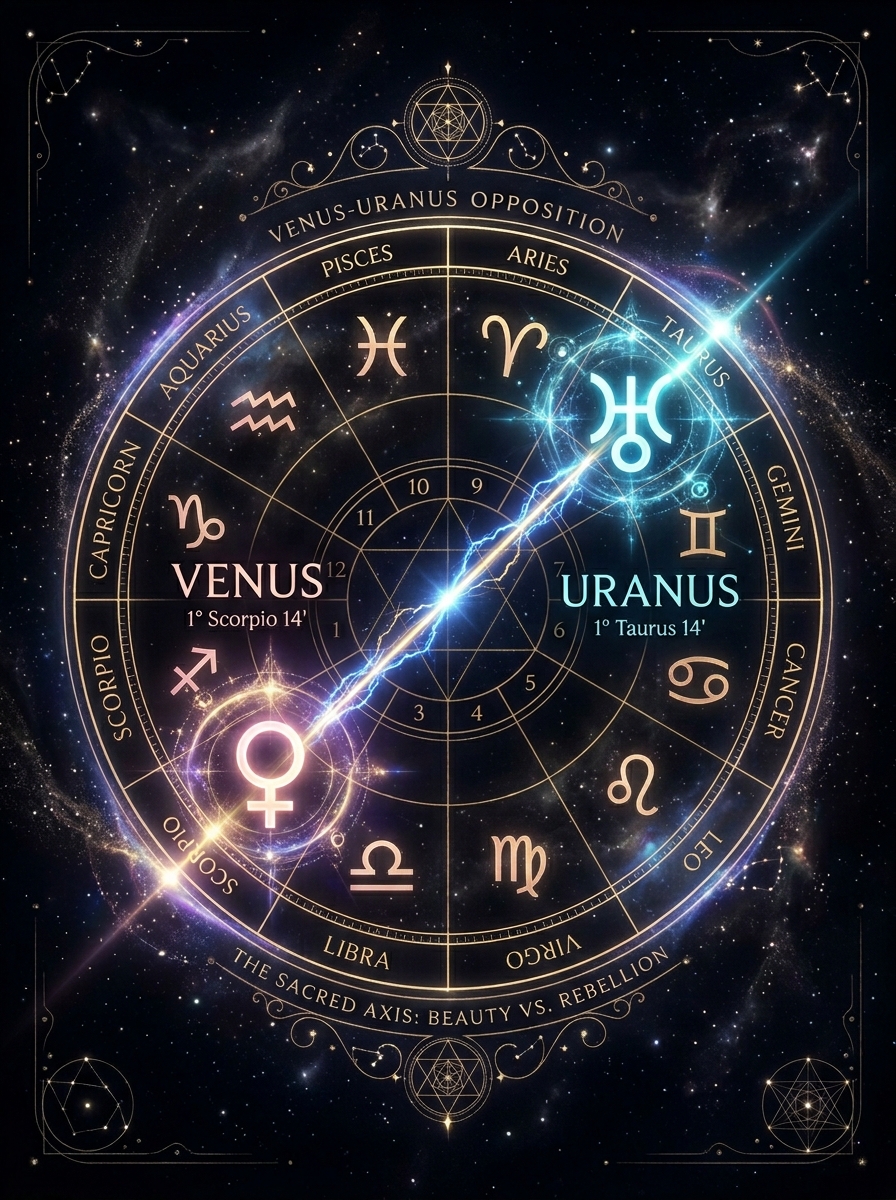
The structural problem: desire wants contact, Uranus wants air
Venus opposition Uranus does not blend longing with freedom; it keeps them facing each other across a charged aisle. The psyche is suspended between two imperatives that refuse to cancel. Venus wants attachment, pleasure, harmony, and the slow build of mutual value. Uranus demands aliveness, surprise, truth, and the right to break any pattern that has gone numb. An opposition is not a synthesis. It is a permanent mirror: every need points toward its own counterclaim.
This means attraction arrives with disruption attached. The person may crave tenderness and then recoil the moment it becomes available, not because they are fickle, but because the nervous system reads intimacy as a potential cage. Stability can start to feel like a velvet trap. The result is a life of exquisite magnetism, a taste for the unusual, and a refusal to love on dead terms—along with abrupt starts and stops, a hair-trigger boredom reflex, and a habit of testing whether closeness can survive honesty. For the geometric logic behind this tension, see the opposition aspect itself: a mirror line that turns every impulse into its own shadow.
What the psyche is actually asking
In Jungian terms, this is a conflict between the longing for belonging and the demand for individuation. The soul will not accept a love that asks it to become smaller, duller, or more compliant. Yet if the opposition remains unconscious, freedom gets acted out as rupture: the sudden breakup, the flirtation with danger, the mysterious disappearance after intimacy deepens. The person is not chasing chaos. They are trying to stay awake. The real problem is not instability but a failure to recognize that the opponent is inside.
Where the wiring comes from: the roots of the split
The Venus-Uranus opposition rarely appears without a backstory. In the natal chart it marks a history—often early—in which closeness and compliance became tangled. A child may have learned that being loved meant suppressing difference, or that expressing individuality risked withdrawal of affection. The result is an inner split: Venus continues to seek closeness, but Uranus has learned to treat closeness as a threat to the self. The adult then replicates the pattern by choosing partners who are brilliant, unavailable, eccentric, younger, older, emotionally elusive, or otherwise impossible to domesticate—because the structure itself protects freedom.
This is not fate but conditioning. The opposition externalizes the split: one partner may become the symbol of security, the other the symbol of escape, or a single relationship may oscillate between domestic longing and anti-domestic rebellion. Understanding the root helps depersonalize the pattern. For a deeper look at how this dynamic expresses through partnership, see Uranus in the Seventh House and Venus in Aquarius, where affection and autonomy must learn the same language.
The high road and the short circuit
The aspect matures or degenerates depending on how the person relates to the split. In its shadow form, Uranus dominates by making novelty the only metric. Every relationship becomes a liberation followed by a jail break. The person confuses voltage with vitality and mistakes crisis for connection. They choose the long-distance bond, the open-ended arrangement, or the unavailable other because the structure itself keeps freedom alive—but the deeper need for trust remains underfed. Repetition becomes a kind of acting out: the psyche repeats what it does not yet understand.
Maturation: making freedom compatible with devotion
The integrated version of this aspect does not need crisis to feel real. It learns to speak directly about boredom, need, erotic variation, and the fear of dependency before those feelings explode into action. Explicit agreements about space, honesty, and autonomy replace the unconscious rebellion. The person discovers that commitment is not sameness—a living partnership changes shape. This is where Venus gains strength from Uranus rather than losing itself to him.
The higher expression often includes unusual relationship structures, but not as a performance of rebellion. It is a redesign of intimacy so that it can tolerate truth. For the broader symbolic framework of this kind of integration, see The Opposition Aspect in Astrology, where the mirror becomes a site of both projection and reconciliation.
Applied: love, work, and money as expressions of the same wire
Once the core dynamic is understood, its concrete manifestations become readable in every domain that Venus governs: love, value, taste, and self-worth.
Romance: chemistry first, continuity second
In love, the opposition produces high-voltage attraction followed by a need for distance. The person falls fast, especially for people who embody freedom, intelligence, or difference. They are often drawn to lovers who cannot be easily categorized. The challenge is not to eliminate novelty but to build a bond spacious enough to contain it. A mature partnership may look unconventional from the outside—separate living, frequent travel, periodic solitude—but inside it holds genuine devotion. For more on the creative and romantic voltage of this archetype, see Uranus in the Fifth House and Venus in the Fifth House.
Work and creative expression
In work, the opposition often produces a gift for radical synthesis. The person bridges classical beauty and experimental form, lyricism and machine logic, tenderness and shock. They dislike stale conventions, not out of contrarianism but because they sense where culture has become sentimental or dishonest. They push toward a cleaner nerve. This is why the aspect shows up in artists, designers, musicians, stylists, and cultural translators of all kinds. The danger is that novelty becomes the only metric, and Uranus starts devouring the very beauty Venus is trying to make. But when integrated, the person becomes a maker of living form. For the house-based expression of this creative voltage, see Uranus in the Tenth House for how it surfaces in public life and career.
Money and value
Because Venus rules value, the opposition destabilizes finances—or at least the person’s relationship to material security. Some make money irregularly, hate budgeting, or need unconventional work structures. Others are brilliant at spotting undervalued art, trends, design, or technology before the market catches up. Either way, the soul does not respect value that is merely inherited. It wants value to feel chosen. This can produce erratic spending but also a sharp instinct for what is fresh and future-facing. For a deeper dive into the financial and self-worth dimensions, see Uranus in the Second House.
The ask of a life
A person with Venus opposition Uranus is not meant to live a beige life. The soul needs contact with the unpredictable, the original, and the alive. But it also needs to learn that every spark does not require an explosion. The mature form of the aspect is a person who can love without possession, innovate without fleeing, and tell the difference between a cage and a commitment.
That is a difficult education, but a valuable one. It produces lovers who are awake, artists who are uncopiable, and human beings who know that beauty becomes real only when it can survive change. For the larger planetary context of this electricity, see Uranus in Astrology; for the timing language, Uranus Transits shows how the same force arrives in seasons rather than as a birth imprint alone.
Related
- Venus Conjunct Uranus: Electric Love, Unruly Desire, and the Need to Stay Free
- Venus Square Uranus: The Voltage of Unruly Desire
- Venus Trine Uranus: The Grace of the Unpredictable Heart
- Venus Sextile Uranus: The Elegant Shock of Love and Style
- Sun Opposite Uranus: The Electric Fault Line of the Self
Comments
Loading comments…