Venus Conjunct Uranus: Electric Love, Unruly Desire, and the Need to Stay Free
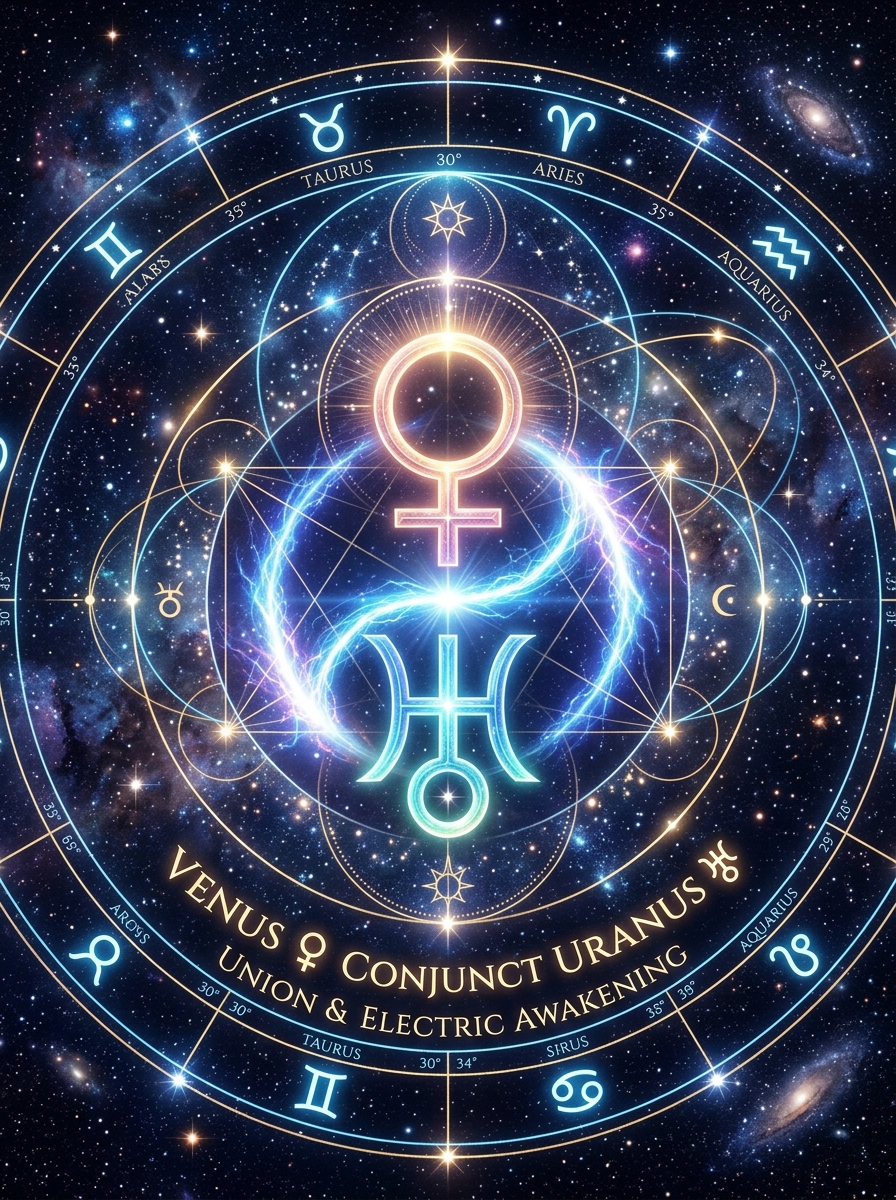
The Signature of an Awakened Appetite
Venus conjunct Uranus does not produce a person who wants love — it produces someone for whom love must feel alive or it feels like death. The conjunction fuses the planet of harmony, pleasure, and bonding (Venus) with the planet of rupture, originality, and individuation (Uranus). The result is a desire circuit that refuses to run on autopilot. Routine affection, scripted romance, or relationships that demand self-erasure trigger an almost somatic revulsion. The psyche learns early that authenticity is non-negotiable, even if it costs stability.
This is not rebellion for its own sake. The deeper need is for contact that preserves aliveness — a kind of relational voltage that cannot be faked. People with this aspect often notice strangeness before sweetness, fall fast, and feel drawn to partners who expand their inner weather. Their taste in beauty, art, and people runs toward the unconventional: the off-center, the futuristic, the genuinely weird. For a broader understanding of the archetype at work, see Uranus in astrology.
The psychological mechanics are wired into the nervous system. Uranus governs sudden flashes of insight and electric charge; Venus governs attraction and value. When they sit together, desire becomes inseparable from surprise. The native may feel bored by predictability to the point of physical restlessness, and can mistake intensity for intimacy. The body responds to timing, contrast, and a sense of freedom — not to comfort. Early on, this can create a loop: longing for closeness, recoiling when it becomes familiar, craving distance again. That oscillation is not fickleness; it is a survival strategy for a psyche that associates possessiveness with psychic static.
Psychological Roots and the Architecture of Self-Worth
Because Venus rules what we value, this conjunction ties self-worth directly to authenticity. The native secretly fears that being deeply known will flatten their radiance into routine. They may feel cheapened by predictability, or betrayed by their own tendency to accommodate. This is where the aspect’s formation matters: many people with Venus conjunct Uranus grew up in environments where affection arrived in flashes, or where boundaries shifted without warning. The conjunction can become a repetition compulsion — an attempt to master early unpredictability by recreating it in adult bonds.
The house placement of the conjunction deeply shapes how this plays out. For example, with the conjunction in the Fourth House, the urge to belong conflicts with a family pattern of eccentricity or emotional discontinuity. In the Tenth House, the native may assert freedom through career choices or public style — a rebel whose charisma is professional. In the Twelfth House, the rebellion is interior, operating beneath the surface: hidden attachments, private longings, a love life that only makes sense as a spiritual disruption. When the chart also features Uranus retrograde, the need for individuation turns inward, less flamboyant but no less fierce.
The conjunction also shapes values through sudden reversals. Aesthetic tastes can shift overnight; what was cherished yesterday may feel irrelevant today. This is not superficial — it reflects a fidelity to an internal law of becoming. The challenge is learning to distinguish conscious evolution from nervous reaction. When Venus conjunct Uranus is conscious, it produces a person whose values are genuinely alive, not frozen.
How It Plays Out: Love, Creativity, and the Refusal of Possession
In relationships
The most durable relationships for Venus conjunct Uranus are those that leave air in the room. The native needs a partner who respects independence, enjoys mental electricity, and is not threatened by change. Friendship matters more than usual here — the bond must be based on mutual admiration and shared ideals, not on sentimental glue. Unconventional structures often work: non-monogamy, long-distance, periodic separations, or a rhythm that allows each person to evolve without the other feeling betrayed. The native is happiest with someone who is intelligent, unusual, and self-possessed — a partner who can be a companion in freedom.
The shadow pattern is the thrill-exit-repeat loop. The native may unconsciously choose unavailable people, because absence keeps the bond charged and spares them the labor of sustained intimacy. Or they may provoke a rupture just to feel something again. This is not superficial fickleness; it is a psyche that has not yet learned that stability can be dynamic. Maturation involves learning to preserve the spark without blowing up the container. Explicit agreements about independence, a relationship culture that welcomes reinvention, and the ability to separate aliveness from crisis are key. For those with Uranus in the Seventh House, the need for relational sovereignty becomes overt; with Uranus in the Fifth House, the spark often pours into romance and creativity with equal force, demanding both passion and freedom.
In creativity and work
The aesthetic radar of Venus conjunct Uranus is extraordinary. These natives often feel what is contemporary before consensus catches up. Their style can be edgy, spare, glam, futuristic, ironic — anything but tired. They bring originality to fashion, design, art, music, social life, or simply the way they arrange a room. In work, they thrive in fields that allow innovation and autonomy: technology, the arts, social movements, entrepreneurship, or any career where they can be seen as a unique creator rather than a cog. When the conjunction falls in the Eleventh House, that originality becomes social and collective — the native may build communities around shared ideals or become a catalyst for group change. In the First House, the personal magnetism is unmistakable; every gesture signals individuality.
The Friction and the Gift
The gift of this conjunction is an almost prophetic sensitivity to what is essential. The native instinctively distrusts social policing, rigid gender scripts, and ownership disguised as love. This gives the aspect an emancipatory quality — it can make someone an ally of the outsider, a champion of the strange. Psychologically, it supports a high tolerance for difference and an ethical aversion to coercion. At its best, the native teaches, by example, that tenderness does not have to be tame and freedom does not have to be cold.
The friction is a tendency to confuse excitement with truth. When any decrease in emotional temperature reads as failure, the native may abandon relationships prematurely or cling to drama as proof of aliveness. There can be abrupt speech about love — the unfiltered honesty that liberates can also wound, especially when detachment is used as a shield against vulnerability. And because Venus rules what we cherish, changing preferences can feel chaotic to others. The mature expression learns to refine the electric impulse: to distinguish genuine originality from mere chaos, liberating freedom from fear dressed up as independence.
Over time, the native can develop an almost surgical discernment about love and beauty. They no longer need shock to feel alive; they learn that reliability can be a container for surprise, not its enemy. This is where Uranus transits often catalyze growth, especially when they activate Venus, the Fifth House, or the Seventh House. The person who integrates Venus conjunct Uranus becomes a living artwork — someone whose love is both tender and unpossessed, whose values evolve without betraying their core. The question this aspect asks is not “Will I be free?” but “Can I stay real inside devotion?” The answer, for those who learn to hold the paradox, is a love that never goes dead.
Comments
Loading comments…