Venus Sextile Uranus: The Elegant Shock of Love and Style
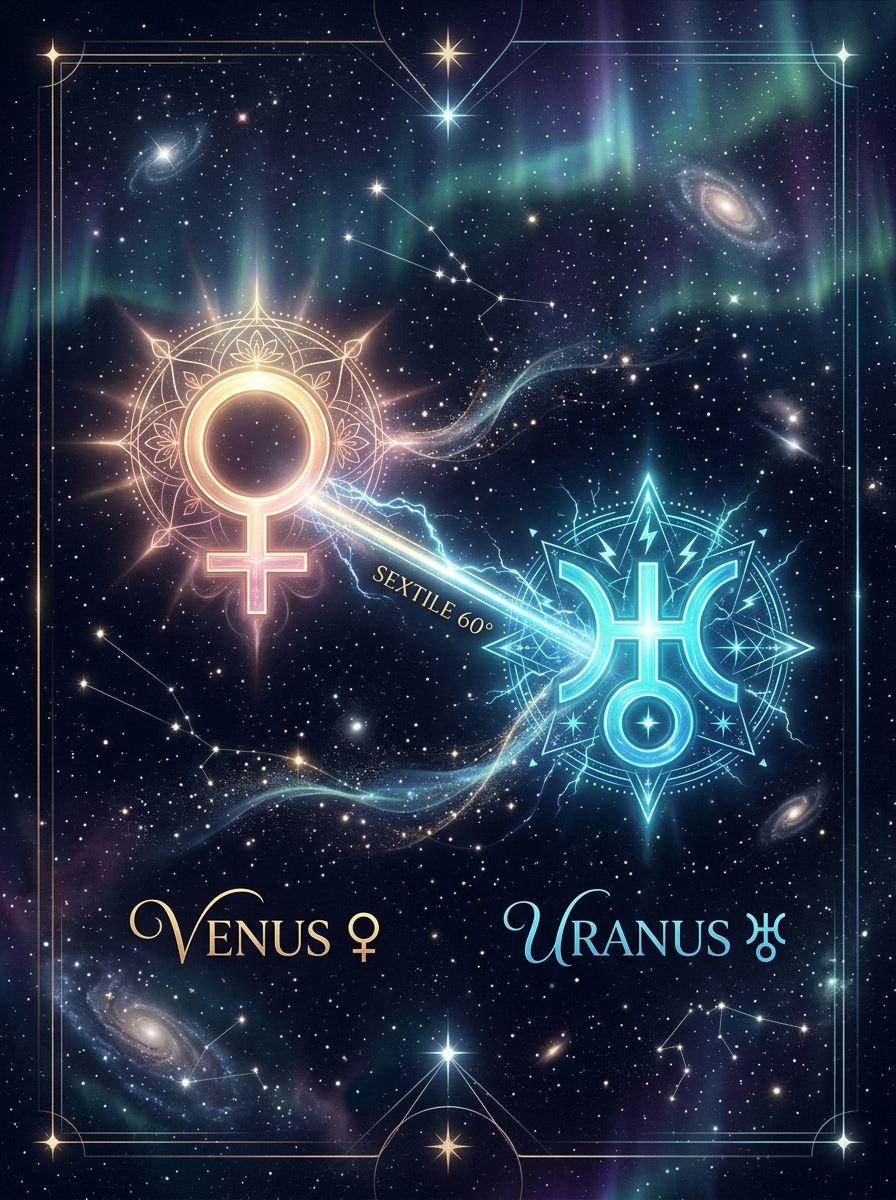
Venus sextile Uranus in the natal chart describes a mind and heart that cooperate around freedom, originality, and attraction. The core thesis is simple: Venus wants harmony, pleasure, and rapport; Uranus wants truth, novelty, and emancipation. In sextile, those drives do not cancel each other out—they become mutually useful. The person often has a clean instinct for what is fresh without becoming merely rebellious, and for what is beautiful without becoming stale.
The Core Dynamic: Venus Meets the Lightning Bolt
This is not the aspect of heavy sentiment or conservative attachment. Venus governs desire, value, sweetness, aesthetics, and the way we metabolize closeness. Uranus introduces asymmetry, speed, surprise, and disobedience to convention. In a sextile, the two planets exchange help without friction. The result is a temperament that can enjoy connection without surrendering autonomy. There is a crisp social intelligence here: the ability to read a room, then gently but unmistakably refuse to be absorbed by it.
The native’s charm arrives with individuality intact. Unconventional taste emerges, but not necessarily shock value. They may prefer an odd detail over a polished cliché, a clever turn over a predictable compliment, a unique person over a socially approved one. When this works well, aesthetic sense becomes a form of truth-telling. The sextile is not passive luck—it is latent capacity that asks to be used. A good companion for understanding this mechanism is the meaning of the sextile aspect, which frames the active potential of the 60° angle.
What the Sextile Actually Does
A sextile is a 60° angle between two planets, often in complementary elements. Here, Venus and Uranus usually occupy signs that share an element or a comfortable polarity (e.g., air + air, or earth + air). That geometry creates a channel for easy exchange. The native does not have to fight to integrate novelty with affection—the integration comes naturally, provided they put the aspect to work. The risk is not using it at all, letting the potential lie dormant. This is why the sextile demands conscious activation, unlike a trine which delivers effortless flow.
Psychological Roots: The Temperament That Needs Air
Affection is rarely static with this placement. The native is typically drawn to people, objects, styles, and relationships that feel alive, intelligent, and a little ahead of the curve. Sentimentality feels like mold; predictability feels like a cage. The emotional rhythm is intermittent rather than heavy. They can love deeply, but need oxygen—partners and friends who are self-directed and not possessive.
The Attachment Style
The bond is strongest when it does not demand emotional uniformity. Many with this aspect flourish with friendship within romance, or romance that feels improvisational rather than scripted. They often do poorly with routines that flatten individuality. Even when loyal, they require relational space to remain warm. This is not coldness; it is a Venus that must breathe. For a subtler, less fluent version of this adjustment, see the semi-sextile in astrology, which describes a quieter, more awkward integration of similar tensions.
The Role of the Nervous System
Because Uranus dislikes repetition, the person may unconsciously devalue consistency. Boredom can arrive quickly, especially when a relationship or creative practice becomes too predictable. The challenge is that intimacy requires some tolerance for rhythm—the return of the same human being in a new mood. If the native is always chasing the next spark, they may miss the slower voltage of trust. This is where brilliance becomes evasion: keeping things light to avoid the demands of depth, using wit and independence as a shield against vulnerability. The shadow expression of this aspect is not catastrophe, but a chronic refusal of the ordinary that masquerades as vitality.
Maturation: From Evasion to Elegant Freedom
The soul lesson of Venus sextile Uranus is not “be unconventional.” It is subtler: learn to keep desire alive without confusing aliveness with interruption. The mature form of this aspect creates someone who can renew what they love instead of abandoning it when it becomes familiar. That is the real achievement—not perpetual novelty, but a capacity to keep eros fresh, style current, and relationship breathable.
The Venus-Uranus Marriage Inside the Psyche
Psychologically, this aspect signals an internal negotiation between the part that wants to be loved (Venus) and the part that refuses domestication (Uranus). When integrated, the person becomes a living bridge between intimacy and independence. They can love without overfusing, and differentiate without disappearing. The best expression is not chaos—it is elegant freedom. The native’s presence can teach others that closeness does not need to mean sameness, and that beauty is most persuasive when it still has a pulse. For a deeper understanding of the Uranian archetype, Uranus in astrology frames the broader principle of liberation and individuation.
How the Shadow Works
When underused, Venus sextile Uranus frays into restlessness. The native may confuse freshness with vitality, or freedom with emotional noninvolvement. They may attract partners who are also inconsistent, then call the instability chemistry. The issue is not lack of feeling; it is sometimes fear that feeling will arrive with obligations attached. Overstimulation is common—sudden changes, surprise messages, unusual attractions can feel exciting at first, then draining. The work is to recognize that freedom is not the same as absence of attachment. This aspect wants relationships and creative spaces where individuality is protected, not relationships that never deepen. It often benefits from partners who are self-contained and confident enough not to cling. For a fuller pattern, especially if the native also has Uranus in the seventh house (Uranus in the 7th House), personal freedom becomes a central life motif in partnership.
How It Lives in One Life: Love, Work, and Taste
This aspect does not require separate sections for each domain. The same dynamic—Venus softened by Uranus, Uranus civilized by Venus—shows up across arenas.
In Love
The native wants a lover who is interesting before they are merely reassuring. Eccentricity, intellectual agility, and social unconventionality attract. The relationship works best when there is an element of friendship, shared curiosity, and permission to remain somewhat separate. Overmanaged romance suffocates; affection that feels spontaneous and alive thrives. This is not the same as emotional coldness—the warmth can be real and generous, but it moves through banter, novelty, and mutual respect. Contrast this with Moon-Venus synastry, which emphasizes soothing attachment and emotional caretaking rather than electric rapport.
In Work and Money
Professionally, Venus sextile Uranus favors fields where taste and innovation intersect: design, media, branding, music, fashion, tech aesthetics, curation, diplomacy with a twist, or entrepreneurial work that rewards flexibility. The native may not thrive in rigid hierarchies unless they have real room to improve the system. They often do better when allowed to refresh a product, a look, a process, or a social atmosphere. Money may come unevenly if the rest of the chart amplifies Uranian unpredictability, but the same quality creates an exceptional instinct for emerging trends and future-facing work. If Venus also relates strongly to the public sphere, Venus in the 10th house deepens the theme of visible taste and professional magnetism, while Uranian emphasis keeps that public image from becoming generic.
In Aesthetic Sense
Taste with this aspect is both refined and offbeat. The eye favors asymmetry, modern lines, unexpected pairings, eclectic music—beauty that feels alive rather than decorative. The native detects what is prematurely fossilized; they know when prettiness has become propaganda. In creative work, this aspect excels at remixing, updating, and recontextualizing. It wants expression, not just ease. That practical pulse is why a sextile matters more than a trine in some cases: it demands action, not lounging. For a look at how Urainan disruption operates in the daily grind, see Uranus in the 6th House.
The Deeper Lesson
The mature form of Venus sextile Uranus is not perpetual novelty—it is devotion that remains light, and freedom that remains warm. The person learns that intimacy does not have to be heavy, and independence does not have to be lonely. This aspect is a blessing for anyone who must live creatively, love intelligently, or build a life that resists stagnation. It does not promise smoothness. It promises movement with grace.
Related
- Venus Trine Uranus: The Grace of the Unpredictable Heart
- Venus Conjunct Uranus: Electric Love, Unruly Desire, and the Need to Stay Free
- Sun Sextile Uranus: The Genius of Awake Selfhood
- Venus Square Uranus: The Voltage of Unruly Desire
- Venus Opposes Uranus: The Electric Heart and the Problem of Freedom
Comments
Loading comments…