Synastry: Venus Conjunct Mars — The Heat Between Wanting and Being Wanted
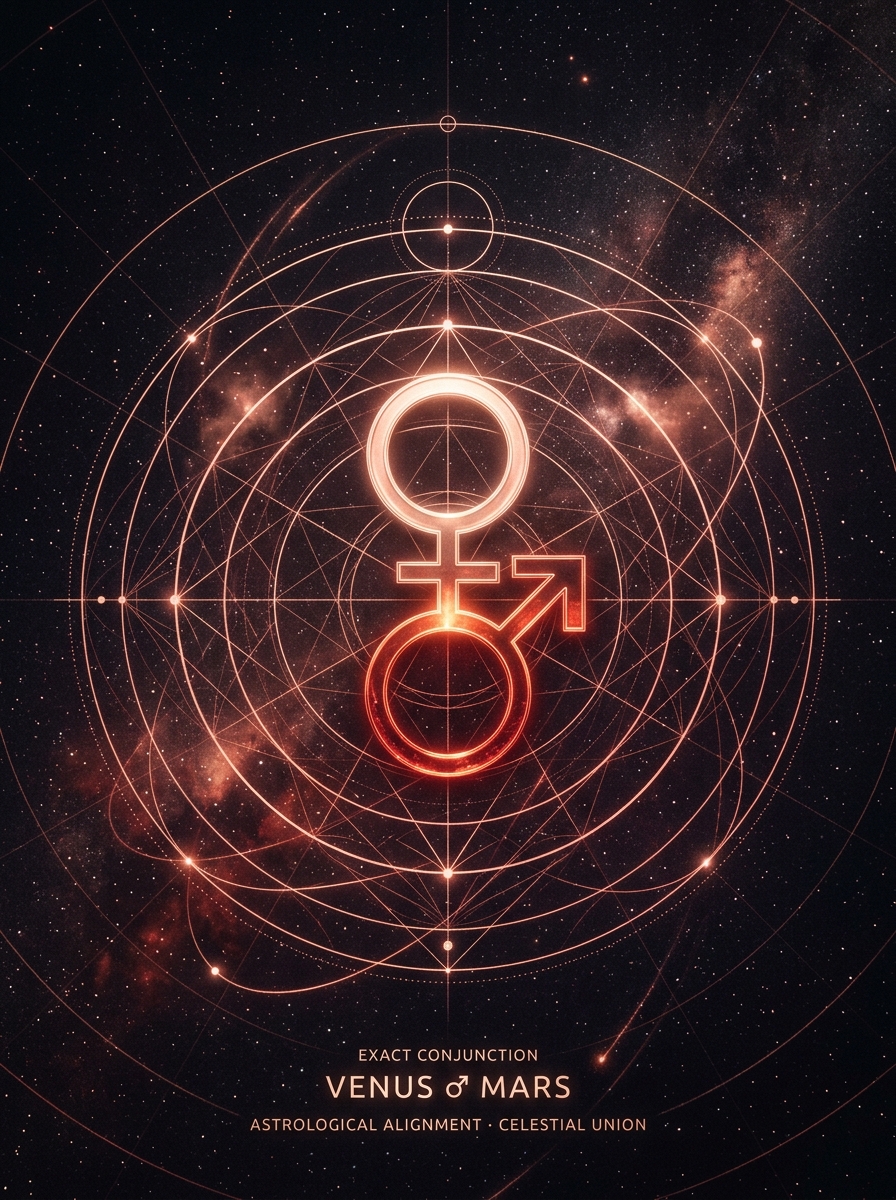
In synastry, Venus conjunct Mars is not “good chemistry” in the abstract sense; it is the moment affection acquires voltage. One person’s Venus receives, values, and allures; the other’s Mars pursues, asserts, and ignites. When they meet by conjunction, desire becomes personal, immediate, and hard to ignore. The core truth is this: the aspect fuses attraction with action, so love feels active and action feels loving. That fusion can be sweet, erotic, creative, competitive, or protective—all four at once. It is rarely neutral.
The Core Dynamic: Attraction That Begins in Contact
A conjunction compresses two planetary functions into a single field. With Venus conjunct Mars, the bond does not begin at a distance; it begins in contact. The Venus person often experiences the Mars person as visibly alive, charmingly forward, or uncannily desirable. The Mars person experiences the Venus person as beauty made human—not just attractive, but worth effort, pursuit, and enactment. This is why the aspect is famous for instant chemistry. It creates a feedback loop in which wanting and being wanted appear to happen at once.
That loop exhilarates, but it also wires the relationship for immediacy. There is little room for cool observation. Feelings translate into gestures quickly, and gestures are rarely “just gestures.” A flirtatious text, a delayed reply, a hand on the small of the back—all land with disproportionate force. For the wider context of how this aspect fits into a relationship chart, see astrological synastry—the conjunction is one note in a larger chord, but often the note people remember first.
Mutual activation, not simple projection
A common misunderstanding is that the Mars person wants the Venus person. That is only half the story. Venus also wants Mars—perhaps not in the same style, but in the same gravitational field. The Venus person may be drawn to the Mars person’s confidence, clarity, or raw aliveness. The Mars person may be drawn to the Venus person’s taste, ease, or capacity to make life feel worth inhabiting. Each supplies what the other does not fully carry alone.
This mutual activation is what makes the conjunction feel alive rather than merely lustful. In stronger versions, the couple becomes more elegant together, more decisive together, more artistically productive. The two planets are different, but they cooperate. That is why the aspect can support both romance and collaboration, especially when the relationship has a shared craft or mission. For a fuller exploration of how Venus and Mars interact as archetypes, see Venus and Mars Synastry.
Psychological Roots: The Embodied Charge
Venus conjunct Mars is one of the clearest synastric signatures for attraction that feels embodied rather than abstract. It is not “I admire you.” It is “my body notices you.” The aspect sharpens tone of voice, eye contact, timing, dress, and proximity. Even when the couple is not overtly sexual, a current of charge makes the relationship feel alive in the room. People may comment on the pair’s chemistry before either partner is ready to name it.
A lot of attraction lives in projection. Venus–Mars conjunctions reduce that distance. The relationship wants to touch reality. The chemistry is strongest when the people are actually engaging: making plans, creating something, solving something, kissing, arguing, moving furniture, showing up. The aspect does not thrive on endless ambiguity. It wants an object. It wants a response. It wants the return stroke.
That can make the relationship thrillingly honest, but it also produces impatience. If the attraction is not met with tangible contact, one or both people may feel agitated, restless, or suspicious. The Mars principle does not like being strung along; the Venus principle does not like being reduced to a chase. When the balance is healthy, the relationship teaches both people how desire becomes companionship through repeated acts of approach. To understand how this dynamic interacts with the rest of the synastry overlay, see synastry step-by-step—this conjunction should be judged after the personal planets, not before them.
Maturation and Shadow: From Heat to Style
The shadow of this aspect is not absence of feeling; it is too much feeling with too little regulation. Mars may press too hard, interpret every pause as rejection, or convert longing into conflict. Venus may attract without meaning to, then feel overwhelmed by the force of the response. In difficult cases, the relationship becomes a theater of seduction and irritation: one person pursues, the other yields; then the roles reverse; then both complain the spark is gone when it has been displaced into drama.
That does not mean the aspect is unhealthy. It means it is vivid. The same energy that fuels romance can fuel competitiveness, impatience, and a need to “win” affection. The aspect asks for refinement, not suppression. Over time, the most successful Venus–Mars unions do not chase intensity for its own sake. They develop a shared style of wanting. That style might be playful, sensual, athletic, flirtatious, or quietly devotional. The point is that the couple learns a rhythm—how to approach, how to repair, how to keep the spark from becoming static. This is where the conjunction stops being an event and becomes a signature.
The difficulty is that this rhythm is fragile. If one person habitually overfunctions, the conjunction turns lopsided. If the Mars person uses force to manage insecurity, or the Venus person uses charm to avoid candor, the aspect degrades into performance. The magnetism may remain, but it stops nourishing the bond. For insight into how specific house overlays or sign placements shift the expression, read about synastry house overlays—a conjunction in the 5th house feels very different from one in the 8th.
Applications in Life: Love, Work, and Creative Alchemy
Because Venus conjunct Mars governs making as well as mating, its effects extend beyond romance. In love, the aspect provides an erotic equality that prevents one partner from collapsing into passivity and the other into conquest. Each person gets to be both desired and active. That is not a small lesson; it is one of the central moral achievements of adult intimacy. The aspect is a natural foundation for relationships that are passionate and equal—though it does not guarantee emotional safety. Other indicators, such as Sun-Moon synastry or Moon-Venus synastry, describe how we belong to each other; Venus conjunct Mars describes how we are pulled into motion together.
In work or creative collaboration, the same charge becomes momentum. Taste and force cooperate: one person knows what pleases, the other knows how to press through resistance. The result can be design, music, entrepreneurship—any joint project requiring elegance and nerve. The erotic energy does not vanish; it is transmuted. That alchemy is especially visible when one partner has a strong Mars signature elsewhere—say, Mars in Aries or Mars in Leo—because the conjunction then has more fire to work with. Even a quieter Mars can animate Venus beautifully when the context supports mutual respect.
The aspect also shapes the way the couple navigates conflict. Because desire and frustration share the same nerve, arguments can feel personal and intense. Yet if both partners remember that the conjunction’s root is a wish for contact, even a fight becomes a form of connection. The key is pacing: the same heat that flares can be channeled into repair, not resentment.
In the end, Venus conjunct Mars is the aspect of a hand reaching for another hand and finding heat. Not peace first, but heat. Not certainty first, but contact. If handled well, that contact becomes tenderness with a pulse. If mishandled, it becomes craving with a costume. Either way, it is never dull—and in relationship astrology, dullness is its own kind of absence. For a complete guide to reading synastry aspects, see synastry aspects.
Related
- Venus Conjunct Mars: Desire That Knows Its Own Name
- Venus Opposite Mars in Synastry: Desire at the Edge of Friction
- Mars Conjunct Mars in Synastry: Shared Fire, Shared Fault Lines
- Synastry: Venus Sextile Mars — The Ease of Mutual Spark
- Venus Square Mars Synastry: Desire, Friction, and the Spark That Won’t Sit Still
Comments
Loading comments…