Synastry Sun Sextile Moon: When Warmth Finds a Home
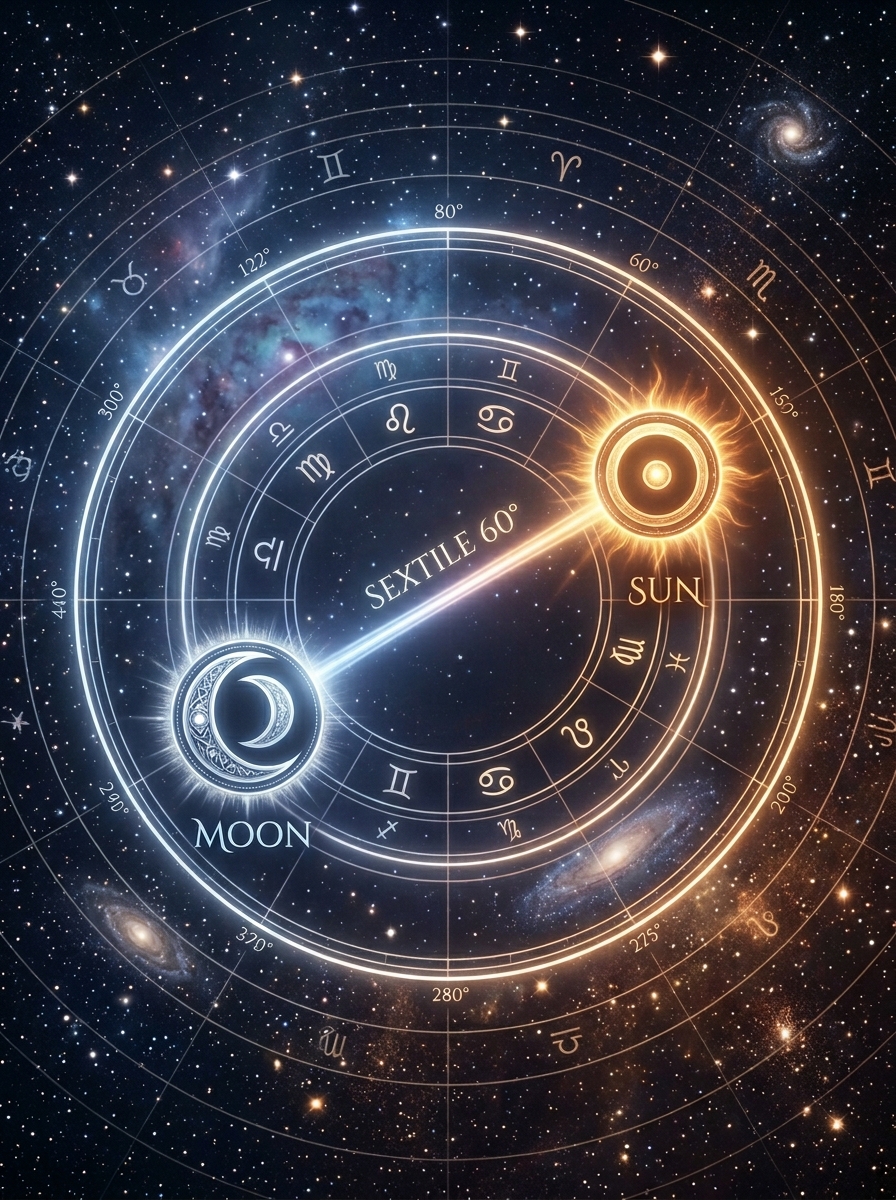
The Core Pattern: Recognition Without Collision
Sun sextile Moon in synastry is one of the clearest signatures of mutual ease: the solar person’s manner of being and the lunar person’s emotional rhythm can cooperate without flattening each other. The aspect is active, not passive. It does not merge two people into sameness; it creates a usable bridge, a current of instinctive recognition that makes it easier to like, trust, and respond. The Sun says “this is who I am.” The Moon says “this is what feels safe.” In a sextile, those statements are different enough to stay interesting and close enough to become collaboration.
That distinction matters. A Sun-Moon sextile is not the dramatic magnetism of a conjunction, nor the tense recognition of a square or opposition. It is the relationship’s capacity to work with human difference rather than dramatize it. The couple may not always feel fated, but they often feel administratively, emotionally, and physically compatible in a way that supports actual life. For a broader frame on this family of contacts, see Sun-Moon synastry and the larger map of synastry aspects.
Why this aspect feels so “natural”
A sextile links signs of compatible elements, so there is usually some shared language underneath the different temperaments. Fire speaks to Air, and Earth speaks to Water. In practice, that means one person may enliven, clarify, or embolden the other, while the other supplies receptivity, emotional memory, or a sense of continuity. The relationship often feels like someone finally knows how to answer the other person in the right tone.
This is why the aspect can seem deceptively simple. The attraction is often quiet at first: ease of conversation, a sense that one person “gets” the other’s needs, or that being together makes ordinary life smoother. The chemistry is not always theatrical, but it is consequential. A sextile can be the difference between a bond that burns brilliantly and a bond that actually lasts. That broader principle of activation is central to the sextile aspect, which tends to reward initiative rather than passivity.
The Psychological Architecture: How Two Different Rhythms Find a Shared Key
The sextile is a 60-degree link, a minor harmonic that implies opportunity through effort. Unlike a trine, which flows automatically, a sextile asks for conscious engagement. In synastry, this means the Sun and Moon do not automatically understand each other—they have an affinity that must be enacted. The solar person’s will and the lunar person’s feeling world are not identical; they are complementary in a way that requires each to attend to the other’s language.
Psychologically, this aspect creates a dynamic of reciprocal psychological differentiation. The Sun person tends to project confidence, direction, and visibility; the Moon person embodies receptivity, memory, and subsurface need. In healthy sextile chemistry, neither collapses into the other’s role. The Moon person does not become a caretaker who abandons their own emotional landscape, nor does the Sun person become a tyrant of will who ignores the lunar weather. Instead, each learns to hold their own center while trusting the other’s difference. This is the opposite of fusion—it is differentiation with rapport.
The subtle friction that keeps the bond awake
A good sextile needs a little resistance to stay alive. If the Sun and Moon were perfectly interchangeable, the relationship would flatten into habit. The minor friction here is not a flaw; it is the engine. One person leads more from intention, the other from need. One is more visible, the other more atmospheric. Those differences create a natural division of labor, but they can also generate subtle disappointment if either person expects total psychic transparency.
The most common friction is not conflict but mismatch in tempo. The Sun may want to move, decide, announce, or define. The Moon may want to sense, wait, retreat, or process. In sextile, these differences are usually negotiable, but they still exist. If ignored, they can produce a strange kind of resentment: “I’m always the one pushing.” Or, “I’m always the one holding the emotional weather.” The relationship stays pleasant, but one or both people begin to feel typecast.
The Mature Expression: When Ease Becomes a Craft
Because the aspect is harmonious, it can lull people into assuming the bond will run itself. That is the main trap. A sextile is latent potential, not a guarantee. The couple may fall into routines that are soothing but unexamined, mistaking emotional ease for actual intimacy. The Moon might become the keeper of atmosphere while the Sun becomes the keeper of direction, and neither realizes they have stopped meeting each other as equals.
This is where the aspect quietly asks for consciousness. The way to lose a sextile is to stop participating in it. Unlike the urgency of a hard aspect, which forces awareness through pressure, the sextile rewards deliberate engagement. The bond remains strongest when each person keeps making fresh contact instead of coasting on goodwill. For the interpretive mechanics of that active quality, the astrology of the sextile is worth reading alongside this page.
The shadow of over-familiarity
When the sextile is not consciously tended, it degenerates into a pleasant but hollow routine. The Sun person may feel emotionally unseen because the Moon person has learned to smooth over all edges; the Moon person may feel that their full emotional range is not welcome because the Sun person prefers steady optimism. This is not dramatic rupture—it is a slow flattening of depth. The couple can drift apart while still being kind to each other.
The antidote is differentiated intimacy: each person must risk asserting the part of themselves that does not fit the script. The Moon person must be allowed to be moody without being treated as irrational; the Sun person must be allowed to be self-directed without being treated as selfish. When that mutual respect is present, the aspect becomes a durable relational language rather than a pleasant accident. Psychological maturity is the vehicle that turns the sextile from a nice coincidence into a craft.
Living the Sextile: Where the Bridge Touches Real Life
The practical expression of Sun sextile Moon depends on which person holds each planet and what else is happening in the chart, but certain patterns recur. The solar person often catalyzes confidence in the lunar person. The lunar person often softens the solar person’s edges without diminishing their will. This is a relationship that tends to support domestic functioning, shared timing, and ordinary affection—the very things that determine whether a connection can survive beyond initial chemistry.
In romantic partnership
The couple is often good at making decisions that honor both personal pride and emotional comfort. They can navigate family, schedules, and daily stress with less relational debris than average. Desire here is not the raw appetite of Venus-Mars synastry alone, but it is sustained because each person feels safe enough to let desire unfold. The Moon often wants emotional steadiness before vulnerability; the Sun often wants to feel seen before fully giving energy. A sextile gives each person enough of what they need to move forward without pushing. For adjacent forms of emotional glue, compare Moon-Venus synastry and Venus-Mars synastry.
In daily life and work
This aspect often appears in relationships that function well under pressure. The Sun and Moon sextile is less about grand gestures and more about the rhythm of ordinary competence: who remembers to buy milk, who picks up the dry cleaning, who knows when the other needs silence. These micro-competencies accumulate into a shared culture that feels almost invisible but is deeply stabilizing. If the Sun and Moon are placed in houses that govern career or home, the couple may collaborate professionally or co-manage a household with unusual efficiency. The synastry house overlays page shows where such ease lands in the concrete geography of life.
The role of the rest of the chart
A sextile is not a complete relationship diagnosis. It can be overshadowed by harsher signatures if the rest of the synastry is strained, or it can sweeten difficult contacts elsewhere. When reading a chart, always contextualize the Sun-Moon sextile within the full overlay and aspect network. The synastry step-by-step guide offers a method for weighing contacts without overinterpreting any single one. The sextile opens a channel, but the actual relationship is built through the rest of the chart, the maturity of the people, and the choices they make inside that channel.
Reading the Texture Without Flattening It
A Sun sextile Moon never means “perfect compatibility.” It means compatibility is available and can be made real. The distinction is essential. The aspect opens a channel, but the actual relationship depends on condition, maturity, and the rest of the chart. A sextile between a wounded Moon and an overinflated Sun can still produce disappointment if neither person knows how to use the gift. A sextile between two emotionally literate adults can become a marvel of timing, mutual encouragement, and domestic grace.
The sign placements matter because they tell you what kind of ease this is. A sextile between Aries and Gemini feels different from one between Cancer and Virgo, even though both are harmonious. One may produce lively stimulation and speed; the other, caretaking intelligence and practical support. The aspect itself describes the bridge. The signs tell you the texture of the bridge. If you want to study that texture in chart form, adjacent sign pages such as Gemini Sun, Cancer Moon or Cancer Sun, Virgo Moon can help illustrate how solar and lunar principles speak inside a single psyche before they meet in synastry.
The deeper reading: invitation, not fusion
From a psychological standpoint, this aspect often marks the place where a person feels invited rather than invaded. That is a subtle but important distinction. The Sun person is not erasing the Moon person’s inner life; the Moon person is not swallowing the Sun person’s will. Instead, each becomes more themselves in the presence of the other. Jung would recognize the value of that: the relationship does not solve the problem of difference, it creates a vessel sturdy enough to contain it.
That is also why this contact can age well. Its gifts are renewable. Attraction becomes trust; trust becomes emotional muscle; emotional muscle becomes a shared culture. The couple may not always speak in grand declarations, but they often know how to find each other in the ordinary dark. In the long arc of intimacy, that is not a minor blessing. It is the architecture of endurance.
When you read this aspect alongside the broader relationship picture, remember the rule of proportion. A supportive Sun-Moon sextile can sweeten difficult contacts elsewhere, and it can also be overshadowed by harsher signatures if the rest of the synastry is strained. But by itself, it is one of the loveliest forms of astrological consent: two people whose essential rhythms can meet, adjust, and continue.
Comments
Loading comments…