Mars in Cancer: Navigating the Tides of Action, Protection, and Desire
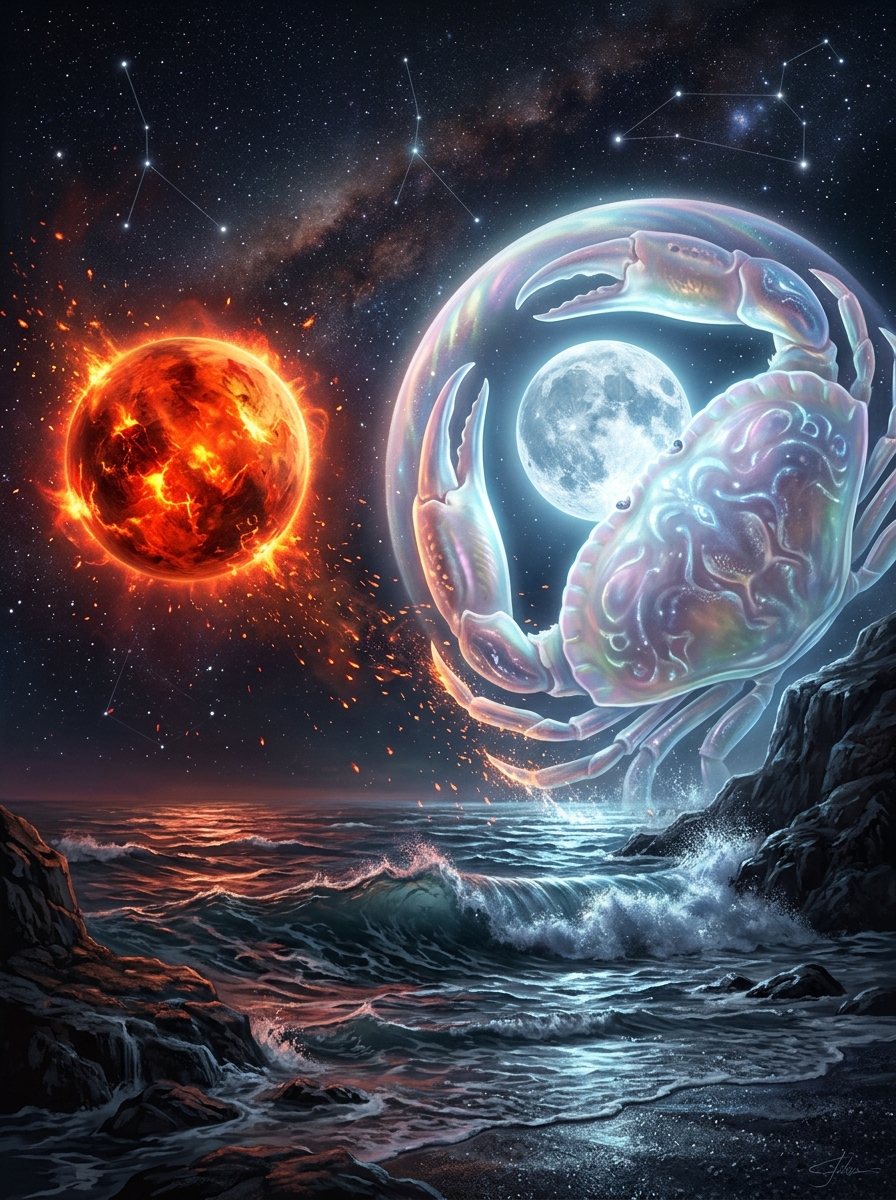
Introduction: The Paradox of Cardinal Water and Martial Fire
To place Mars, the planet of raw impulse, severing action, and burning ambition, into the cardinal water sign of Cancer is to drop a red-hot iron into a deep, cool well. The immediate result is steam—a mist of feeling, defense, and protective instincts that veils direct sight. In traditional astrology, Mars in Cancer is described as being in its "fall" (or debility). This classification is not a cosmic condemnation; rather, it is a structural statement about how planetary energy behaves when forced to adapt to an environment that operates on rules opposite to its own nature. Mars is naturally outgoing, linear, and divisive. It seeks to separate, conquer, and establish the ego’s boundaries through direct action. Cancer, ruled by the Moon, is receptive, cyclical, consolidating, and deeply concerned with security, history, and emotional safety. When the warrior planet operates within this watery, protective sanctuary, the blunt sword is replaced by a fluid shield, and the frontal charge becomes a protective circle.
When Mars resides in Cancer, the drive for self-assertion cannot rely on simple, unthinking aggression. If you try to wield Mars in Cancer like a standard Aries or Scorpio Mars, the emotional consequences are immediate and destabilizing. Instead of an immediate outward explosion, the martial heat is absorbed by Cancer’s watery medium, creating a pressurized chamber of feeling. To understand this placement is to recognize that energy is never truly lost; it is simply translated. Here, the drive to build, fight, and compete is subordinate to the emotional state of the individual. If the inner environment feels unsafe, the outer drive is temporarily suspended, pulling back into the shell until the emotional weather clears. This produces a temperament that is profoundly cautious, deeply intuitive, and intensely loyal, acting not out of a desire for abstract victory or dominance, but out of a fundamental need to establish and maintain a secure foundation for the self and those within its intimate sphere.
Astrologically, Mars rules our survival instincts, our libido, and our capacity to cut ties when a situation no longer serves our evolutionary growth. In Cancer, this capacity to cut is softened and complicated by the sign's natural urge to cling, preserve, and remember. The resulting tension is one of the most significant themes in the life of a Mars in Cancer individual. They must learn to balance the desire to protect the past with the necessity of moving forward into the unknown. When this balance is achieved, they display a unique form of courage—a quiet, enduring strength that is not based on the destruction of the enemy, but on the preservation and nourishment of life itself.
The Concept of Astrological Fall
Astrological traditions, particularly those synthesized by twentieth-century psychological astrologers like Liz Greene, suggest that a planet in its fall reveals where we must work most consciously to integrate our primal drives. When a planet is in its "fall," it is placed in the sign opposite to its sign of exaltation (for Mars, this is Capricorn). While Mars in Capricorn is exalted because it channels energy into structured, objective, and long-term goals with cool, detached efficiency, Mars in Cancer operates in a deeply subjective and emotional landscape. There is no distance between the observer and the observed; every action is personal, every challenge is felt as an emotional threat, and every ambition is tied to the fluctuating weather of the psyche.
This subjectivity means that the individual cannot easily detach their actions from their feelings. In Capricorn, Mars can compartmentalize, executing tasks regardless of personal discomfort or emotional resistance. In Cancer, however, if the emotional alignment is missing, the physical body itself will rebel, exhibiting fatigue, somatic symptoms, or an insurmountable sense of lethargy. This forces the individual to develop a high level of self-awareness. They must learn that their drive is not a machine to be switched on at will, but a living ecosystem that requires nurturing, safety, and clear emotional motivation before it can function effectively in the outer world. They must recognize that their energy is naturally cyclical and that trying to force a linear progression will only result in burnout and frustration.
Emotional Armor and the Red Planet
Esoterically, this placement represents the soul's decision to defend the soft, vulnerable spaces of life. In the analytical psychology of Carl Jung, we find the concept of the persona—the mask we wear—and the anima/animus, which help illuminate how Mars in Cancer functions as a psychic defense mechanism. The outer shell of the Cancerian crab is hard, calcium-rich armor, but inside lies an incredibly tender, sensitive core. Mars in this sign acts as the gatekeeper of this inner sanctuary. Every action taken by a Mars in Cancer individual is designed, at some level, to ensure that this vulnerability is never exploited or violated by a harsh external environment.
This armor is not purely defensive; it is also highly selective. Mars in Cancer individuals are masters of reading the emotional temperature of a room, sensing threats long before they manifest physically. This makes their actions highly calculated and protective. They do not initiate conflict for the sake of triumph or intellectual superiority; they mobilize their energy to preserve the integrity of the home, the family, and the internal emotional landscape. When we analyze this placement, we must look beyond the surface level of simple physical output and examine the complex psychological architecture that dictates when, how, and why these individuals choose to act, recognizing that their apparent hesitation is often a sophisticated form of strategic assessment. Their defense is active, watchful, and deeply tied to the preservation of their emotional sanctuary.
The Sinuous Walk: Lateral Action and Indirect Defense
If you observe a crab on a sandy beach, you will notice that it never walks in a straight line toward its destination. It moves sideways, keeping its eyes fixed on potential threats while navigating the terrain with lateral, winding steps. This is the fundamental physical metaphor for Mars in Cancer’s approach to action, ambition, and conflict resolution. Confronting a problem head-on feels unnatural, reckless, and unnecessarily risky to this placement. A direct frontal assault is viewed not as a sign of courage, but as an invitation to vulnerability, exposure, and potential destruction.
Instead of charging forward, Mars in Cancer maneuvers around obstacles. They feel out the emotional currents of a situation, sensing where the resistance is weakest and where they can gently slide through without triggering an open battle. In the evolutionary astrology framework popularized by Steven Forrest, this is recognized as a highly sophisticated method of psychic preservation. By avoiding direct confrontation, the individual conserves their vital energy and avoids the clean, traumatic breaks that Mars so loves to make in other signs. They seek to resolve disputes through persuasion, atmospheric adjustments, and quiet negotiations rather than dramatic, public showdowns.
This lateral movement can make them incredibly effective in negotiations and diplomatic settings. While others are busy asserting their egos and demanding immediate compliance, Mars in Cancer is quietly observing, understanding what each party needs to feel secure, and formulating a solution that addresses those underlying emotional needs. They are the masters of the soft sell, the gentle persuasion, and the gradual alignment of interests. Their strategy is to disarm their opponents not with force, but with empathy, making it very difficult for others to maintain their defensive posture against them.
The Metaphor of the Crab
The lateral movement of the crab is not a sign of cowardice, though less sensitive observers might mistake it for such. It is a strategic calculation based on a realistic assessment of vulnerability. To Mars in Cancer, the shortest distance between two points is rarely a straight line; it is a path that minimizes emotional exposure and preserves resources. When faced with a demanding boss, a difficult partner, or a competitive colleague, these individuals will rarely issue a direct challenge or demand a public reckoning. Instead, they will adjust their positioning, build quiet alliances behind the scenes, or work diligently to make themselves indispensable before anyone even realizes they are competing.
This indirect approach is also highly visible in how they pursue their professional ambitions. Rather than loudly declaring their goals or engaging in aggressive self-promotion, they quietly cultivate the skills and relationships necessary to secure their position. They occupy spaces gradually, like water filling a vessel, making themselves indispensable. This can make them incredibly effective strategists and leaders, as their moves are difficult to predict or counter by those who rely solely on direct, linear styles of engagement. They play the long game, relying on patience, timing, and emotional resonance to achieve what others attempt to take by force.
Cyclical Drive: Fluctuating Energy and Lunar Moons
One of the most challenging aspects of Mars in Cancer for the individual—and for those who work or live with them—is the highly cyclical nature of their energy. In a modern culture that demands constant, linear productivity and treats human beings as machines, the natural rhythm of Mars in Cancer can feel like a distinct liability. Because Cancer is ruled by the Moon, the martial drive is intimately tied to the changing lunar phases, the shifting tides of the emotional body, and the general sense of internal security.
There are days when the Mars in Cancer individual is filled with a quiet, fierce determination, working tirelessly to organize their environment, support their loved ones, and care for their responsibilities. There are other days when their energy completely vanishes, replaced by a deep need to retreat, sleep, and withdraw from the demands of the world. This is not laziness or a lack of discipline; it is a physiological and psychological necessity. When the emotional cup is empty, the physical engine simply will not start. The body and mind demand a period of hibernation to process accumulated impressions and restore the energetic reserves.
To live in harmony with this placement, one must learn to reframe the concept of progress. In a society that values constant forward movement, the cyclical retreat of Mars in Cancer is often pathologized. However, in the natural world, all growth occurs in cycles. Winter is not a failure of summer; it is the necessary preparation for it. Similarly, the periods of withdrawal and low energy experienced by Mars in Cancer are essential for their creative and physical renewal. It is during these quiet times that they integrate their experiences, recharge their emotional batteries, and prepare for the next active phase of their life.
The Tide of Motivation
Understanding this ebb and flow requires a fundamental shift in how we define motivation. For Mars in Cancer, motivation is not a mechanical switch that can be turned on at will through discipline or logic. It is a tide. When they attempt to force themselves through a period of low energy using sheer willpower or societal pressure, they often encounter severe internal resistance, resulting in physical exhaustion, digestive issues, or deep emotional burnout.
To work effectively with this placement, one must learn to read the internal weather and honor the cycles. During the high tide, tasks should be tackled with intensity, particularly those that require deep focus, emotional investment, and creative problem-solving. During the low tide, the focus should shift to maintenance, rest, reflection, and nurturing the self. By aligning their schedule with these natural fluctuations rather than fighting against them, Mars in Cancer individuals can achieve a sustainable, highly productive rhythm that honors their water element and protects their well-being. They must learn to trust that the tide will always return, and that their periods of rest are just as valuable as their periods of action.
The Active Guardian: Fierce Protection of the Tribe
While Mars in Cancer may hesitate to defend themselves directly, their entire demeanor changes when someone they love is threatened. In these moments, the indirect, cautious crab disappears, replaced by a maternal or paternal guardian of terrifying intensity. The cardinal nature of Cancer emerges, showing its capacity for decisive, defensive action when the stakes are high. This protective instinct is not limited to biological family; it extends to anyone the individual has accepted into their inner circle—their chosen "tribe."
Whether it is a close friend, a romantic partner, or a vulnerable colleague, Mars in Cancer will stand as an impenetrable wall between the threat and the protected. They are the ones who will quietly handle a crisis, make sure everyone is fed and safe, and confront an external enemy with surprising ferocity. Esoterically, the warrior energy of Mars is here dedicated to the preservation of life, continuity, and emotional sanctuary. The home is not just a building; it is a fortress, and Mars in Cancer is the sentinel guarding the gate. This makes them exceptionally loyal partners and friends, individuals who will stick by those they love through the darkest times, provided that loyalty is respected and reciprocated.
This protective drive also manifests in their work and community life. They are often drawn to roles where they can defend the vulnerable, advocate for the safety of others, or build environments that foster comfort and security. They make excellent educators, nurses, counselors, and community leaders, utilizing their martial energy to create spaces where others can grow and heal without fear of external harm. Their strength is not designed to dominate, but to shield, making their presence deeply grounding and reassuring to those in their care. They are the quiet protectors who watch over the community, ensuring that the flame of human connection and mutual care is never extinguished. In modern psychological terms, this is the activation of the protective parent archetype, where aggression is sublimated into service. Instead of fighting for egoic validation, Mars in Cancer uses its sword to clear a safe clearing in the wilderness of the world, building a sanctuary where life can be nurtured, educated, and healed.
Esotericist and mystic authors, when discussing this cardinal water action, highlight its capacity for deep, subterranean endurance. It is the steady erosion of stone by water, the slow but inevitable victory of the maternal instinct over the destructive martial force. A person with this placement does not need to show off their power; they carry it as a quiet conviction, knowing that when the time comes, they will find the necessary strength to protect what they love. This makes them formidably resilient opponents in any struggle that involves the welfare of their chosen group.
The Shadow of the Crab: Passive-Aggressiveness and Guilt
Every astrological placement has its shadow, and for Mars in Cancer, this shadow is particularly complex and challenging to navigate. Because the direct expression of anger is blocked by fear of vulnerability or rejection, the martial energy must find alternative routes to escape the psychic system. When anger is repressed, it does not dissolve; it ferments and sours. The result is the classic Mars in Cancer shadow: passive-aggressiveness, the silent treatment, guilt manipulation, and emotional orchestration.
When hurt or offended, a Mars in Cancer individual is unlikely to say, "You hurt me, and I am angry." Instead, they may withdraw their warmth, project a heavy, atmospheric silence, or drop subtle, emotionally charged hints designed to make the other person feel guilty. They may unconsciously cast themselves as the martyr, highlighting their own sacrifices and care to make others feel responsible for their discomfort. This dynamic can create toxic, confusing patterns in relationships, as partners are left to guess what is wrong while navigating a minefield of unspoken resentment and shifting emotional currents. They become masters of the emotional guilt trip, using their vulnerability as a weapon to control the behavior of those around them. In its worst manifestation, this shadow uses helplessness as a coercive tool, forcing others to walk on eggshells to avoid triggering a subterranean emotional crisis.
Repression and the Pressure Cooker
This pattern often stems from early childhood experiences where open conflict was dangerous, chaotic, or discouraged. The child learned that expressing anger directly led to rejection, abandonment, or the loss of emotional security, so they developed sophisticated, indirect ways of getting their needs met or expressing dissatisfaction. Over time, this becomes an automatic, unconscious reflex that persists into adulthood. When they feel threatened, they revert to the child's defense mechanism of hiding and projecting their anger through indirect channels.
The danger of this pattern is that it prevents genuine resolution. Because the real issue is never brought into the light, it cannot be addressed, discussed, or healed. The pressure cooker continues to boil, leading to sudden, explosive outbursts that seem completely disproportionate to the immediate trigger, leaving others confused and defensive. Breaking this cycle requires the individual to develop a new, conscious relationship with their own anger, recognizing it not as a destructive force to be feared, but as a valuable signal that boundaries have been crossed and need to be communicated. They must learn that healthy conflict is not the enemy of intimacy, but rather the foundation upon which true, honest connection is built. They must realize that expressing direct, clear boundaries is actually an act of trust and love, rather than a threat to the relationship's security.
Intimacy and Desire: Sexuality and Relational Chemistry
In the realm of relationships and sexuality, Mars in Cancer operates with a distinct set of priorities that set them apart from more detached placements. For this placement, physical intimacy cannot be separated from emotional safety. Casual, detached sexual encounters are rarely satisfying and can often leave them feeling depleted, exposed, or emotionally unsettled. They require a foundation of trust, tenderness, and mutual care to fully open up and express their passion.
When they feel secure and cherished, however, Mars in Cancer is an incredibly intuitive, receptive, and deeply sensual partner. They possess an innate ability to read their partner’s emotional and physical needs, responding with a nurturing, protective touch that makes the intimate space feel like a true sanctuary. Their desire is not a conquest or a performance; it is a merging, a shared retreat from the harshness of the outside world where they can let down their armor completely. They seek a soulful connection, where the physical act of intimacy becomes a language for expressing deep, unspoken feelings of devotion and care.
In terms of compatibility, Mars in Cancer aligns naturally with the other water signs (Pisces and Scorpio), who understand their emotional depth, unspoken language, and need for intimacy without requiring constant verbal explanation. They also find strong compatibility with the earth signs (Taurus, Virgo, and Capricorn), who provide the stable, tangible structure and material security that allows the Cancerian water to flow safely. Capricorn, in particular, offers a fascinating polarity—its structured, objective approach to action can help ground and direct the fluid, subjective energy of Mars in Cancer, creating a powerful balance of emotional depth and practical stability. Together, they can build a life that is both emotionally rich and materially secure, combining the protective instincts of Cancer with the enduring discipline of Capricorn.
Channeling the Flood: Physical Outlets and Sports
Because Mars in Cancer stores a significant amount of emotional tension in the physical body—often manifesting as digestive issues, stomach tension, or chronic fatigue—finding appropriate physical outlets is essential for their overall well-being. Traditional high-impact, highly competitive sports that rely on aggressive confrontation or intense pressure can feel draining or emotionally stressful for this placement. They need activities that allow them to release pent-up energy without triggering their defensive instincts or exhausting their system.
Water sports are, naturally, an excellent fit. Swimming, kayaking, paddleboarding, or surfing allow them to connect with their native element, using the natural resistance of water to tone the body and soothe the nervous system. The rhythmic, repetitive motions of swimming can be highly meditative, helping to clear the emotional static that accumulates throughout the day. The water acts as a literal and symbolic cleanser, washing away the stress and tension of the external world and returning them to a state of emotional equilibrium.
Additionally, home-based physical activities are highly recommended. A dedicated yoga space, a home gym, or a simple routine of bodyweight exercises within their personal sanctuary allows them to move their body without the pressure of a public gym or the scrutiny of others. Gardening, hiking in nature near water sources, or participating in flow-based martial arts like Tai Chi or Qigong can also help balance the flow of energy, ensuring that the fire of Mars is smoothly integrated with the water of Cancer, promoting physical health and emotional peace. These practices help them stay grounded in their bodies, preventing the emotional buildup that leads to stress and somatic illness.
Pathways to Integration: Transforming Sensitivity into Strength
The ultimate goal for Mars in Cancer is not to try and change their nature, but to integrate their sensitivity so that it becomes a source of conscious power rather than unconscious defense. This begins with acknowledging that anger is a natural, healthy, and necessary emotion. They must give themselves permission to feel angry without immediately feeling guilty, feeling like a bad person, or fearing that their anger will destroy their relationships. They must learn to separate the feeling of anger from the act of destruction, realizing that anger is simply information indicating that a boundary has been violated.
Practicing direct communication is a crucial step in this journey. This does not mean they have to become confrontational, aggressive, or loud. Rather, it means learning to state their boundaries clearly, calmly, and honestly, using "I" statements to express their needs without resorting to hints, emotional withdrawal, or manipulation. For example, saying, "I feel overwhelmed and need some quiet time," is far more constructive than retreating into a sullen silence and hoping others notice their distress. It is about claiming their right to exist, to feel, and to defend their space without needing to make excuses or play emotional games.
By honoring their need for security while building the courage to stand their ground, Mars in Cancer individuals can transform their astrological "fall" into a profound spiritual asset. They become the true guardians of the heart, capable of taking powerful, sensitive action in service of what truly matters: love, family, community, and the preservation of the sacred spaces of life. They teach us that true strength is not found in the loudness of the shout or the force of the blow, but in the capacity to care, protect, and stand firm in our vulnerability. They show that sensitivity, when consciously integrated, is one of the most powerful and transformative forces in the human experience.
Frequently Asked Questions
Is Mars in Cancer really a weak placement in a birth chart?
No, it is not a weak placement. While traditional astrology terms it the "fall" of Mars, this simply means the energy operates differently than the typical martial stereotype. Mars in Cancer possesses immense defensive strength, emotional intelligence, and a powerful protective drive. Their strength is not explosive or loud; it is resilient, quiet, and enduring. They are capable of surviving trials that would break more aggressive placements because of their capacity to adapt and protect their core energy. They fight not for glory, but for survival and the defense of those they love.
How does Mars in Cancer handle conflict and confrontation?
Mars in Cancer tends to avoid direct confrontation, preferring to navigate conflicts laterally and indirectly. If threatened or hurt, they may withdraw into their shell, use the silent treatment, or exhibit passive-aggressive behaviors. However, if their loved ones, home, or emotional security are threatened, they will defend them with surprising intensity and courage, showing that they can be fierce protectors when necessary. Their defensive instinct is powerful and immediate when their core boundaries or tribe are compromised.
What are the best career paths for someone with Mars in Cancer?
Individuals with Mars in Cancer thrive in careers where they can protect, nurture, or build secure structures. Excellent fields include psychology, counseling, caregiving, real estate, culinary arts, interior design, historical preservation, and any profession that allows them to work independently or in a supportive, family-like environment where their emotional intelligence and dedication are valued. They excel in environments where success is measured by the quality of care and the strength of relationships rather than purely competitive output.
How can a Mars in Cancer individual express anger healthily?
They can start by recognizing their anger early before it builds up into resentment. Writing down their feelings, practicing direct but gentle boundary-setting, and using physical outlets like swimming, yoga, or home workouts can help release emotional tension and prevent passive-aggressive behavior patterns. Learning to trust that their relationships can handle honest communication is key. They must understand that expressing their boundaries is an act of love that preserves the relationship rather than damaging it.
What signs are most compatible with Mars in Cancer?
Mars in Cancer finds natural compatibility with the other water signs, Pisces and Scorpio, who share their emotional depth and intuitive understanding. They also align well with the earth signs, Taurus, Virgo, and Capricorn. Capricorn, as the opposite sign, offers a grounding polarity that can help Mars in Cancer structure and direct their emotional drive. This combination allows for a harmonious balance of emotional sensitivity and practical stability in relationships.
Comments
Loading comments…