Mercury Trine Saturn: The Mind That Can Hold Its Shape
The Core Dynamic
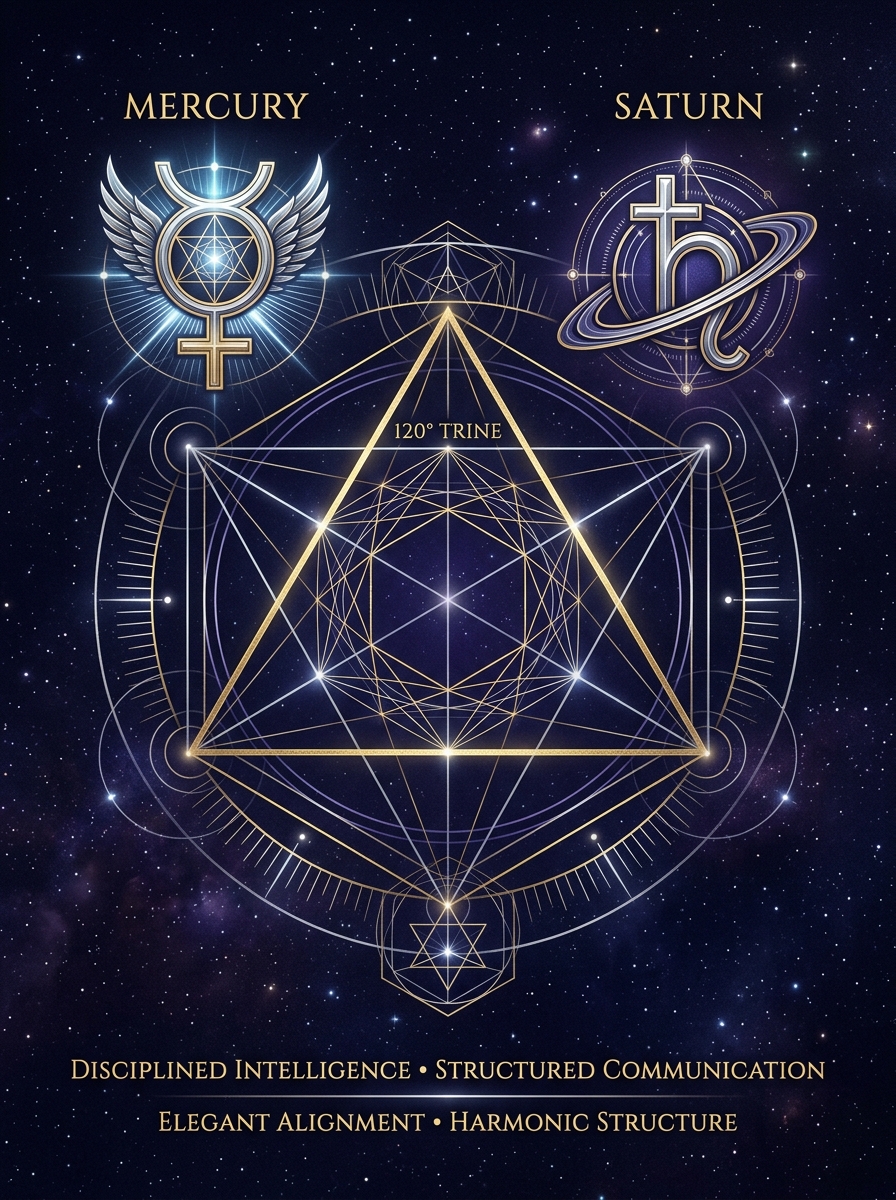
Mercury trine Saturn gives a mind that can bear weight. Thought and structure are not at odds here; they cooperate fluently, as if the quicksilver of Mercury had always known the spine of Saturn would hold. The result is a native who thinks in paragraphs rather than fragments, who edits before speaking, and whose judgment often proves reliable under pressure. But this ease comes with a hidden cost: the same fluency that produces discipline can harden into a caution so ingrained that spontaneity feels like a risk rather than a resource.
This is a trine, a 120° aspect that signals natural coordination, not tension. The planets do not need to fight for dominance — they already agree. For the geometric logic behind this, see the trine aspect. With Mercury and Saturn, the agreement is especially visible in the relationship between mental motion and mental containment. The native can explain a complex thing without ornamental excess, reads the room before speaking, and respects evidence, sequence, and consequence. There is usually an early sense that words matter because they have consequences. In some charts, this becomes expertise. In others, it becomes silence: thought arrives only after it has already been judged.
How This Architecture Forms
The psychology of Mercury trine Saturn begins in childhood. The native learns quickly that careless speech leads to correction, that being wrong is costly, and that precision earns approval. Saturn internalizes that lesson into an inner supervisor — a voice that asks “Is this accurate? Is this necessary? Will this hold up?” — while Mercury adapts by learning to think before it speaks. The two planets cooperate so naturally that the native may not recognize how much inhibition has been built into the mind.
This is different from the experience of Saturn in Gemini, where structure is applied to thinking through a sign — often with more friction and a need to consciously develop discipline. Here, the trine makes the discipline feel effortless, which is both gift and trap. The mind becomes a well-ordered archive, but the cost can be a subtle loss of creative chaos. The native may never feel free to think aloud without the inner examiner grading every syllable. The shadow of a harmonious aspect, as described in the Grand Trine’s trap of harmonic inertia, is precisely this: nothing forces the issue, so the psyche can coast inside its own competence.
When Mercury is stationed in a more private house — say Mercury in the 12th House — the internalized authority can become ancestral in tone. The person may have absorbed that thinking aloud had to be earned, that their voice must justify its existence. In such cases, the trine describes not just skill but a survival strategy that became elegant enough to be mistaken for personality.
The Mature Expression and Its Shadow
This aspect improves with age, because both planets are patient in different ways. Mercury becomes better at choosing its targets; Saturn becomes less punitive and more wise. The native often grows into a voice that is cleaner, leaner, more grounded — someone who can speak with earned authority rather than performed certainty. They write better in adulthood, teach better after practice, and finally trust the evidence of their own experience. By midlife, they often sound as though they have been thinking with a longer horizon than their peers all along.
But the ease of the trine can also mask a problem: the native may not recognize how much inhibition has been built into the mind. The warning signs are subtle: overediting, difficulty improvising, needing certainty before speaking, treating every idea as a contract. The person may mistake caution for rigor and silence for wisdom. This is the shadow of a trine that the Astrological Trine aspect describes as the risk of complacency — here, it takes the form of mental austerity. The native edits out curiosity before it can become insight.
The fear underneath is straightforward. Bad ideas feel dangerous. Being wrong feels costly. Looking foolish may feel intolerable. So the mind learns to delay itself until it can be certain — and certainty never fully arrives. The corrective is not recklessness but permission: the chart asks for rooms in the mind where unfinished thought can exist without immediate sentencing.
How It Plays Out in a Life
In work, Mercury trine Saturn shows up as a talent for tasks that require sustained attention: editing, accounting, law, engineering, medicine, research, coding, archival work — any craft where precision accumulates value over time. The native learns through repetition, then refines through reflection. They are rarely the most chaotic genius in the room; they are the one who can still think clearly after the noise has passed. This is why the aspect is common in charts of strategists, analysts, teachers, and system-builders whose mind must keep its balance under pressure. For a deeper look at how this operates professionally, see Mercury in the 10th House and Saturn in the 10th House, where the mind and reputation become instruments of vocation.
In relationships, this aspect is often mistaken for emotional distance. More precisely, it is emotional regulation. Saturn gives Mercury a container sturdy enough to keep feeling from flooding language, so the native speaks calmly even in serious moments. They do well with difficult conversations because panic does not easily hijack syntax. But the same containment can become a defense: analysis replaces confession, competence replaces vulnerability. The psyche learns that being clear is safer than being seen — a functional stance in crisis, but impoverishing in intimacy. When the rest of the chart supports warmth, this aspect gives emotional maturity. When it doesn’t, it produces someone articulate about life but underwritten in living it.
In daily life, the native often has an instinctive respect for sequence and consequence. They are the person who remembers details, notices contradictions, and rarely promises what they cannot deliver. They become trustworthy not because they try, but because their mind naturally favors accountability. This is especially visible when Mercury operates in the Sixth House, where work and method become the theater for this discipline, or when paired with Saturn in a house that emphasizes craft.
What It Asks For
The final task of Mercury trine Saturn is not more control, but wiser use of control. The psyche already knows how to hold. The deeper work is learning when to open, when to revise, and when to let an idea be imperfect long enough to become alive. This means consciously inviting the strange version, the unfinished draft, the conversational risk — even when every instinct says to wait.
The aspect matures most fully when the native learns to distinguish between rigor and fear. Rigor serves truth; fear serves safety. The same mind that can build a cathedral of thought can also learn to leave the door open. That is the real elegance of this trine: a mind strong enough to make form, and mature enough not to confuse form with truth.
For those with Mercury in Aquarius, the electric mind can be grounded without losing innovation; for those with Mercury in Pisces, the intuitive mind can be given structure without drowning. The trine offers a foundation; the sign and house tell you what the foundation supports. The chart is not finished until the native learns to trust both the container and the space inside it.
Comments
Loading comments…