Mercury in Sagittarius: The Expansive Mind and the Quest for Universal Truth
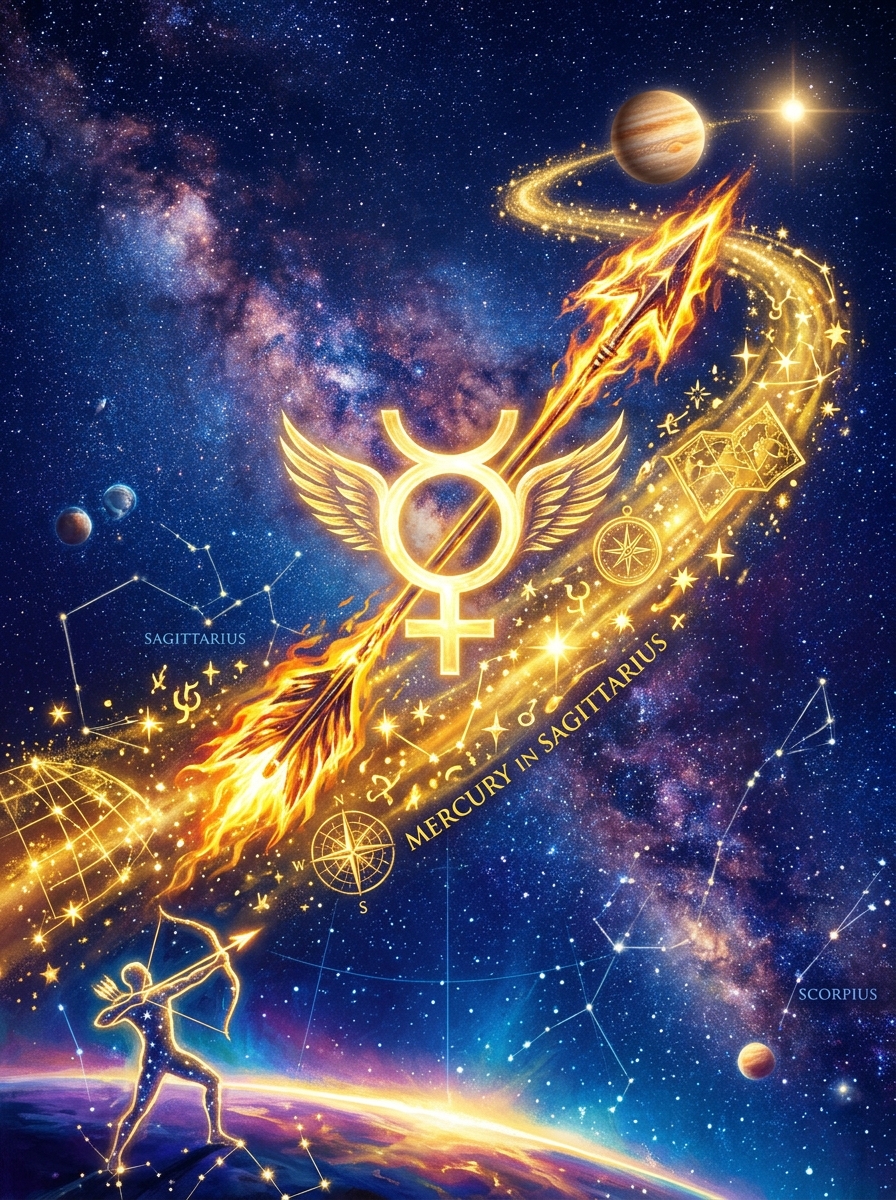
The Detriment Dilemma: Mercury in the Mutable Fire of Sagittarius
In classical astrological taxonomy, Mercury is said to be in its detriment, or exile, when traversing the mutable fire sign of Sagittarius. To understand this archetypal tension, we must examine the fundamental polarities of the zodiac. Mercury finds its domiciles in Gemini and Virgo—signs characterized by their meticulous attention to immediate detail, empirical classification, local networks, and precise analytical sorting. When Mercury enters Sagittarius, the polar opposite of Gemini, the planetary energy of intellect, language, and cognition is thrust into the expansive, Jupiter-ruled domain of the Centaur. Here, the local focus is shattered in favor of the global, and the immediate environment is replaced by the distant horizon. The mind is pulled away from the microscope and forced to look through the telescope, adjusting to a scale of perception that can feel both frustratingly vague and exhilaratingly vast.
Astrologers like Liz Greene have long pointed out that planetary "detriment" does not denote a lack of intellectual capacity or cognitive failure. Rather, it indicates a structural mismatch between the planet's native function and the sign's operational mode. Mercury's primary function is to distinguish, label, categorize, and relay information. It is the psychopomp, the translator, the keeper of the alphabet. Sagittarius, however, is a sign of synthesis, philosophy, belief systems, and cosmic order. Under the rulership of generous Jupiter, Sagittarius seeks the unifying principle behind the data points. If Mercury wants to look at the individual cells under a microscope, Sagittarius wants to look at the ecology of the entire forest. Consequently, Mercury in Sagittarius can feel awkward when tasked with taxes, technical manuals, or fine-print legalities. The mind rebels against the boundary, viewing the containment of details as a form of intellectual imprisonment. The native experiences a persistent impatience with the incremental steps of logical proof, preferring to leap directly to the conclusion, which they perceive as intuitively obvious.
This detriment creates a psychological landscape where the individual must learn to translate the vast, symbolic languages of the cosmos into functional human speech. Steven Forrest notes that mutable signs are transitional, constantly adjusting to new inputs. In fire, this mutability manifests as an intellectual wanderlust—a mind that is perpetually scanning the horizon for the next great truth. The detriment dilemma is therefore a conflict between analysis and synthesis. The Mercury in Sagittarius native does not want to merely know how something works; they want to know why it matters. This search for ultimate meaning can lead to brilliant philosophical breakthroughs, but it also carries the risk of skipping the foundational steps necessary to build a cohesive argument. The intellect operates by leaps of faith, relying on intuition to cross the chasms where logical bridges have not yet been constructed. They may struggle in environments that demand rigid compliance with administrative rules, yet they excel in situations that require creative vision, speculative leaps, and strategic foresight.
The Jovian Influence and the Hermetic Tension
The relationship between Hermes (Mercury) and Zeus (Jupiter) in mythology illustrates this cognitive tension. Hermes is the messenger who travels between worlds, utilizing cunning, agility, and wit to deliver messages. Zeus is the lawgiver, the king of the gods who oversees justice, philosophy, and the grand moral order from Mt. Olympus. When Mercury is ruled by Jupiter, the messenger is tasked with delivering the laws of the gods. The danger here is that the messenger may mistake themselves for the lawgiver, translating personal opinions into absolute universal truths. The Hermetic agility is subordinated to Jovian grandiosity. This can lead to a state of mind where the individual feels a sense of divine rightness, assuming their perspective is the only logical one and that anyone who disagrees is simply missing the bigger picture.
To resolve this tension, the individual must learn to cultivate the Mercurial art of listening. Because Sagittarius is inherently expressive and prophetic, Mercury here has a tendency to lecture rather than converse. By integrating the Gemini polarity—learning to appreciate the small, seemingly mundane facts that contradict their grand theories—they can ground their Jovian visions. The detriment is only a limitation if the native refuses to recognize the value of the details. When integrated, it yields a mind capable of translating complex metaphysical concepts into practical, inspiring philosophy. They become the bridge between the high mountain of Olympus and the busy streets of the marketplace, ensuring that the fire of inspiration is matched by the earth of practical execution.
Cognitive Style: Big-Picture Thinking, Intuition, and the Search for Meaning
The cognitive style of Mercury in Sagittarius is characterized by a high-altitude perspective. This is a mind that operates at ten thousand feet, looking down at the landscape to trace the patterns of rivers, roads, and cities rather than examining the architecture of a single house. The cognitive processing here is holistic rather than linear. While a native with Mercury in Virgo might build an argument brick by brick, ensuring each joint is perfectly aligned, the Mercury in Sagittarius individual starts with the blueprint of the entire city and assumes the bricks will find their place. This non-linear processing style allows them to synthesize massive amounts of disparate information, drawing connections between historical eras, scientific disciplines, and artistic movements.
This holistic approach is deeply rooted in intuition. In Jungian typology, Sagittarius corresponds strongly to Extraverted Intuition (Ne) or Introverted Intuition (Ni) operating through an active, passionate framework. The cognitive process is less about discursive reasoning and more about sudden flashes of insight. The mind leaps from one concept to another, identifying structural similarities between disparate fields—such as connecting quantum physics to ancient esoteric texts, or linking economic trends to psychological archetypes. This associative capacity allows them to see patterns that more analytical minds might miss. They are natural systems thinkers, seeing the world as an interconnected web of meaning rather than a collection of isolated phenomena. They perceive the underlying architecture of ideas, recognizing how beliefs shape behavior and how cultural myths govern history.
The Search for the Holy Grail of Truth
For Mercury in Sagittarius, cognition is not an academic exercise; it is a spiritual quest. The search for meaning is the primary driver of their intellectual life. Every book read, every course taken, and every conversation had is viewed as a step toward finding the "Holy Grail" of universal truth. This orientation makes them incredibly enthusiastic learners. They bring a passionate, almost religious fervor to their intellectual pursuits. When they discover a new philosophical system, scientific theory, or spiritual practice, they don't just study it—they adopt it as a worldview, seeing it as the key to understanding the universe. Their intellectual curiosity is fueled by a desire to locate the moral and existential compass of humanity, making them highly sensitive to hypocrisy or narrow-mindedness in the theories they encounter.
However, this cognitive style has a significant shadow side. The reliance on intuition and big-picture synthesis can lead to a dismissal of facts that do not fit the grand narrative. If a detail contradicts their philosophical model, the Mercury in Sagittarius mind may simply overlook it or declare it irrelevant. This can result in a superficial understanding of complex subjects, where the individual knows the vocabulary and the general concepts but lacks the technical competence to apply them rigorously. The challenge is to realize that the search for meaning must be paired with intellectual discipline, ensuring that the grand vision is supported by empirical reality. Without this grounding, their philosophical theories become airy castles built on shifting sands, incapable of withstanding critical scrutiny from more detail-oriented minds.
Communication Dynamics: Enthusiastic Rhetoric, Metaphor, and the Risk of Dogmatism
To listen to someone with Mercury in Sagittarius is to be swept up in a wave of enthusiasm. Their communication style is rarely dry, academic, or neutral. Instead, it is colorful, passionate, and deeply rhetorical. They communicate to inspire, to teach, and to convert. Using rich metaphors, allegories, and sweeping generalizations, they paint vivid mental pictures for their audience. They are natural storytellers who use narrative to convey deeper moral or philosophical truths. Whether they are discussing a trip to the grocery store or the nature of the cosmos, their language is infused with a sense of adventure and discovery. Their speech is marked by an expansive cadence, often building to a climax of inspirational insight that seeks to elevate the listener's consciousness.
In the Rider-Waite-Smith tarot deck, the card associated with Sagittarius is Temperance (XIV), representing the art of blending, balancing, and alchemy. In communication, this translates to an ability to synthesize different viewpoints and find the common thread that unites them. However, when Mercury is functioning poorly in this sign, the alchemy fails, and the communication becomes unbalanced. The enthusiasm can quickly morph into preachiness, and the desire to share truth can devolve into dogmatism. They may become proselytizers, convinced that their path is the only true way, and view disagreement as a sign of intellectual or spiritual blindness. This communicative righteousness can alienate friends, family, and colleagues who feel that their own perspectives are being run over by a philosophical steamroller.
The Prophetic Voice and the Lecturing Habit
The primary communication pitfall for Mercury in Sagittarius is the assumption of the pedagogical role. They naturally fall into the habit of teaching, lecturing, or counseling, even when the situation calls for simple listening or casual conversation. They may monopolize discussions, treating a dialogue as a platform for a sermon. This stems from a genuine belief that they have discovered something of immense value that must be shared for the benefit of all. However, to the listener, this can feel patronizing, condescending, or simply exhausting. They must learn that true communication is a two-way street, requiring receptive space as well as expressive force, and that listening is often the most generous intellectual gift one can offer.
Furthermore, Mercury in Sagittarius is notorious for its lack of diplomatic tact. Jupiter is the planet of expansion and truth, which means this placement values honesty over harmony. They speak their truths bluntly, often without considering the emotional impact of their words on others. This is not out of malice—as might be the case with Scorpio—but out of a naive belief that the truth is always liberating and should be spoken at all costs. The concept of the "noble lie" or the gentle softening of facts is foreign to them. They must learn that how a truth is communicated is just as important as the truth itself, and that silence can sometimes be the most profound philosophical statement. Learning to speak with kindness as well as honesty is a key milestone in their development, preventing unnecessary conflicts and ensuring their message is actually heard.
Learning Profiles: Universal Concepts, Cultural Systems, and Academic Fields
When it comes to education and learning, Mercury in Sagittarius thrives in environments that offer freedom, breadth, and philosophical depth. Standardized testing, rote memorization, and highly structured, linear curricula are the bane of their academic existence. They need to see the practical or philosophical utility of what they are learning. If they are taught algebra, they want to know how it connects to the structure of the universe, not just how to solve for $x$. Without this connection to a larger framework of meaning, their attention quickly wanders, and they may be labeled as unfocused or undisciplined students. They require teachers who act as guides and fellow travelers rather than rigid authoritarians, encouraging their innate questing spirit.
Their natural intellectual home is in the humanities, social sciences, and comparative systems. They excel in fields like comparative religion, philosophy, anthropology, international relations, and mythology. These disciplines allow them to compare different cultures, historical epochs, and belief systems, seeking the universal human truths that transcend time and space. They are also drawn to languages—not necessarily for the mechanical syntax, but as windows into different cultural worldviews. Travel is one of their primary learning tools; they learn best by immersing themselves in unfamiliar environments, testing their beliefs against the reality of different human experiences. They are the students who take a gap year to work in a remote village, returning with a profound thesis on cultural synthesis that challenges conventional academic models.
The Academic Nomad: Embracing Interdisciplinary Study
Because their interests are so broad, Mercury in Sagittarius individuals often struggle to specialize. They are the classic "academic nomads," moving from one major to another, or pursuing multiple degrees in seemingly unrelated fields. They are drawn to interdisciplinary studies where they can bridge the gaps between science, art, and spirituality. In a university setting, they are the students who challenge the professor's assumptions, seeking to connect the lecture topic to broader societal or ethical issues. They thrive in independent study programs that allow them to set their own reading lists and choose their own research paths, refusing to be confined by departmental borders.
To maximize their learning potential, they must learn to balance their desire for breadth with the necessity of depth. While it is exhilarating to know a little bit about everything, true intellectual power comes from mastering the specific methodologies of a discipline. They must learn to tolerate the dry, technical stages of learning—such as mastering grammar before writing a novel, or learning statistics before formulating a psychological theory. By framing these technical skills as necessary tools for their grand journey, they can overcome their natural aversion to detail. They must realize that a map is only useful if one also understands how to walk the terrain step by step, appreciating the structural integrity of each element.
Weaknesses and Integration: Grounding the Grand Vision and Finding Intellectual Humility
The primary intellectual shadow of Mercury in Sagittarius is a combination of conceptual laziness and intellectual grandiosity. Because they easily grasp the "gist" of an idea, they often assume they have mastered it entirely. This can lead to a form of pseudo-intellectualism where they speak authoritatively on subjects they have only studied superficially. They are prone to confirmation bias, actively seeking out philosophical or scientific theories that validate their pre-existing beliefs while ignoring data that challenges them. This dogmatic tendency can make them rigid and defensive when their worldview is questioned. They may interpret intellectual critique as a personal attack on their integrity or vision, retreating into a fortress of philosophical righteousness.
To integrate this placement, the individual must engage in the psychological work of grounding. In tarot symbolism, the Fool (associated with Uranus/air) must eventually learn the lessons of the Emperor (structure/boundaries) to manifest their potential. For Mercury in Sagittarius, this means developing a relationship with Saturn—the planet of boundaries, discipline, and empirical testing. They must learn to submit their grand ideas to the cold, hard test of reality, checking their facts, citing their sources, and acknowledging the limits of their knowledge. They must realize that details are not the enemy of vision, but the anchors that prevent the vision from blowing away in the wind, giving it the physical weight needed to impact the world.
Cultivating the Socratic Method and Gemini Playfulness
One of the most effective ways for Mercury in Sagittarius to find intellectual humility is to adopt the Socratic method of questioning. Socrates famously claimed that his only wisdom lay in knowing that he knew nothing. By shifting their role from the "teacher who knows" to the "student who questions," they can unlock the true potential of their placement. They must learn to ask: "What are the facts that contradict my theory?" and "What are the specific details I am overlooking?" This active pursuit of their own blind spots transforms them from dogmatic preachers into true philosophers who are genuinely committed to finding the truth rather than just being right.
Additionally, they can benefit from integrating the energy of their opposite sign, Gemini. Gemini brings playfulness, curiosity, and an appreciation for the variety of life without the need to fit everything into a moral or philosophical system. By allowing themselves to be curious about small, trivial, or disconnected facts just for the fun of it, they can break up the rigidity of their beliefs. Intellectual maturity for this placement involves holding their grand visions with a light touch, remaining open to correction, and recognizing that truth is not a fixed destination but an ongoing, collaborative dialogue. They learn to laugh at their own intellectual pretensions, embracing the simple joy of discovery and the beauty of a world that is too complex to be captured by any single theory.
Solar Combinations: Psychological Profiles when Paired with Scorpio or Sagittarius Suns
The expression of Mercury in Sagittarius is heavily modified by the position of the Sun. Because Mercury is never more than 28 degrees away from the Sun, a person with Mercury in Sagittarius will almost always have their Sun in Scorpio, Sagittarius, or Capricorn. Here, we examine the psychological profiles of the Scorpio and Sagittarius Sun combinations, highlighting how these solar forces shape the cognitive and communicative output.
The Scorpio Sun with Mercury in Sagittarius: The Philosophical Detective
When the Sun is in Scorpio and Mercury is in Sagittarius, we see a fascinating psychological paradox. Scorpio is a water sign characterized by its intensity, privacy, emotional depth, and focus on the hidden, taboo, or psychological aspects of life. It wants to dig deep into the shadows, uncovering secrets and understanding the emotional undercurrents of human behavior. Mercury in Sagittarius, by contrast, is expressive, optimistic, and focused on the broad, philosophical horizon. This creates an individual who uses their communicative and intellectual skills to shine a bright, searchlight-like beam into the dark corners of the human psyche.
This native is the "philosophical detective." They are not content with simple answers; they want to expose the hidden dynamics of power, psychology, or spirituality. However, unlike a typical Scorpio who keeps their findings private, this combination wants to speak about what they find, translating their deep, intuitive insights into broad philosophical principles. They can be powerful agents of transformation, using their blunt, Sagittarius communication style to break through social hypocrisies and speak the unspeakable. The challenge for this combination is to avoid becoming paranoid or dogmatic, ensuring that their search for hidden truths does not lead to conspiracy theories or a refusal to see the simple, light-hearted aspects of life. They must balance their deep skepticism with genuine optimism, recognizing that exposing a wound is only the first step toward healing it.
The Sagittarius Sun with Mercury in Sagittarius: The Pure Visionary
When both the Sun and Mercury are in Sagittarius, the Jupiterian archetype is amplified to its highest expression. This is the profile of the pure visionary, the teacher, the explorer, and the philosopher. There is a high degree of alignment between their core identity (Sun) and their cognitive style (Mercury). They live, think, and breathe the search for meaning, projecting an aura of boundless optimism, intellectual curiosity, and moral enthusiasm. They are often charismatic speakers who can inspire large audiences with their grand narratives, carrying people along on the strength of their vision.
This individual is a natural leader in the realm of ideas. They are the ones who inspire others to dream bigger, travel farther, and think deeper. However, the lack of contrasting planetary energy in their cognitive setup makes them highly vulnerable to the shadow sides of the sign. Without the emotional depth of Scorpio or the practical realism of Capricorn, the double-Sagittarius can become completely detached from reality, living in a world of abstract concepts and future promises while neglecting their current obligations. They can be prone to extreme exaggeration, dogmatism, and a refusal to face unpleasant facts. For this native, cultivating practical, grounding relationships and habits is not just helpful—it is essential for survival. They need practical partners or colleagues who can handle the administrative realities of their grand visions, allowing them to remain in the realm of inspiration without causing chaos in their physical lives.
Detailed Astrological Analysis: Houses and Aspects
To fully understand the manifestation of Mercury in Sagittarius, one must look beyond the sign placement to the house position and the major planetary aspects. The house where Mercury resides indicates the specific life department where the native's quest for meaning is enacted. For example, Mercury in Sagittarius in the Ninth House is in its natural joy, amplifying the focus on higher education, philosophy, and foreign travel. In contrast, Mercury in Sagittarius in the Fourth House might focus this philosophical search on family roots, psychological foundations, and the concept of homeland, creating a person who seeks to understand the ancestral myths that shape their domestic life.
Planetary aspects further refine this cognitive profile. A trine from Mars to Mercury in Sagittarius can inject their speech with courage and rapid decision-making, producing a dynamic, motivating communicator. However, a square from Saturn to Mercury in Sagittarius introduces a profound conflict. Saturn demands structure, empirical proof, and caution, which directly clashes with the expansive, speculative nature of Sagittarius. This aspect can create a mind that is constantly swinging between wild philosophical optimism and deep intellectual self-doubt. The individual may feel blocked in expressing their ideas, forcing them to work twice as hard to construct the rigorous logical frameworks that Saturn demands. Through this struggle, they often develop an incredibly robust, disciplined intellect that successfully bridges the gap between vision and reality, producing work of lasting value.
Esoteric Dimensions: The Rider-Waite-Smith and Crowley Connections
Looking at the esoteric associations of Sagittarius helps deepen our understanding of this placement. In the tarot system established by the Hermetic Order of the Golden Dawn, Sagittarius is ruled by the Temperance card (called Art in the Thoth system by Aleister Crowley). In the Rider-Waite-Smith deck, Temperance depicts an angel pouring liquid from one cup to another, symbolizing the mixing and balancing of opposites. For Mercury in Sagittarius, this is the intellectual task: to blend the rational with the intuitive, the scientific with the mystical, and the local detail with the global concept. The path of Temperance is not one of moderation in the boring sense, but of creative synthesis—the active creation of harmony from disparate elements.
In Crowley’s Thoth system, the Art card represents the alchemical marriage, the transformation of raw materials into spiritual gold. The Mercury in Sagittarius native is engaged in an intellectual alchemy. They take the raw, chaotic experiences of life and subject them to the fire of philosophical inquiry, seeking to extract the gold of universal truth. If the alchemy is rushed—if the native skips the detail-oriented steps of the process—the crucible cracks, resulting in dogmatic illusion. But if the process is respected, the result is a profound spiritual and intellectual transformation. Understanding this connection helps the native see their cognitive struggles not as a curse, but as a necessary phase in their development, where the detriment of Mercury is the very catalyst that forces the alchemical transformation of their mind.
Frequently Asked Questions
Why is Mercury in Sagittarius considered to be in its detriment?
In astrology, a planet is in detriment when it is in the sign opposite to the one it rules. Mercury rules Gemini (and Virgo), signs that focus on detail, analysis, and localized logic. Sagittarius, ruled by Jupiter, focuses on synthesis, broad concepts, and philosophy. Because Mercury's natural function is to analyze and categorize, it struggles in a sign that wants to expand, synthesize, and ignore the details. This creates an intellectual tension where the mind prefers the big picture over factual precision. The cognitive apparatus is configured for wide-angle views rather than macro close-ups, meaning the native must work consciously to develop precision and avoid skipping the logical steps required for coherent communication.
How does this placement affect communication in personal relationships?
Mercury in Sagittarius communicates with great enthusiasm, honesty, and passion, but can lack tact and diplomacy. In relationships, they are direct and blunt, often speaking the truth without considering how it affects their partner's emotions. They also have a tendency to lecture or teach rather than engage in a balanced dialogue. To improve their relationships, they need to practice active listening and learn that timing and delivery are just as important as the honesty of the message. They must learn that emotional vulnerability and validation are often more valuable than offering philosophical solutions to their partner's problems, shifting from a posture of teaching to one of sharing.
What are the best career paths for someone with Mercury in Sagittarius?
They thrive in careers that involve teaching, writing, philosophy, travel, or complex system analysis. They make excellent university professors, spiritual guides, travel writers, publishers, public speakers, and cultural anthropologists. They are also well-suited for roles in international business or law, where they can apply their broad perspective and conceptual thinking. They should avoid careers that require meticulous attention to repetitive data, such as accounting or technical proofreading, unless they have other grounding placements in their chart. They need environments that offer intellectual autonomy and the freedom to explore diverse conceptual terrains.
How can a Scorpio Sun with Mercury in Sagittarius balance depth and breadth?
This combination can balance depth and breadth by using their Sagittarius Mercury to voice and conceptualize the deep, psychological insights gained by their Scorpio Sun. They should focus on research, psychology, or investigative journalism, where they can dig deep into a subject (Scorpio) and then translate those findings into a broad, accessible narrative (Sagittarius). They must watch out for the tendency to become dogmatic about their psychological insights, remaining open to alternative perspectives. Developing a collaborative creative practice or seeking peer feedback can assist in grounding this intense cognitive combination.
Does Mercury in Sagittarius struggle with learning disabilities or cognitive issues?
No, planetary detriment does not translate to cognitive deficits or learning disabilities. Rather, it indicates that the individual's learning style does not align with traditional, linear, rote-based educational systems. They learn through intuition, narrative, and big-picture context. When forced to learn isolated facts without a unifying theme, they may struggle with focus or memory. However, when presented with the philosophical framework or historical context behind the subject matter, they demonstrate exceptional intellectual capacity and retention. They are narrative-driven learners who need to understand the 'why' before they can master the 'how'.
How can someone with Mercury in Sagittarius improve their attention to detail?
They can improve their attention to detail by deliberately linking details to their larger philosophical goals. For example, instead of viewing citations or formatting as boring chores, they can frame them as the essential structural supports that allow their grand ideas to be taken seriously by the intellectual community. Practicing mindfulness, using organizational tools, and collaborating with detail-oriented individuals (such as those with strong Virgo or Capricorn placements) can also help. The key is to see details not as a restriction of their freedom, but as the medium through which their grand vision becomes manifest in the physical world.
Comments
Loading comments…