Mercury Trine Jupiter: The Mind That Sees the Larger Pattern
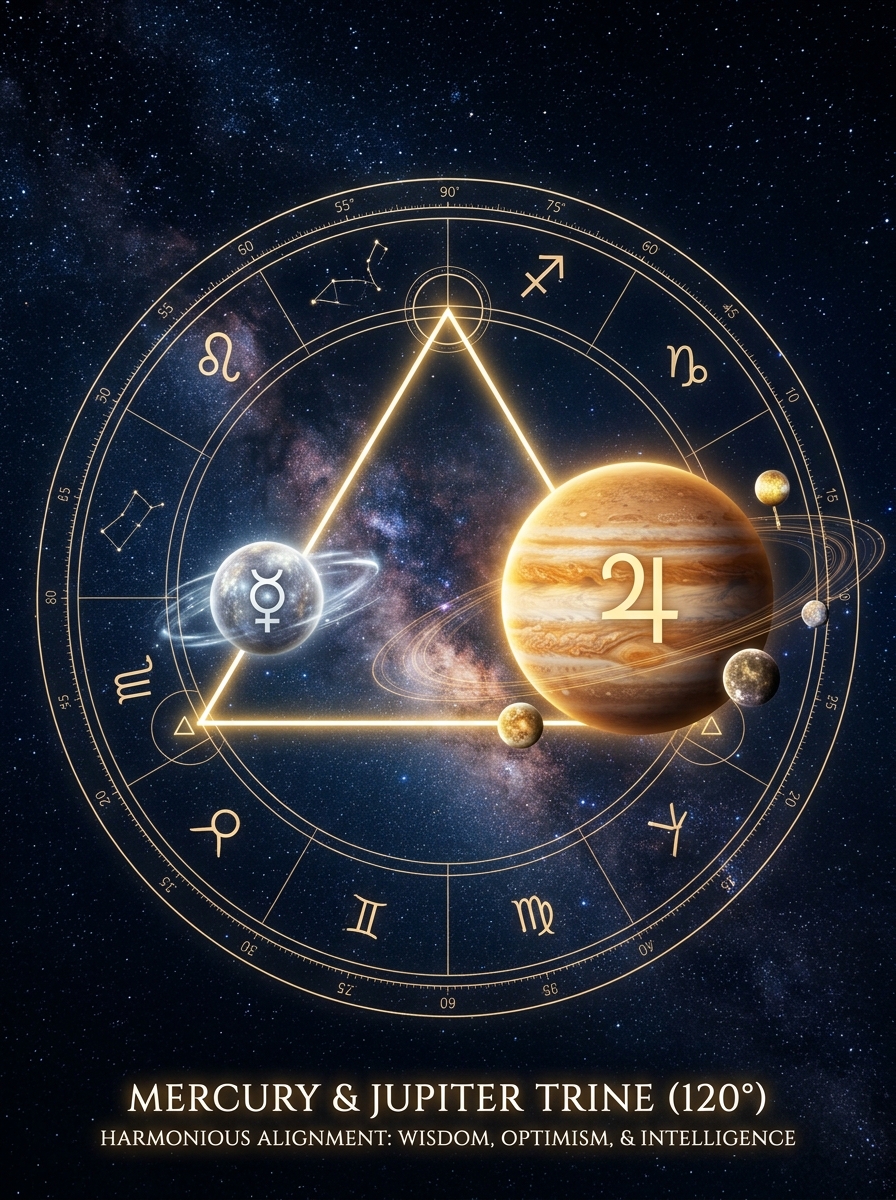
Mercury trine Jupiter is not a talent for knowing everything. It is a talent for knowing what everything means. The aspect pairs Mercury—the planet of perception, language, and local data—with Jupiter—the planet of horizon, coherence, and the conviction that life holds an intelligible shape. The trine allows these two energies to cooperate without friction. The result is a mind that naturally reaches for the principle inside the example, the story inside the statistic, the ethic inside the event. This is one of the chart’s clearest signatures of articulate hope: the person can make sense of complexity in a way that enlarges others rather than overwhelming them.
The Core Dynamic: A Mind That Trusts the Whole
The psychology here is straightforward but easy to underestimate. Mercury gathers the pieces; Jupiter insists those pieces belong to a wider order. Together they produce a cognitive style that is both quick and generous. People with this aspect rarely get stuck in detail for its own sake. They habitually ask: What does this connect to? Where does this fit? What larger pattern does this reveal? That reflex gives them an unusual capacity for synthesis—the ability to summarize a tangled subject in a sentence that clarifies instead of flattening.
The trine matters because it removes the typical tension between caution and confidence. In harder Mercury-Jupiter aspects—square or opposition—the mind battles itself: one voice says “prove it,” another says “I already see it.” Here the flow is easy, which means the native may not realize how unusual their gift is. They speak as though understanding is obvious, and because of that, they often make it contagious. For a deeper look at why the geometry itself encourages this ease, the trine aspect page explains how harmonious flow can become a habitat rather than a discipline.
What Jupiter Amplifies in Mercury
Jupiter does not overwrite Mercury’s style; it amplifies whatever sign and house Mercury occupies. A Mercury in Virgo trine Jupiter becomes precise without becoming pedantic, able to organize large amounts of information without losing the thread. A Mercury in Sagittarius trine Jupiter becomes a natural teacher, quick to enthuse and quick to generalize—sometimes too quick. A Mercury in Gemini trine Jupiter multiplies viewpoints until the person can hold a dozen perspectives at once and still find the common chord. The constant is that Jupiter lifts the mind upward: toward meaning, toward ethics, toward the kind of understanding that feels like arrival.
How It Forms: The Harmonic Flow of Messenger and Philosopher
Every trine is a 120-degree angle between two planets, typically in the same element. That elemental resonance is why the interaction feels natural. Mercury and Jupiter do not have to fight for airtime. They share the same tonal frequency. In fire signs, that frequency is enthusiasm and vision. In earth signs, it is structured wisdom. In air signs, it is conceptual architecture and social intelligence. In water signs, it is symbolic intuition that can articulate feelings otherwise wordless.
The result is a mind that learns best when it can connect new information to something larger. Rote memorization feels hollow. The native needs to know why something matters, who it affects, what it means in a moral or philosophical sense. This is not intellectual laziness; it is a different kind of rigor. The person may absorb complex subjects faster than peers because they instinctively build mental frameworks rather than collecting isolated facts. For a fuller discussion of how Mercury behaves when it operates from its own sign of abundance, the Mercury in Sagittarius page shows what the messenger looks like when Jupiterian breadth is already wired into the sign.
The Role of House Placement
The aspect itself is the engine; houses tell you where it drives. In the 9th House, the trine often expresses as formal scholarship, travel-as-education, publishing, or spiritual inquiry—the native may be a natural theologian or university lecturer. In the 3rd House, it becomes conversational brilliance, a gift for teaching siblings, writing for a local audience, or explaining complex ideas to non-specialists. In the 11th House, ideas become collective; the person may thrive in groups that exchange knowledge socially, as described on the Mercury in the 11th House page. In the 5th House, the mind turns playful and performative—a storyteller, an entertainer who educates without the audience noticing.
The Mature Expression: Synthesis, Teaching, and Intellectual Ethics
The highest use of Mercury trine Jupiter is not self-expression but service-through-meaning. The person can become a bridge between specialists and the public, between academic knowledge and lived wisdom, between data and ethics. This is why the aspect is so common in the charts of good teachers, translators, coaches, lawyers, editors, and theologians. They naturally know how to sequence ideas, how to choose the example that makes abstraction land, how to frame a problem so that solutions become visible.
Maturity here means learning to honor Mercury’s precision as much as Jupiter’s breadth. The trine makes it easy to speak from conviction; wisdom makes it necessary to verify before speaking. The developed native fact-checks without losing enthusiasm. They can hold a strong opinion without mistaking it for a proven truth. They understand that Jupiter’s confidence is a gift only when tethered to Mercury’s specifics. When that balance holds, the person becomes a genuine authority—not because they claim to know everything, but because they can always locate what they know inside a wider context. The Jupiter in the 9th House page explores how this placement amplifies the urge to teach and to seek universal truth, often giving the trine a vocational dimension.
The Shadow: Expansion Without Anchor
The weakness of any trine is that ease can become inertia. Because Mercury trine Jupiter produces little inner friction, the native may never develop the habit of self-correction. They assume an idea is sound because it feels expansive. They may speak before thinking, over-promise, or turn a single strong example into a universal claim. This is not dishonesty; it is a bias toward meaning over verification. The mind skips the unglamorous middle step: testing.
The shadow also shows up as intellectual grandiosity. The person may believe they understand a subject thoroughly after a single good conversation. They may dismiss details as “nitpicking.” They may become impatient with anyone who slows the conversation down with questions about accuracy. In group settings, they can dominate with a conversational style that feels inspiring but leaves little room for nuance. This is where the Grand Trine pattern becomes relevant: when three or more planets form a whole-element triangle, the ease compounds and the shadow can become a trap. Even a single trine needs conscious discipline to avoid speaking from conviction before the facts are in the room.
What Maturation Requires
The remedy is not to dull the optimism but to pair it with a practice: editing one’s own work, reading opponents charitably but carefully, distinguishing between a powerful idea and a proven one. The native benefits from any discipline that forces them to slow down—writing, teaching the same material repeatedly, taking on a mentor who values precision. The goal is not to kill Jupiter’s fire but to build Mercury’s scaffolding. When that happens, the trine produces someone who can think at scale without losing the ground.
Live Applications: Where the Aspect Shows Up
In daily life, this aspect is most visible in the tone of the person’s speech. They sound like they believe life is worth explaining. They can encourage others not with platitudes but by reframing a problem—showing the horizon beyond the immediate crisis. That makes them valuable in any collaborative setting: they are the person who can translate between departments, mediate a disagreement by pointing to shared principles, or give feedback that feels like expansion rather than criticism.
In relationships, the trine often produces a partner who wants to understand you intellectually. They will listen not just to your feelings but to the story behind them. They may love explaining themselves, and they usually assume you want the same. The shadow here is that they can over-intellectualize emotion, treating a partner’s pain as a puzzle to solve rather than a presence to hold. The gift is that they rarely dismiss what they don’t understand—they will keep asking until the larger picture emerges.
In career, the aspect favors roles that require both analysis and big-picture framing: consultant, marketer, journalist, professor, lawyer, minister, curriculum designer. The native excels at any job where they must receive information and then present it in a context that makes it meaningful to others. They are natural at thought leadership—not because they are the smartest person in the room, but because they make intelligence feel accessible.
The final marker of this aspect well-lived is intellectual humility. Not the false humility of someone who pretends not to know, but the real kind: knowing how much you don’t know, yet still trusting that meaning exists and is worth pursuing. That is the gift Mercury trine Jupiter offers at its best: a mind that remains open to the whole, even as it stays accountable to the part.
Comments
Loading comments…