December Birthstone Turquoise: Meaning, History, and Symbolism
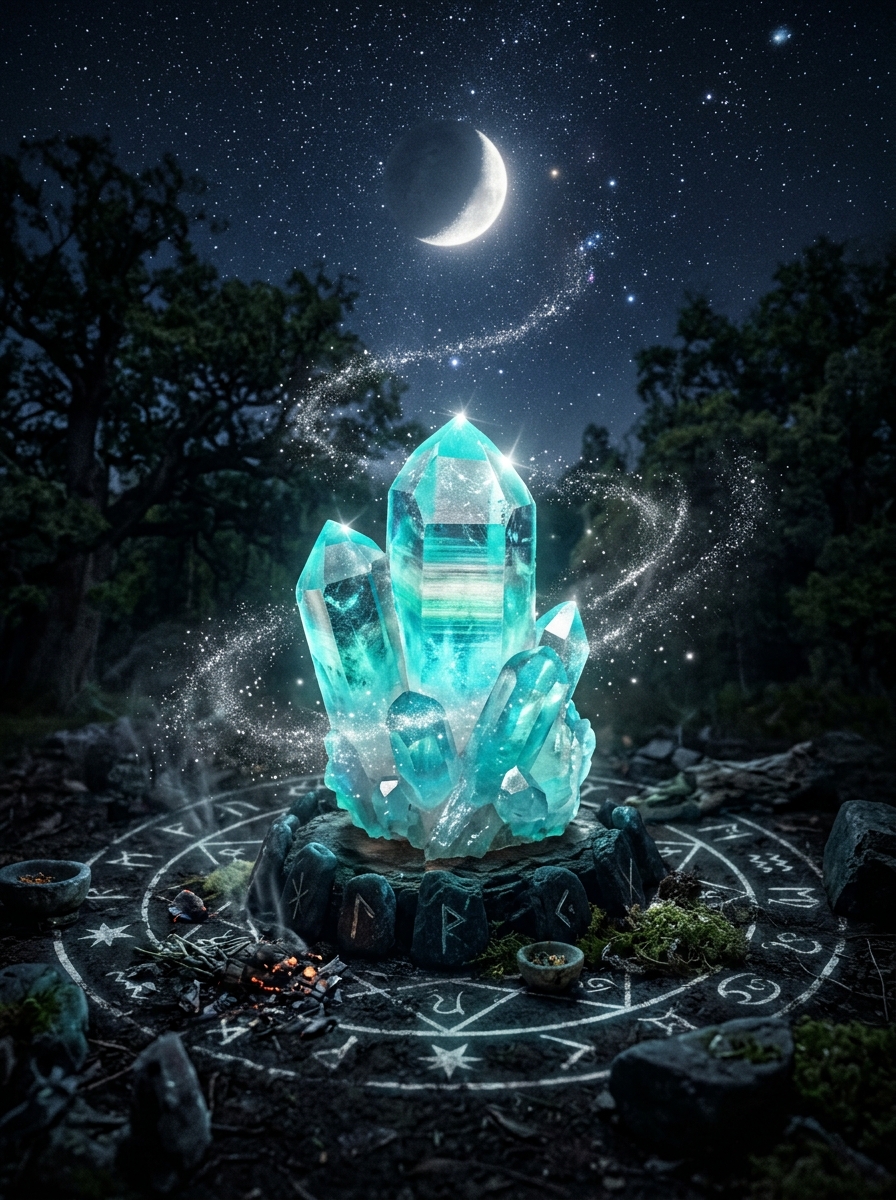
The Core Claim: Turquoise Protects Before It Decorates
Turquoise is December’s birthstone because it does not pretend to be soft. Its blue-green belongs to winter sky and cold water—elements that sustain life but also demand respect. The stone’s oldest meaning, across cultures, is protection: a portable shield against danger, ill speech, and unseen harm. Beauty came second. That order—function before ornament—gives turquoise its gravity. It is an amulet that happens to be beautiful, not a jewel that happens to protect.
This protective instinct is not vague. It is specific to the human experience of moving through uncertain terrain—physical journeys, social negotiations, spiritual thresholds. Turquoise collects those anxieties and holds them steady. Its color sits between blue (distance, thought, the celestial) and green (growth, recovery, the earthly). That liminal quality is the key to its symbolism: turquoise belongs in the space between one state of being and the next. For a December-born person, this is exact. December is the year’s threshold month—a time of endings, inwardness, and preparation for what comes. Turquoise gives that crossing a visible shape, a touchable anchor.
The Stone’s Biography: How Humans Shaped Its Meaning
Turquoise was never a local secret. It traveled farther than the people who first worked it—from the Sinai Peninsula to the courts of Persia, from the mines of the American Southwest into Mesoamerican ceremonial centers. That trade history is not accidental; it taught the stone a second meaning. A mineral that survives distance, handling, and exchange without losing its identity becomes a symbol of continuity—something that remains itself even when everything else shifts.
In ancient Egypt, turquoise appeared in funerary masks and royal regalia, not merely as decoration but as a guarantee of safe passage into the afterlife. The Egyptians called it “the stone of the horizon,” linking it to the liminal zone where the sun was born every morning. In Persia, its sky-blue hue was read as divine favor; turquoise adorned throne rooms and weapon hilts alike, blessing both sovereignty and combat. Among the Pueblo and Navajo peoples of the Southwest, turquoise has been sacred for a millennium—associated with rain, sky, and the balance of the natural world. It is not a single mythology but a repeating human intuition: when life is exposed, turquoise is the gesture of guarding.
This protection is not magical in a literal sense. It is psychologically real. A stone believed to change color when danger nears does not need to change—the belief itself organizes attention. The wearer becomes more alert, more present. Turquoise functions as an early technology of awareness, a way of turning abstract wariness into something you can hold.
Why December and Turquoise Belong Together
December compresses light, heightens contrast, and sharpens emotional weather. It is a month of accounting—what ended, what waits, what must be carried forward. A birthstone for this season must answer that mood without denying it. Turquoise does not offer warmth in the sentimental sense. What it offers is a reliable clarity: winter sky, but not winter emptiness. Its color carries coldness in the visual register but warmth in association, because it recalls life-sustaining water and the breathable air.
The psychological message of blue-green is precise. Pure blue leans toward mind, distance, spiritual height. Pure green leans toward body, recovery, regeneration. Turquoise refuses to choose. It occupies the middle, and that middle is the domain of honest speech—communication that is not detached and healing that is not sentimental. December’s season demands truth-telling, but truth that does not slice. Turquoise supports the voice that can say what is real without cruelty, that can distinguish what has gone brittle from what still has life.
Wider Symbolic Field: Astrology and Tarot
Astrologically, turquoise aligns with Jupiter—the planet of meaning, faith, and benevolent expansion. Jupiter enlarges perspective; turquoise grounds that enlargement in communication. It is not a stone of vague luck but of meaningful movement: traveling with guidance, speaking with integrity, learning to trust the path without abandoning discernment. This resonance is strongest with Sagittarius, the December sign most linked to philosophy, questing, and frankness. Sagittarius seeks truth; turquoise is the steadying grip on the bow, helping the aim become clean rather than scattered.
In tarot, turquoise does not belong to a single card but to a mode of consciousness. It appears in The Fool—the open step into the unknown, carried by trust and experience. It appears in the Knight of Wands, whose forward motion needs composure to avoid recklessness. And it echoes The Star, whose image of water, renewal, and calm guidance shares turquoise’s blue-green glow. But the stone is not “hope” abstracted. It is hope made practical—the traveler who checks the map because she intends to arrive.
What the Stone Asks of Us: Care, Ethics, and the Wearing
Turquoise is porous, soft, and vulnerable to heat, chemicals, and oils. It fades in direct sun. That fragility is not a flaw in its story; it is part of the instruction. A stone of protection that requires care teaches a subtle truth: what guards us must also be guarded. Wearing turquoise with attention—removing it before lotions and cleansers, storing it away from light—is a daily practice of respect. The stone asks for relationship, not ownership.
There is also an ethical dimension. Turquoise carries deep sacred meaning in living Indigenous traditions, especially in the American Southwest. It is not a vague New Age token. Wearing it thoughtfully means recognizing that its symbolic life is older and broader than modern birthstone marketing. That recognition deepens the stone’s power. A talisman approached with humility is more potent, not less.
In a life—whether in relationships, work, or inner work—turquoise supports the ability to speak from the center. It tempers impulsive speech with depth. It tempers isolation with trust. For the December-born, it is not a charm of escape but a compass for the crossing. It says that truth is not only what can be declared; it is also what can be held steady long enough to be understood. That is the stone’s final gift: a clear road through winter, borrowed from the sky and made small enough to carry.
Related
- Topaz in November: Meaning, History, and the Fire Beneath the Calm
- August Birthstone Peridot: Meaning, History, and Symbolism
- Amazonite Meaning & Healing Properties: The Stone of Clear Boundaries
- Amethyst in February: The Violet Stone of Clarity, Devotion, and Night Vision
- September Birthstone: Sapphire Meaning, History, and Symbolism
Comments
Loading comments…