Dream About Snow: What the White Silence Is Saying
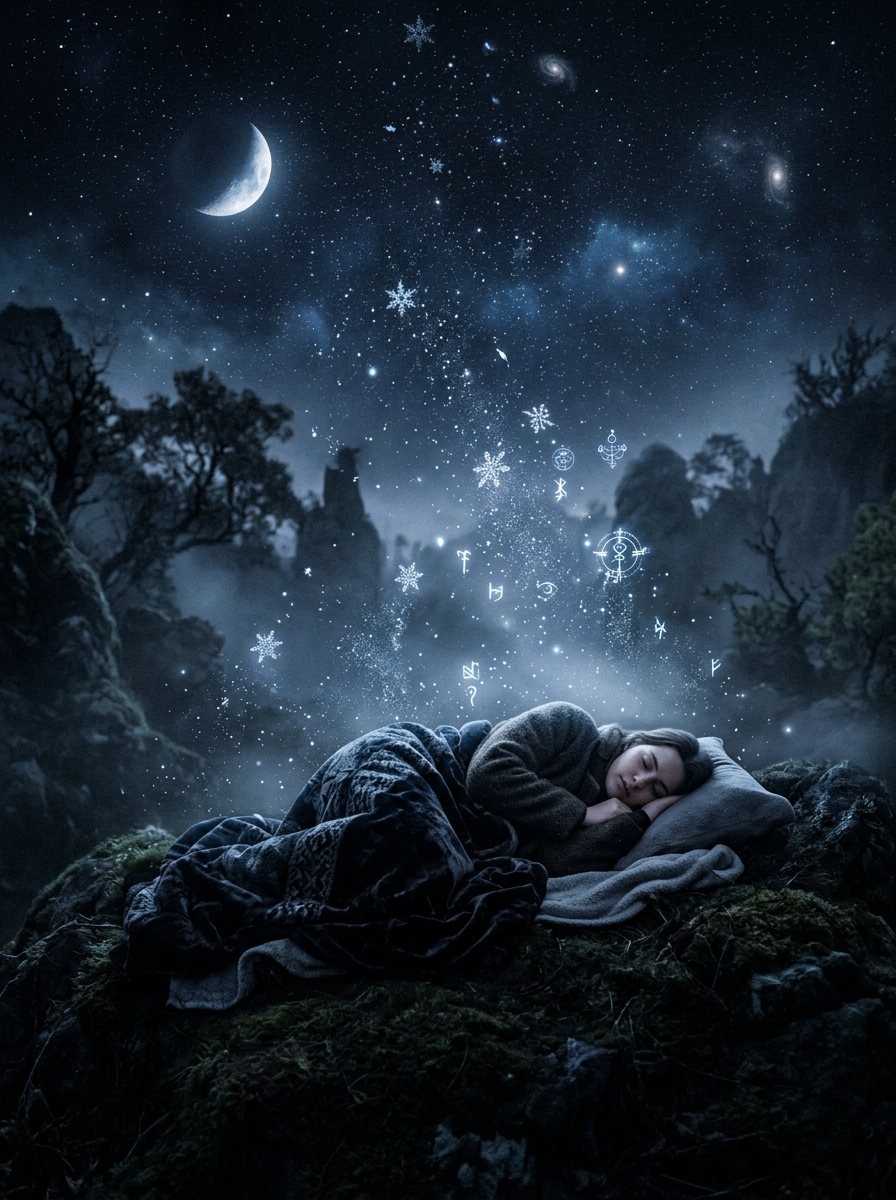
The core dynamic: snow is emotional temperature slowed to near stillness
A dream about snow does not announce a single meaning. It reports a change in the climate of your inner life — a shift that alters how emotion feels, how visible your path is, and how much distance lies between you and what you carry. Snow is not absence; it is suspension. The water is still there, but its state has changed. That is why the dream arrives when feelings are present yet held at a remove: after grief, during burnout, in the quiet after a fight, or when the psyche chooses containment over expression.
The color white dominates the image, but white in dream language is rarely innocence. It is undifferentiation — a field where contrast has been erased. In Jungian terms, snow can signal contact with the deep unconscious, not chaotic but spacious and impersonal. The dreamer may feel blessed or lost, and often both. The symbol does not judge; it registers temperature. The first question is always whether the snow feels beautiful or obstructive, holy or deadening. That emotional texture tells you more than any fixed definition.
Psychological roots: how the psyche uses cold to survive or to heal
From a psychological angle, snow depicts affect under anesthesia. The mind metabolizes feeling more slowly when the load is too heavy. This appears during grief, depressive flattening, or periods of intense self-control — the ego says, If I do not feel too much, I can keep moving. The dream captures that strategy. But the image also carries a second, subtler root: the psyche sometimes chooses cold as a form of purification. Cleansing happens when the world is stripped back to what matters. Snow quiets noise, erases clutter, makes the overgrown legible again.
These two roots — protective numbness and deliberate simplification — are not opposites; they are the same force at different temperatures. The dream’s task is to tell you which one is active. If the snow feels suffocating, the psyche may be warning that emotional insulation has become a prison. If it feels clarifying, the dream may be showing a necessary pause, the kind that precedes real emergence.
Frozen feeling as an adaptive strategy
When the dream emphasizes coldness, silence, or immobility, it often reveals an ego strategy of containment. A partner, a family system, or a workplace may be technically intact while warmth has withdrawn. The dream captures the atmosphere before the facts catch up. This is not lack of feeling but feeling wrapped in insulation — a survival adaptation that carries a cost. Over time, the insulation hardens into isolation. The dream may be asking whether that cold is still protecting you or simply keeping you from what you need.
Hibernation and the dream of a reset
On the other hand, snow can function as psychic hibernation. People dream of snow after upheaval — after a breakup, a loss, a major life transition — when the mind needs to slow its metabolism. The white field resembles a blank page, but not a naïve one. It is the moment after a storm when the world has been stripped to essentials. In that context, snow belongs to the same family as silence, stillness, and the fallow season. The psyche is not broken; it is resting.
How snow behaves in the dream reveals the message
The symbol’s true meaning lives in its mechanics — what the snow is doing, how your body responds, and whether the landscape supports movement or stops it. These variations are not decoration; they are the actual message. Interpretation begins with texture, not abstraction.
Walking, getting stuck, or moving easily
If you are walking through snow, the dream concerns effort under altered conditions. Progress is slower, heavier, more deliberate. This can mirror real life when you are moving through grief, recovery, or uncertainty. Deep drifts suggest resistance — something is holding you back or weighing you down. Packed snow suggests a path already shaped by repetition; you may be following habits rather than choosing freely. If you move with ease, the dream may be saying that restraint is currently helpful — your pace has become sustainable. If you cannot move at all, the image points toward immobilization: an area where emotion, obligation, or fear has thickened into inertia.
Falling, melting, and changing state
Falling snow indicates an ongoing process. Something is still arriving. You may be entering a quieter phase, or a situation may be cooling gradually rather than all at once. Falling snow can feel sacred — a hush — or endless, depending on whether it calms you or obscures. When snow melts, the dream is moving toward revelation. What was hidden becomes visible. That can be a relief or a disappointment, depending on what the cold had protected. Melting snow often marks the end of denial. Slush or dirty snow is a more compromised symbol: what once looked clean has been contaminated by time, use, or disillusionment. The dream asks you to see without the fantasy of purity.
Snow indoors, snow in summer, snow covering the body
When snow appears inside a house, the symbolism becomes intimate. A house usually represents the psyche or domestic life. Snow indoors implies emotional coldness where warmth should be, but it can also suggest an intrusion from the unconscious into private life — the boundary between inner and outer has become porous. Snow in summer breaks seasonal law, flagging a contradiction: numbness where passion should be, or unexpected coolness in a time that should feel alive. The psyche is calling attention to mismatch. If snow covers your body, the image can mean concealment, protection, or surrender — you are being enveloped by a feeling you cannot yet name.
Snow in relationship with other dream elements
Dreams become more precise when snow meets other symbols. The contrast reveals the psyche’s actual tension.
Fire and snow: purification by opposition
If the dream includes fire alongside snow, the psyche is staging a collision between feeling and restraint, desire and inhibition. Fire melts; snow slows. Fire exposes; snow covers. The image may describe a conflict between the need to feel intensely and the need to stay composed. In some cases, it depicts transformation by opposition — one force softening the other. For a broader framework on how the psyche uses opposites to generate meaning, the approach we use at Aurora Arcana treats every dream element as a living metaphor, not a fixed code.
Footprints, animals, and traces in white
Footprints in snow are a powerful sign of impermanence and evidence. They show that presence leaves a mark, even when the landscape seems blank. The dream may be telling you that your actions matter more than you think, or that a path exists because someone — perhaps you — has already crossed it. Animals in snow bring instinct into a quiet world. A bird suggests resilience, a wolf survival, a deer gentleness. The meeting point between the animal’s nature and the dream’s climate is the key, not a universal dictionary.
Color shifts the field
Although white snow is the classic image, color changes the tone decisively. Blue-tinged snow feels lunar, detached, otherworldly. Black snow signals contamination, dread, or a collapsed ideal. Pink or golden snow may soften the dream into wonder, romance, or surreal blessing. The color tells you whether the snow is merely cold or symbolically charged with another element — and that element points to a specific emotional register.
Practical response: thaw or shelter?
A dream about snow usually asks for discernment, not immediate action. The symbol can point in opposite directions: you may need to thaw, or you may need to stay in winter a little longer. The work is to tell which.
If the dream leaves you calm, spacious, or contemplative, it may be affirming a necessary pause. Your psyche is regulating itself. If it leaves you lonely, trapped, or unable to find a road, the dream may be revealing emotional isolation or a fear of moving forward. If you wake with relief as the snow melts, the message leans toward recovery and release.
The most important question is simple: what in your life has gone cold, and is that coldness protective or costly? Snow is never just weather in dream language. It is a change in atmosphere — sometimes holy, sometimes defensive, sometimes both at once. For a deeper exploration of how dream imagery mirrors the body’s emotional state, our astrology and tarot perspective emphasizes the body as a symbolic instrument, not just a physical one.
Related
- Dream About Rain: Emotional Release, Renewal, and the Weather of the Psyche
- Dream About a Forest: Meaning, Psychology, and Symbolic Variations
- Dream About a Mountain: Meaning, Psychology, and Symbolic Variations
- Dream About a Butterfly: Change, Delicacy, and the Soul in Motion
- Dream About a Bear: Power, Protection, and the Wild Unsaid
Comments
Loading comments…