Dream About Fire: Passion, Warning, and Transformation
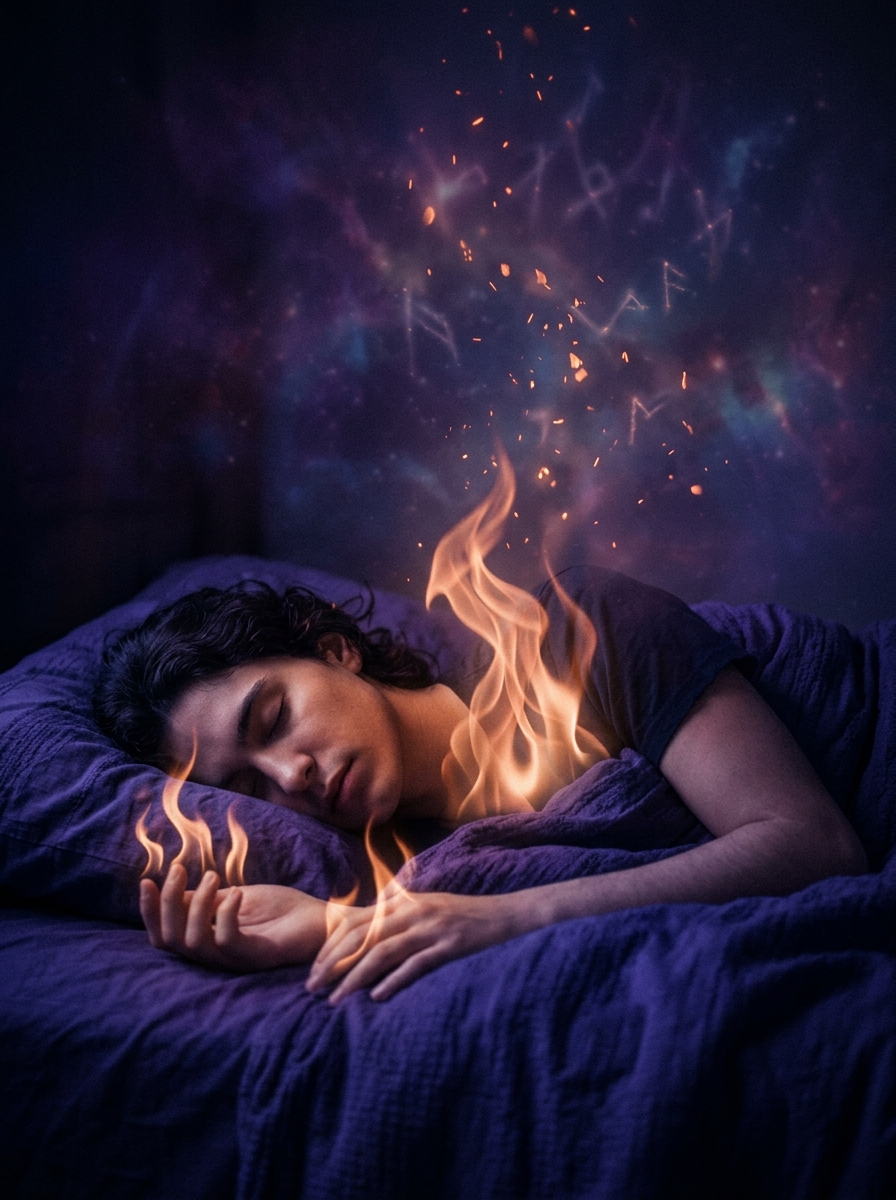
A fire dream is never an idle image. It arrives when psychic heat builds beyond the threshold of metaphor — desire, rage, grief, or an urgency that no longer fits inside waking language. Fire is one of the oldest symbols for a force that illuminates, warms, destroys, purifies, or spreads beyond control. But the dream is not about fire as a thing. It is about fire as an event: movement, appetite, consequence. Where energy accumulates and what that energy begins to do to your life is the only question that matters.
The Core Dynamic: Fire as Event, Not Object
Fire in a dream behaves. It does not sit still. A candle flame concentrates attention; a wildfire consumes the landscape. What distinguishes them is not the element but the relationship between containment and release. In psychological terms, a controlled flame (candle, hearth, fireplace) often points to a desire or insight that is still manageable — a small truth that needs protection, a stable emotional center. The hearth, especially, hints at belonging and the climate of a close relationship. An uncontrolled flame (house fire, wildfire, spreading smoke) registers excess: a feeling, conflict, or ambition that has moved beyond discretion. The house fire is intimate — the structure of identity or family threatened. Smoke adds ambiguity: something is burning, but you may not yet know what or who started it.
The emotional tone inside the dream is more important than the visual spectacle. Horror and warmth are opposite signals, and the same symbol can mean opposite things. A fire that feels magnetic tends to represent desire in its broadest sense: sexual wanting, creative drive, hunger for change. This is the compensatory heat the psyche produces when waking life has gone cold. New beginnings, crushes, artistic breakthroughs — these often summon fire dreams because something inside you wants contact with the world again. A tense, destructive, guilt-ridden fire, by contrast, carries anger that has been overmanaged. People dream of setting things ablaze when they are furious but polite by day, or of standing helpless as flames spread — a map of suppressed rage, passive resentment, or the fear that feelings will have consequences.
Psychological Roots: Desire, Anger, Burnout
Fire dreams are pressure gauges for three primary drives: desire, anger, and burnout. Each leaves a distinct signature in the dream’s texture.
Desire-fire is hot but not threatening. It may appear as a bonfire drawing you closer, a torch you carry, or a flame that feels alive and warm. This fire asks what you have stopped allowing yourself to want. It is rarely only sexual, though it can be; more often it signals a longing for intensity, purpose, or contact. The psyche produces this image when a person has been over-controlled, emotionally flat, or cut off from appetite. The flame compensates — it is the return of vitality.
Anger-fire is sharp, guilty, or panicked. You might be the one setting the fire, or you might watch it consume what you love. The dream often exposes a truth you have been avoiding: you are angry, or someone else’s anger is pressuring you. Shame enters through the back door here — fire exposes what should have stayed hidden, and the dreamer may feel exposed herself. This is not moral guilt; it is psychic overexposure. Too much pressure, too little shelter, not enough room to metabolize emotion.
Burnout-fire is the most alarming. It appears as exhaustion inside the flame: a house burning while you stand too tired to move, or a wildfire that feels inevitable. This fire is not about desire or anger but about depletion. The dream is saying that the system is overworked and the heat has turned toxic. The psyche is not generating energy now — it is being consumed by energy it cannot manage. Burnout dreams often precede real collapse if ignored.
For a fuller description of how dreams convert inner life into image, Aurora Arcana’s about page offers the interpretive lens behind this reading.
How Fire Behaves in the Dream — Variations That Change the Read
Two people can dream of the same blaze and wake with opposite meanings. The dream’s setting, scale, and your relationship to the flames determine the reading. Three common patterns deserve close attention.
Dreaming of Being Burned
Being burned is about contact with something too intense to hold safely — a relationship, a truth, an opportunity, a self-image that can no longer survive unchallenged. Burns are not always punishments. They can mark initiation: the old form of the self is damaged so a stronger one can emerge. The detail that matters is whether the burn is accidental, witnessed, self-inflicted, or somehow cleansing. A brief singe suggests a warning that arrived in time. Severe injury points to prolonged exposure to stress, conflict, or shame. If the dream includes pain but also clarity, the psyche may be insisting that transformation has a cost.
Dreaming of Escaping a Fire
Escaping fire often means the psyche has already identified danger and is trying to preserve what can still be saved. This is one of the most common forms during stressful transitions: layoffs, breakups, family conflict, sudden responsibility. The dream does not necessarily mean you are in immediate danger; it may mean you are emotionally evacuating a situation that no longer feels livable. If you rescue others, the dream speaks to obligation and overload. If you escape alone, it can point to survival instincts, detachment, or guilt about leaving something behind. The question the dream asks: what are you willing to abandon in order to live?
Dreaming of Fire That Cleanses
Some fire dreams feel sacramental. A brush fire clears dead growth. A ritual flame burns away old material. In these dreams, fire does not destroy life; it makes life possible again. This is the purifying side of the symbol, and it appears when a person is ready to let go of an identity, habit, or attachment that has become stale. But cleanse and char can look similar in myth, and they feel different in the body. If the dream leaves you lighter, sharper, or strangely relieved, it points toward renewal. If it leaves you panicked, then the “cleansing” interpretation is probably premature.
Fire in the Symbolic System — Astrological and Tarot Angles
Astrologically, fire belongs to Aries, Leo, and Sagittarius — initiation, radiance, and expansion. The dream’s style can hint at which mode is active.
Aries, Leo, Sagittarius in Dream Tone
A sudden blaze, a match struck, a kitchen flare-up, or an argument that ignites in seconds feels Aries-like: instinctive, fast, and often clumsy but honest. A grand bonfire, stage lights, or a fire that attracts witnesses has a Leo quality — visibility, pride, creative force, the need to be seen. A distant forest fire, a sacred flame, or a dream of fire on a journey can feel Sagittarius-like, pointing to worldview, belief, or the burning question of where you are headed. Do not force a sign label; just notice how the fire behaves. Does it attack, perform, or illuminate? That behavior tells you which fire principle is speaking.
Wands and the Tower
In tarot, Wands are the suit of fire: will, passion, enterprise, creative force. A dream of fire that feels energized rather than catastrophic echoes the suit’s raw vitality. But if the dream is a collapse, an explosion, or a building struck by flame, the Tower becomes relevant. The Tower’s lightning is not fire exactly, but the image belongs to the same family of sudden rupture and revelation. The number 16 in the major arcana signals structures that can no longer hold. In fire dreams, that theme appears when an old arrangement is being forcibly removed — often a blessing disguised as disaster. For readers who want to explore how these symbolic layers interact, the about page explains the interpretive method behind this kind of cross-reference.
Reading Your Own Fire Dream Without Flattening It
The most accurate interpretation comes from the relationship between heat and context. Ask: what in waking life has become hotter, brighter, riskier, or harder to contain? Then ask whether the dream shows that force as creative, destructive, or both.
If the fire gives light, think revelation — a truth you have been avoiding. If it gives warmth, think attachment or comfort — a relationship that still nourishes. If it spreads, think escalation — a conflict or demand that is growing beyond control. If it consumes a structure, think of identity under stress — a role you can no longer inhabit. If it burns cleanly and leaves space behind, think release — the old is making room for something new.
And if you wake shaken but not sure why, the dream may be less a message than an alarm: the psyche has noticed more than consciousness has admitted. The deepest truth of a fire dream is often simple: some part of you is no longer willing to stay dormant. Whether that energy becomes illumination or damage depends on what you do with it once you open your eyes. For a broader framework on how dreams speak through symbol, see the about page for Aurora Arcana’s editorial approach.
Related
- Dream About War: Conflict, Pressure, and the Mind Under Siege
- Dream About Being Fired: What the Panic Is Really Saying
- Dream About a Storm: Turbulence, Truth, and the Weather of the Psyche
- Dream About a House: What the House Means in Your Dream
- Dream About the Sun: What It Means, Psychologically and Symbolically
Comments
Loading comments…