Dream About a Butterfly: Change, Delicacy, and the Soul in Motion
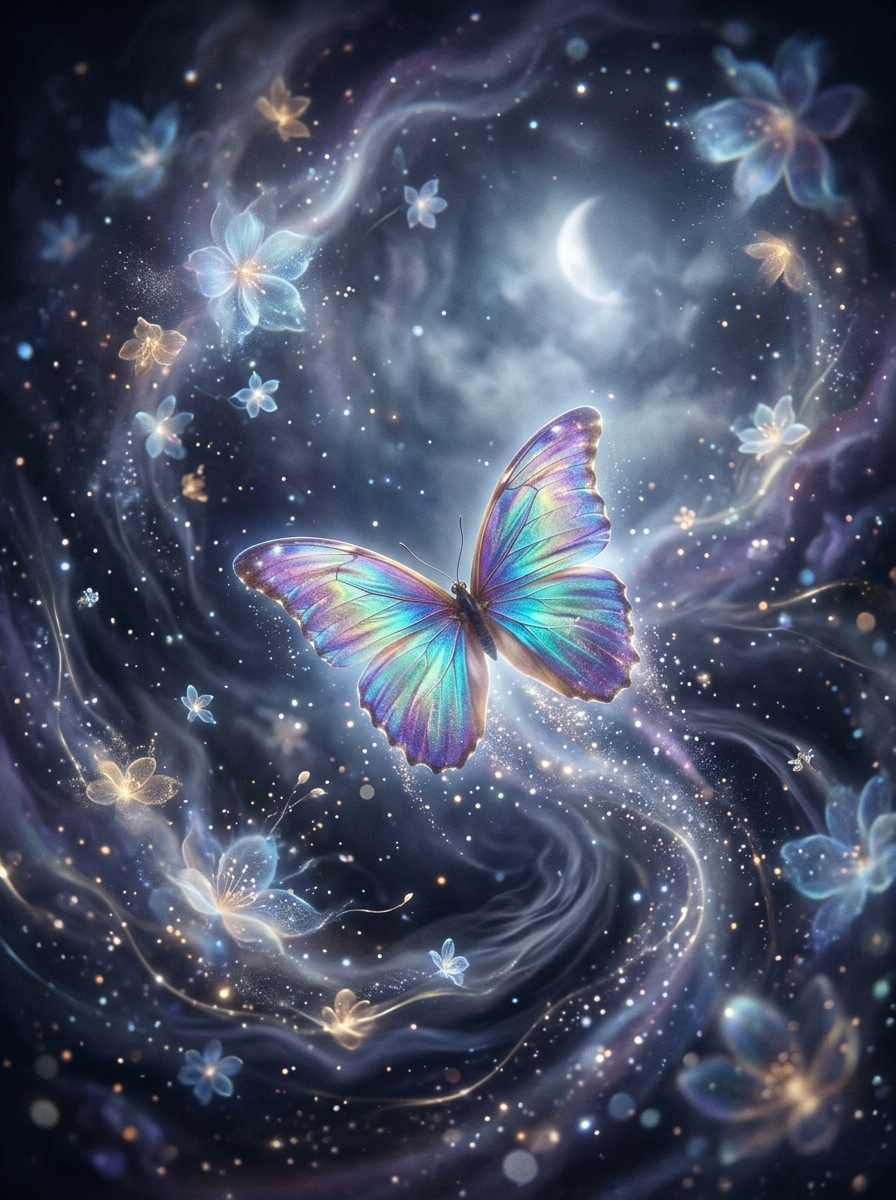
The core meaning: transformation made visible
To dream about a butterfly is to meet an image of change that has already crossed an inner threshold. The butterfly does not symbolize “change” in the abstract; it symbolizes change that has become visible, beautiful, and temporary. In dream language, that matters. A caterpillar becomes a butterfly only after an ordeal of dissolution, and the dream often borrows that pattern to describe a life phase in which an older identity is no longer adequate, but a new one has not yet stabilized.
That is why butterfly dreams arrive during transitions that are emotional rather than merely external: a breakup, recovery, creative awakening, spiritual opening, relocation, grief, or a shift in self-image. The dream rarely means “something is changing” in a vague way. It more often says that the psyche has already started reorganizing itself and wants you to notice the emergence. The butterfly is light, brief, and exquisitely vulnerable. It can be read as a sign of beauty, but not the decorative kind; it is beauty with a lifespan, beauty that can be lost if mishandled. In that sense, the dream is less about aesthetics than about timing. Something in your life is ready to be handled delicately. A new relationship, idea, or version of yourself may still be in a fragile state. The dream can ask for restraint where you would normally push.
If you want a broader frame for how symbolic dreams work, our approach to interpretation is rooted in reading image, mood, and sequence together rather than reducing a dream to a one-line omen.
Why the butterfly feels psychologically charged
A butterfly dream often emerges when the psyche is trying to bridge an old identity and a new one. Jungian language is useful here because the butterfly behaves like a symbol of individuation: not self-improvement, but the slow, costly process of becoming more fully oneself. The dream may appear when your outer life is still organized around an older adaptation, while an inner part is already moving on.
Metamorphosis, not escape
People sometimes mistake butterfly dreams for pure positivity. That flattens them. Psychological change is rarely tidy, and the butterfly’s beauty depends on a hidden history of dissolution. In dreams, metamorphosis can point to a necessary breakdown of habits, defenses, or roles. You may be outgrowing a persona that once helped you survive. The dream doesn’t necessarily celebrate that loss; it may register both relief and grief. That duality is important. If the dream feels luminous, you may be nearing a genuine breakthrough. If it feels anxious, the image may be compensating for fear of change: the psyche offers you a graceful form because the reality beneath it is messy and uncertain. Either way, the butterfly says the transformation is not hypothetical. It is underway.
What the emotional tone reveals
The mood of the dream matters more than the dictionary meaning of the symbol. A calm butterfly resting on your hand can suggest acceptance, tenderness, and readiness for a new phase. A butterfly trapped indoors may point to a beautiful possibility that feels confined, delayed, or overprotected. A swarm may indicate overstimulation, too many changes at once, or a scattering of attention across multiple beginnings. If the butterfly is dead or injured, the image can feel painful because it often speaks to a threatened emergence. Something delicate in you may have been dismissed, interrupted, or prematurely named before it had time to mature. That kind of dream does not necessarily predict loss; it can expose a fear that your growth will not be protected. When this happens, the question is not “What does a butterfly mean?” but “What part of my becoming feels unsafe?”
For a deeper exploration of how inner messages take shape, Aurora Arcana’s framework treats every dream image as a living metaphor with psychological weight, not a fixed code.
Color, setting, and behavior: how the dream sharpens its message
Not all butterfly dreams point in the same direction. The color, setting, and behavior of the butterfly can shift the message sharply. This is where symbolic reading becomes practical: the dream is not a riddle with one answer, but a composition.
What the colors mean
A white butterfly often reads as purity, clarity, grief, or spiritual nearness, depending on the dream’s mood. White can signal a clean beginning, but it can also feel like mourning when something has become so stripped down that only essence remains. A black butterfly is not automatically ominous. In dream symbolism, black frequently marks the unknown, the unconscious, or a transformation that is not yet visible. It can indicate a hidden passage rather than a bad outcome. If the dream is unsettling, the black butterfly may represent an identity that is emerging from shadow material. A yellow or orange butterfly tends to carry vitality, mental quickening, and joy. These colors can point to fresh optimism or creative life returning after a dry spell. A blue butterfly often feels rarer and more inward, suggesting insight, sincerity, or a truth that needs quieter conditions to unfold. A multicolored butterfly can indicate a personality or future path that is becoming more integrated, less split between conflicting impulses.
Setting and your relationship to it
A butterfly in the house often brings the theme of transformation into the domestic or private self. The home in dreams usually stands for the psyche or inner life, so a butterfly inside the house can suggest that change has entered your core patterns, not just your public circumstances. It may also reveal a tension between safety and freedom. If the butterfly lands on your hand, the dream often emphasizes contact and consent. Your waking life may be asking you to handle a fragile opportunity carefully rather than seize it. When the butterfly lands on your body, especially near the chest or shoulders, the image can imply that change is becoming embodied. This is not just an idea; it is entering your nervous system, posture, and daily behavior.
Behavior reveals your stance
Ask not only “What did the butterfly do?” but “What did I do in relation to it?” Did you chase it, protect it, fear it, admire it, or ignore it? Your response in the dream often reveals your waking stance toward change. Chasing suggests appetite or anxiety. Protecting suggests reverence, but possibly overcontrol. Ignoring can imply that the soul’s message is being minimized. Simple observation can be more revealing than any grand symbolism. For guidance on interpreting the interplay of image and response, the way we read dreams prioritizes the dreamer’s own actions over fixed dictionary entries.
Reading the dream in your current life
The most useful interpretation comes from pairing the butterfly with what is changing in your life now. Dreams rarely speak in isolation. They echo current tensions, and the butterfly specifically tends to appear when change is close enough to be felt but not yet fully named.
If you are ending something, the dream may confirm that a release is part of the design, not a failure. If you are beginning something, it may caution you not to crush the new with premature certainty. If you feel stuck, the butterfly can arrive as a corrective image: the psyche reminding you that identity is not fixed, and that what seems delicate may be your most adaptive self.
A useful interpretive question
Beyond the symbol itself, the most practical key is to ask: “What part of my becoming feels most tender right now?” The butterfly is a barometer of fragility. It does not promise permanence. It points to the cost of becoming. An injured or elusive butterfly may indicate that you are trying to perfect a transformation before it has had time to root. A calm, resting butterfly can confirm that the timing is right and that your only job is to protect the space around it.
Closing perspective: beauty that asks for readiness
A butterfly dream rarely concerns beauty alone. It points to the beautiful thing that can only exist after a prior form has been abandoned. That is why the image feels so intimate: it does not describe a distant spiritual principle, but a living stage in the making of a self. Sometimes it announces healing. Sometimes it reveals grief. Sometimes it warns that something new is too tender to be rushed.
What remains consistent is the archetypal shape of the message: you are not who you were, and you are not yet finished. The butterfly is the in-between made visible. If the dream lingers, trust that it is not merely decorative. It is the psyche showing you what can survive transformation and still remain beautiful. For more on how we approach such archetypal symbols, Aurora Arcana’s philosophy honors the dream as a living conversation with the self, not a fixed prediction.
Related
- Dream About Birds: What Wings, Calls, and Flocks Reveal
- Dream About an Insect: Meaning, Psychology, and Symbolic Variations
- Dream About a Frog: Meaning, Psychology, and Symbolic Variations
- Dream About a Rainbow: Promise, Repair, and the Color of Aftermath
- Dream About Spiders: What the Web Is Trying to Tell You
Comments
Loading comments…