Dream About a Storm: Turbulence, Truth, and the Weather of the Psyche
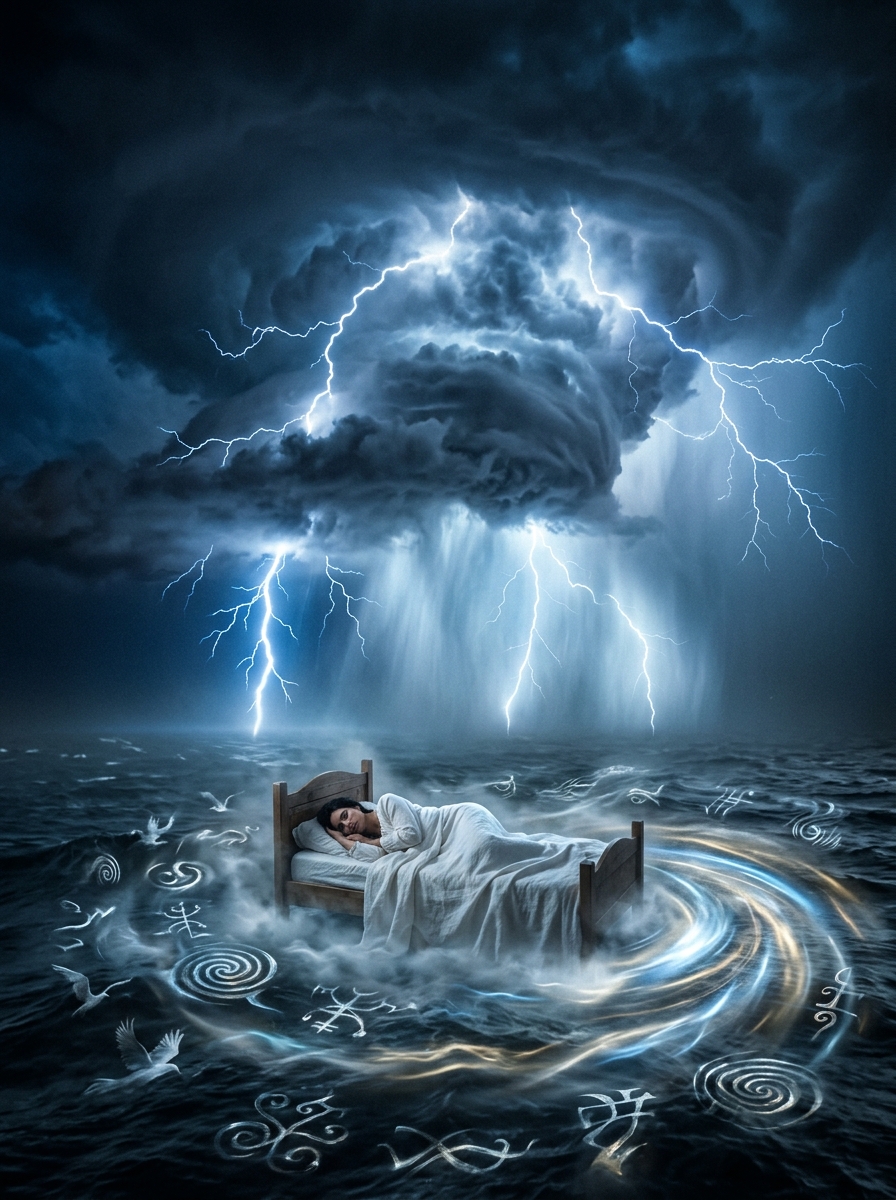
A dream about a storm rarely foretells literal disaster. More often, it dramatizes inner weather—stress, anger, grief, sexual charge, or a necessary upheaval already underway. The psyche uses weather because weather is honest, forceful, and impersonal. It allows the mind to say, “This is bigger than a mood, but it is still inside the organism.” The core thesis is simple: the storm is a diagnostic image of pressure that has been building, boundaries thinning, and a situation in waking life that is no longer stable enough to stay invisible.
The storm as a diagnostic image
A storm dream works first as diagnosis, not prophecy. It gathers multiple kinds of disturbance into one scene: wind suggests agitation and mental scatter; rain can indicate release, mourning, or cleansing; lightning is sudden insight or a sharp break in denial; thunder adds force and consequence—the event is no longer hypothetical. These elements are not interchangeable. The dream is a weather system with several emotional currents moving together, and the specific mix changes the reading.
If you feel the air shift before the storm arrives, the unconscious may be tracking a tension you have not yet named aloud. As we explore in our dream symbolism approach, the dream often mirrors waking logic: conditions have been destabilizing, and the psyche gives them atmospheric weight before you can articulate the problem in plain language.
The psychological engine: suppression and catharsis
The most common inner pattern behind storm dreams is containment failure. Suppressed emotion does not disappear; it accumulates, then returns as noise, leakage, or impact. If you have been swallowing anger, postponing grief, or pretending calm where there is only compliance, the dream converts that restraint into thunderheads. The nervous system, running hot, translates its activation into weather because weather expresses force without apology.
A fast-moving squall often points to sudden irritability or a surprise trigger. A long, oppressive storm suggests chronic stress—a relentless pressure that has worn down resilience. A tornado-like or hurricane-force scene implies a situation that feels larger than your ability to control it. Yet not every storm dream is a warning. Some are catharsis—the psyche finally giving form to a feeling that has been stalled by etiquette, duty, or fear of consequence. If you wake relieved rather than frightened, something moved. Something discharged. That release is part of the meaning, not a secondary detail.
The dream may also exaggerate severity to match the felt size of the problem. Inflation is informative: it tells you the issue has become mythic in your inner life, whether or not it looks that way externally. This is where the line between personal psychology and symbolic resonance blurs, and where our approach to tarot and astrology can offer a wider grammar.
The variations that rewrite the message
The same image—a dream about a storm—changes meaning drastically depending on the type of storm, the location, and what survives. Precision lives in the details.
Lightning, thunder, and rain are not interchangeable
Lightning usually means sudden realization, a flash that breaks a long silence. It can also point to anger with a split-second edge—an insight that burns. Thunder is the aftermath: the echo, the consequence, the thing you hear after the event has already been released. Rain is the most ambiguous. Gentle rain can signal washing, tenderness, and fertility; violent rain can mean emotional saturation, tears, or being unable to keep up with what is arriving. When rain becomes a flood, the meaning shifts from weather to overflow. Flood dreams often indicate that emotion, memory, or external responsibility has breached the containers you relied on. If you are trying to save objects, documents, or children, the emphasis is on what you value and fear losing. If the flood is cleansing rather than catastrophic, the dream may be portraying a necessary reset.
Tornado and hurricane: the problem of scale
A tornado has a narrow, violent center. It often points to concentrated chaos—one person, one issue, one event pulling everything into its orbit. A hurricane is broader and more systemic, symbolizing an environment saturated with instability: family, workplace, community, or a long-running emotional pattern. In both cases, the dream is about force that reorganizes the landscape, but the scale tells you whether the disturbance is local or structural. These distinctions matter because a storm dream seldom has a single meaning; it is a weather system with several currents, and the dream’s emotional center is often in the secondary damage—flooding, fallen trees, broken shelter—because that is where the waking-life vulnerability lives.
The tarot and astrological echo
Storm dreams resonate strongly with The Tower in tarot—the card of sudden collapse, revelation, and structures revealed as fragile. A storm dream can carry Tower energy when lightning strikes, walls fail, or the dream’s architecture breaks under pressure. The difference is that the dream may show the atmosphere before the collapse, not only the collapse itself. It is the pressure system leading up to the flash.
Astrologically, storm dreams often echo Mars, Uranus, and Neptune in different combinations. Mars brings conflict, urgency, anger, and survival instinct. Uranus brings disruption, volatility, and the shock of change that cannot be negotiated into neatness. Neptune brings dissolution, ambiguity, and surrender—the blurry edges of fear or compassion. A storm dream can feel like all three: the strike, the rupture, and the mist. If the dream has a karmic feel—arriving as consequence rather than randomness—it may also carry Saturn undertones. Saturn does not cause the weather; it describes the structure that the weather tests: a leaky roof, a weak foundation, an exposed road. For readers who want to explore these archetypal patterns further, our symbolic framework offers a broader grammar.
What the dream is asking you to notice now
The most useful response to a storm dream is not prediction but discernment. Ask what in your life has become atmospheric: what feels tense before it becomes spoken, what has lost stability, what needs clearing, what has been held together by sheer will. A storm dream is often the unconscious insisting that the visible world is not the whole weather report.
If you woke frightened, the dream may be naming overload and asking for containment. If you woke cleansed, it may be releasing a burden you have carried too long. If you saw destruction, the question is not only what ended but what false structure the end exposed. Storms do not merely damage; they reveal where the house was already unsound.
And if the dream ended with calm after the downpour, do not overlook that detail. The psyche often knows that weather passes, but not before it rearranges the air. In that ending lies the quietest meaning of a storm dream: something intense has moved through you, and the next phase begins in the clearer atmosphere left behind. For a fuller discussion of how dreams use natural imagery to stage psychological truth, see our approach to dream symbolism.
Comments
Loading comments…