Dream About a Forest: Meaning, Psychology, and Symbolic Variations
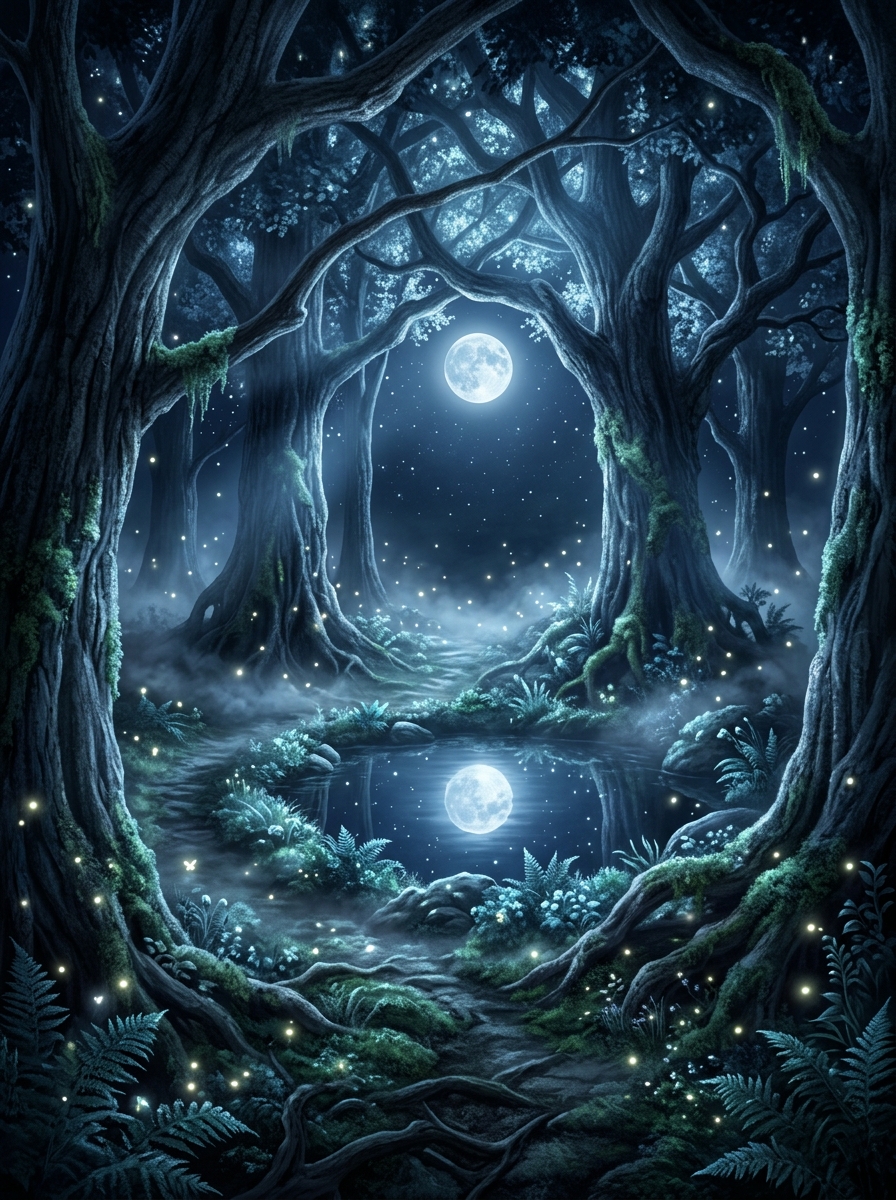
A dream of a forest rarely delivers a single message. It delivers a condition: you have entered a place where visibility is low, paths multiply, and the usual maps fail. That condition is the meaning. The forest in dream language is the unconscious itself — not as a symbol with fixed definitions, but as a living terrain where depth, confusion, fertility, danger, and discovery coexist. The core thesis is this: the forest appears when your waking mind touches something larger than its usual categories. How you move through it tells you how you are relating to the unknown.
The forest as a psychic ecosystem
The dream does not ask you to decode the forest; it asks you to feel its atmosphere. That atmosphere is the first and most reliable clue. A forest that is dark and tangled often mirrors a life situation that resists mental organization — missing information, repressed emotion, a decision that keeps splitting into new branches. A sunlit, spacious forest points toward replenishment, instinctual trust, and a recovery of something more original than your daily persona. The psyche translates complexity into vegetation because vegetation is alive, proliferating, and impossible to fully manage.
Why the tone matters more than the content
Emotional tone is the unconscious’s preferred grammar. If you wake frightened, the dream is likely staging an encounter with material you have not made legible to yourself: postponed grief, rationalized resentment, a desire you keep shelving. If you wake peaceful, the forest may be compensating for a life grown too abstract or too controlled. The same symbol can carry both registers, and the difference is not in the trees but in the weather you bring to them. This principle — that images shape perception before they become explanations — is central to the way we read symbols throughout the work at Aurora Arcana1, whether in tarot or astrology.
Psychological roots: why the forest appears now
A forest dream is rarely random. It tends to surface during threshold periods: a breakup, a move, a career pivot, grief, recovery, pregnancy — any moment when identity is being revised in real time. The dream does not narrate the event; it stages the psychological climate around it. Disorientation, wonder, danger, concealment, or the first stirrings of confidence in unfamiliar ground — all of these can be the real content.
Overwhelm and the crowding of life
The most common trigger is overwhelm. A dense forest mirrors a life that has become overgrown with demands, feelings, or options. The psyche does not tell you “you are stressed.” It shows you a thicket, and the feeling of being unable to see the next step. That is not a metaphor; it is a direct rendering of the neural state. If the dream involves being lost, ask whether you are forcing linear solutions onto a problem that requires patience or intuition. Lostness in a forest dream can be the psyche refusing premature certainty.
The hidden self and initiation
The forest also draws on its mythic role as a threshold. In folktale and Jungian thought, the woods are where the familiar world ends and initiation begins. That is why the dream arrives when the ego can no longer pretend it has everything under control. The hidden self — the parts of you that do not fit your self‑image — begin to stir. You may meet an animal, a guide, or a structure inside the forest; each is a fragment of that hidden self trying to become known.
How the forest dream matures — and how it turns shadow
The same dream can follow a developmental arc. In its shadow form, the forest is an engine of anxiety: you are trapped, pursued, or unable to find any exit. That pattern often reflects a life in which repression has become chronic. The dream is not saying “the forest is bad”; it is showing you the architecture of your own avoidance. The fear is a signal that you have walled off too much territory.
In its mature form, the forest becomes a place of orientation. You may find a path, a cabin, or a clearing. Each marks a different relationship to the unconscious. A path suggests that the blur is beginning to reveal structure. A cabin implies a protected inner space — a private truth, a new psychological boundary, a rest stop inside complexity. A clearing signals visibility and relief: the unconscious has been partially illuminated without being exhausted by explanation.
Animals, fire, and other agents of change
Interior details shift the grammar. A deer in the forest indicates sensitivity and vigilance; a wolf can point to appetite, fear, or the need to distinguish real threat from projected threat. Birds introduce a higher register — information arriving from above the undergrowth. Fire burning through the forest dramatizes transformation that feels uncontrollable, yet it also signals release and irreversible change. Cutting or clearing the forest often reflects an attempt to force clarity where a slower process would be wiser. The question is never whether the action is dramatic; it is whether the action serves insight or domination.
The forest in a life: how it plays out
A forest dream becomes readable only when you place it in your actual context. Dreams are contextual messages shaped by stress, memory, aspiration, and the body’s rhythms. The same dream of wooded depth after a season of social exhaustion does not mean the same thing as that dream after a major loss.
In relationships and work
If the forest emerges while you are navigating a relationship question, it often points to emotional opacity — something you sense but cannot yet name. The dream may be asking you to tolerate uncertainty rather than demand an answer. In work or creative projects, a dense forest can signal that the way forward requires instinct, not data. The psyche is showing you that the problem is not a lack of information but an excess of noise. In both cases, the dream is less about finding the right path than about learning to stay present while the path reveals itself.
Season, weather, and personal history
The season of the forest adds its own layer. Spring emphasizes beginning and latent possibility; autumn carries release and the beauty of things changing color before they fall; winter strips the symbol down to endurance and whatever remains when growth is no longer decorative. Personal history matters too. If you grew up near woods, the dream may be tied to childhood memory more than universal symbolism. If you fear forests, the image may speak through caution rather than invitation. The dream is asking you to recognize what kind of inner world you are walking through — and to meet it with the kind of attention it deserves.
Related
- Dream About a Garden: What the Dream Is Growing in You
- Dream About the Ocean: What the Water Is Trying to Tell You
- Dream About a Bear: Power, Protection, and the Wild Unsaid
- Dream About River: Flow, Crossing, and the Emotional Current Beneath
- Dream About a Mountain: Meaning, Psychology, and Symbolic Variations
Footnotes
-
The larger framework for reading symbols — whether in dreams, tarot, or astrology — is developed in detail throughout the work at Aurora Arcana. The forest dream may not be asking for a conclusion. It may be asking for better companionship while you are inside the trees. ↩
Comments
Loading comments…