The Geometry of the Heavens: A Complete Guide to Astrological House Systems
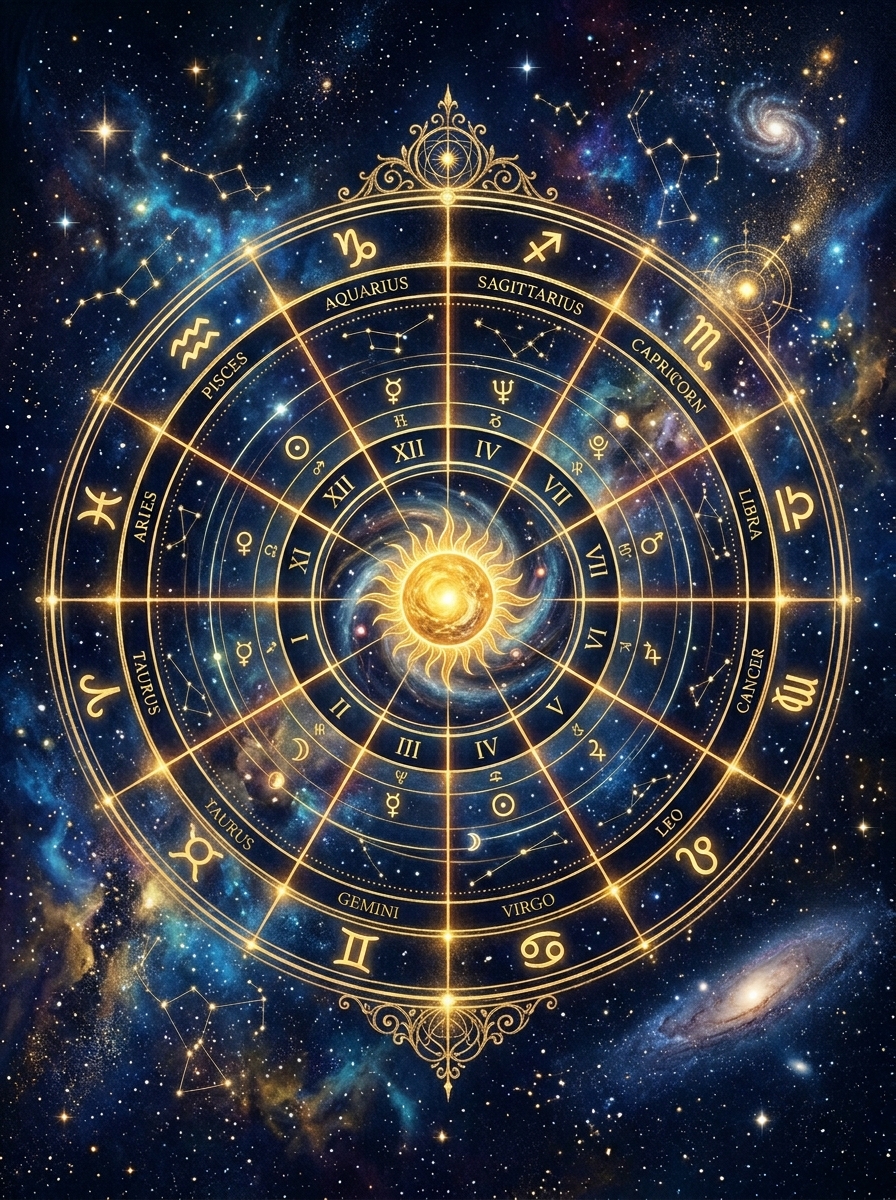
The Celestial Sphere: Why Multiple House Systems Exist
To stand under the open sky at midnight is to realize that the cosmos is not a flat sheet of paper, but a vast, three-dimensional cathedral of light. The celestial dome curves over us in every direction, a shimmering vault of stars and moving planets. Yet, when an astrologer constructs a birth chart, they must project this multi-dimensional geometry of the heavens onto a flat, two-dimensional wheel. This mathematical translation is where the complexity of astrology's house systems begins. The zodiac signs represent the ecliptic—the path the Sun appears to travel across the sky over the course of a year. The houses, however, are local. They depend entirely on the exact longitude, latitude, and minute of birth, anchoring the cosmic movements to a specific spot on Earth.
The Challenge of Celestial Geometry
The fundamental challenge of house division is mapping the local sky onto this zodiacal circle. The horizon intersects with the meridian to divide the local space into four quadrants. The eastern horizon marks the Ascendant, the western horizon the Descendant. The highest point where the meridian crosses the ecliptic is the Midheaven, and the lowest point is the Imum Coeli. This cardinal cross is the skeleton of the chart, representing the four pillars of physical manifestation. But how do we divide each of these four large quadrants into three distinct sectors to create twelve houses?
This is where mathematicians, astronomers, and mystics have diverged for over two thousand years. The sky is three-dimensional, but the ecliptic is a single circle. When we try to project the local sphere onto the ecliptic, we find that the horizon, the celestial equator, and the ecliptic do not sit at the same angle. Should we divide the celestial equator into equal parts and project those divisions onto the ecliptic? Should we divide the prime vertical—the circle passing directly overhead from east to west? Or should we divide the time it takes for a planet to rise and set?
Every house system represents a different mathematical answer to these questions. They are different projections of the same astronomical reality, much like how different map projections depict the spherical Earth on a flat page. The differences do not mean one system is correct and the others are false; rather, they show that there are multiple ways to slice the celestial pie. Each method reveals a different layer of the relationship between the macrocosm and the microcosm, casting a unique light on how the soul's potential manifests in the physical world.
The Placidus House System: The Modern Western Standard
For the vast majority of Western astrologers today, the Placidus house system is the default setting on calculation software and websites. Named after the seventeenth-century Italian monk and mathematician Placidus de Titis, this system has dominated contemporary astrology for over a century. However, its popularity was not due to a sudden revelation of spiritual superiority, but rather to historical convenience. In the nineteenth century, when Raphael’s Ephemerides began publishing mass-produced astrological tables, they utilized the Placidus system. Generations of astrologers learned to cast charts using these printed tables, cementing Placidus as the modern standard.
The Time-Based Logic of the Soul's Arc
Unlike systems that divide space, Placidus is a time-proportional system. It divides the time it takes for a degree of the ecliptic to travel from the eastern horizon (the Ascendant) to the meridian (the Midheaven). The diurnal and nocturnal arcs of the planets are divided into three equal time intervals. Because the Sun rises and sets at different speeds depending on the season and the latitude, these time intervals do not project as equal degrees on the ecliptic. Consequently, the houses in a Placidus chart are almost always of unequal size.
This time-based structure aligns perfectly with the focus of modern psychological astrology. Life is rarely divided into neat, equal compartments. Our personal growth occurs in fits and starts; some developmental areas require decades of intense focus, while others seem to resolve quickly. The varying sizes of the Placidus houses reflect this organic, uneven rhythm of human life. In Placidus, the houses expand and contract, mirroring the psychological reality that certain arenas of life demand more space in our conscious experience than others. It is a system built on process, movement, and time, capturing the dynamic nature of the personality as it unfolds through the cycles of maturity. Proponents of this system appreciate how it ties the chart to the local rotation of the Earth, grounding the psychological archetypes in the immediate flow of daily experience.
When a modern seeker first inputs their birth details online, the resulting chart is almost always generated using Placidus. This default setting shapes their initial understanding of their planetary placements. They become accustomed to seeing planets nestled in specific houses of varying sizes, associating the visual asymmetry of the chart with the complexity of their own psyche. It is only when they compare this default chart with other systems that the mathematical relativity of house division becomes apparent, prompting a deeper investigation into the mechanics of the astrological wheel.
Intercepted Signs: Jungian Shadow Work and Latent Archetypes
One of the most fascinating phenomena that occurs in quadrant-based systems like Placidus is the creation of intercepted signs. An interception occurs when a zodiac sign is completely contained within a single house, meaning it does not hold the cusp—the starting boundary—of any house. Because there are twelve signs and twelve houses, if two signs are intercepted, two other signs must share cusps, resulting in "double-cusp" houses. This visual and mathematical distortion is a natural consequence of projecting the tilted Earth's horizon onto the ecliptic, especially at latitudes further from the equator.
Unlocking the Closed Gates of the Psyche
From a psychological perspective, Liz Greene and other Jungian-oriented astrologers view intercepted signs as latent archetypes. Because the intercepted sign does not rule a house cusp, the psychological energy of that sign lacks a direct, conscious outlet in the external world. It represents a part of the psyche that is "locked away" or hidden in the deep drawers of the unconscious. The individual may feel the internal pressure of this sign's traits but struggle to express them naturally in their daily life.
For example, if the signs Aries and Libra are intercepted, the individual may face a profound challenge in balancing personal assertion and relationship harmony. With Aries intercepted, the raw, self-directed drive to initiate and fight for one's desires is buried, perhaps manifesting as passive-aggression or a fear of conflict. With Libra intercepted, the capacity to create cooperative, equal partnerships is similarly obscured, leading to sudden, unconscious relationship dramas. To resolve this, the individual must engage in conscious shadow work, descending into the unconscious to unlock these closed gates. By identifying and integrating the latent archetypes of the intercepted signs, they can bring these hidden aspects of the self into conscious expression, turning a source of psychological frustration into a wellspring of personal power.
The environment often plays a significant role in keeping these signs locked. During early childhood, the qualities of the intercepted signs may not have been supported or mirrored by the family dynamics, leading the child to repress them. The double-cusp houses, by contrast, represent areas of life where we tend to overcompensate, using the shared sign to manage the duties of two different life sectors. The process of integrating an interception is therefore a vital part of the individuation journey. It requires us to recognize that the qualities we feel we lack are actually present within us, waiting to be claimed. As we consciously develop the traits of the intercepted signs, the blockages dissolve, allowing the life force to flow more freely through the entire chart.
Whole Sign Houses: The Ancient Hellenistic Revival
In stark contrast to the mathematical complexity of Placidus stands the Whole Sign house system. This is the oldest known method of house division, dating back to the very origins of Hellenistic astrology in the Mediterranean basin around the first century BCE. For centuries, it was the foundational framework used by ancient practitioners. While it fell out of favor in the Western world as quadrant systems gained popularity, the Whole Sign system has experienced a massive contemporary revival. This renaissance is largely due to translation projects that have made ancient texts accessible to modern readers, prompting many astrologers to return to classical roots.
The Elegant Sign-Equals-House Framework
The mechanics of the Whole Sign system are remarkably elegant. The entire zodiac sign that contains the Ascendant becomes the first house, running from 0 to 30 degrees of that sign. The next sign in zodiacal order becomes the second house, the sign after that the third, and so on. If your Ascendant is at 25 degrees of Scorpio, your first house is the entirety of Scorpio, starting at 0 degrees. The second house is the entirety of Sagittarius, and so forth. In this system, there are no unequal houses, no intercepted signs, and no shared cusps. The boundaries of the signs and the boundaries of the houses are identical.
One of the most significant features of the Whole Sign system is that the Midheaven (MC) does not serve as the cusp of the tenth house. Instead, the MC is a floating point that can fall anywhere in the upper portion of the chart, typically in the eighth, ninth, tenth, eleventh, or twelfth house. This creates a multi-layered approach to career and reputation. The tenth house represents one's daily activities and actions in the world, while the Midheaven indicates one's ultimate public calling, legacy, and highest aspirations. Astrologers who use this system find that it brings a profound structural clarity to chart interpretation, making it highly reliable for traditional predictive techniques such as annual profections and zodiacal releasing.
Conceptually, the Whole Sign system views the houses not as custom-built spatial sectors, but as the signs themselves acting as temples for the planets. Each sign is a complete environment with its own ruler, and when a planet enters that sign, it enters that house. This sign-equals-house alignment simplifies the relationship between planetary rulerships and house topics, allowing the astrologer to trace the links between different life areas with greater ease. For example, the ruler of the first house (the self) will rule the entire first sign, and its placement in another house will show a clear, direct path of personal focus. This clarity is why many traditional astrologers prefer the system, finding that the removal of mathematical distortions allows the core symbolic structure of the chart to shine through more clearly.
Koch and Equal House Systems: Time-Based and Space-Based Alternatives
For astrologers who seek a middle path between the complex time-calculations of Placidus and the sign-aligned simplicity of Whole Sign, the Koch and Equal House systems offer compelling alternatives. Both of these systems attempt to resolve the challenges of dividing the sky while preserving specific astronomical reference points. However, they approach the task from opposite directions: one prioritizing equal spatial divisions from the Ascendant, and the other refining the time-based quadrant methodology.
Dividing by Degree vs. Dividing by Time
The Equal House system is one of the oldest alternatives to the classical Whole Sign method. It starts with the exact degree of the Ascendant and projects twelve equal 30-degree sectors from that point. If your Ascendant is at 12 degrees of Taurus, your second house begins at 12 degrees of Gemini, your third at 12 degrees of Cancer, and so on. Like Whole Sign, it keeps every house at exactly 30 degrees, which prevents the occurrence of intercepted signs and maintains a balanced visual layout. However, unlike Whole Sign, the house cusps do not align with the sign boundaries. This system is popular in modern British astrology and is favored by those who want to avoid high-latitude distortions while keeping the Ascendant as the exact start of the first house.
The Koch system, named after German astrologer Walter Koch but mathematically designed by Heinz Specht, is a twentieth-century time-based quadrant system. Popularized within the Huber School of Swiss-German psychological astrology, Koch is similar to Placidus but calculates its divisions based on the diurnal path of the Midheaven rather than the horizon. Proponents of the Koch system argue that it is more astronomically consistent and offers a more accurate reflection of environmental conditioning and childhood psychology. In interpretation, Koch cusps often shift planetary placements slightly compared to Placidus, offering a refined tool for tracking how we respond to the outer world's expectations.
The choice between Equal House and Koch represents a choice between spatial simplicity and temporal complexity. Equal House offers a clean, symmetric wheel where every house has equal weight, which can make it easier to see overall chart patterns and planetary aspects. Koch, on the other hand, embraces the unequal, asymmetric nature of quadrant division, viewing the variations in house size as essential indicators of psychological emphasis. While Equal House is straightforward to calculate and interpret, Koch requires complex mathematics that link the chart to the specific geographic latitude and the passage of time. Astrologers often choose between them based on whether they prioritize a clean, uncluttered visual layout or a highly detailed, time-based model of psychological development.
Historical and Traditional Systems: Porphyry, Regiomontanus, Alcabitius, and Campanus
Before Placidus became the modern default, the history of astrology was a rich tapestry of competing house systems. Medieval and Renaissance astrologers were constantly searching for the perfect mathematical model to divide the sky. Many of these historical systems are still active today, particularly among classical, horary, and medieval practitioners who require structural consistency in mapping local space.
The Evolution of Astronomical Quadrants
The Porphyry system, named after the third-century Neoplatonist philosopher Porphyry, is one of the oldest and simplest quadrant systems. It takes the mathematical distance in degrees between the Ascendant and the Midheaven and divides that quadrant into three equal parts. It does the same for the distance between the Midheaven and the Descendant. This straightforward spatial division avoids the time-based abstractions of Placidus, making it a popular choice for modern astrologers who want a quadrant-based system without complex time-arc formulas.
During the Renaissance, the German mathematician and astronomer Johannes Müller of Königsberg, known as Regiomontanus, introduced a space-based system that trisected the celestial equator. Regiomontanus projected these equal equatorial divisions onto the ecliptic. This system became the backbone of seventeenth-century British astrology, championed by the legendary William Lilly. If you practice horary astrology—the art of casting a chart for the exact moment a question is asked to find a concrete answer—Regiomontanus is still the standard system, as it excels at mapping the physical directions of local space.
Other historical systems include Alcabitius and Campanus. Alcabitius, a tenth-century Arabic system, was the standard in late medieval Europe before being replaced by Regiomontanus. It divides the celestial equator based on the time it takes for the Ascendant to traverse the quadrant. Campanus, formulated by the thirteenth-century mathematician Campanus of Novara, divides the prime vertical—the east-west circle passing through the zenith—into equal segments. This creates massive, equal-sized wedges of the local sky, emphasizing the immediate physical environment of the birth location.
Each of these historical systems reflects the scientific and philosophical spirit of its era. Porphyry's simple division reflects the geometric purity of Neoplatonism, while Regiomontanus's equatorial calculations align with the Renaissance drive for astronomical precision and navigation. Campanus's focus on the prime vertical represents a deeply spatial, local view of the cosmos. These traditional frameworks, alongside other Hermetic concepts, were later studied and integrated by Western esoteric authors such as A.E. Waite and Aleister Crowley, who sought to align the geometry of the houses with the tarot's symbolic keys. For the modern astrologer, exploring these systems is not just an academic exercise; it is a way to align one's practice with specific traditional techniques. By choosing a system like Regiomontanus for horary or Porphyry for classical natal analysis, contemporary practitioners can tap into the specific symbolic logic that these systems were designed to support, enriching their interpretive depth.
Chart Interpretation Dynamics: Planetary Shifts and Evolving Focus
When you switch between different house systems, you are not changing the zodiacal positions of your planets. Your Sun remains at the same degree of Aries, and your Moon remains in Taurus. What changes is the house alignment—the specific stage where these planetary energies are expressed. For a seeker, discovering that a planet shifts from the creative, self-expressive fifth house in Placidus to the service-oriented, health-focused sixth house in Whole Sign can be confusing. It raises the question of which placement represents the true self.
Shifting the Lens of Evolutionary Growth
In evolutionary astrology, as taught by Steven Forrest, the houses are not merely empty slots; they are the primary evolutionary arenas where the soul must do its work. Shifting a planet's house placement alters the entire landscape of this developmental journey. For instance, if you have Saturn in the fourth house under Placidus, your lessons of boundary-setting, structure, and responsibility are focused on your home, family roots, and inner emotional security. If Saturn shifts to the fifth house under Whole Sign, the focus of those same Saturnian structures shifts to creative self-expression, romance, and children.
Rather than viewing these shifts as contradictions, many contemporary astrologers treat them as complementary perspectives. The quadrant chart (such as Placidus or Koch) is often interpreted as representing the internal, psychological reality—how you subjectively experience your inner world and process your conditioning. The Whole Sign chart, by contrast, is seen as representing the objective, external environment—the concrete circumstances, events, and people that manifest in your physical life. Both perspectives are valid. By analyzing the chart through both lenses, you gain a richer, multi-dimensional understanding of your life, seeing how your inner psychological patterns interact with the outer events of your destiny.
This dual approach is especially useful in professional consultations. A client might struggle to recognize a planet's energy when interpreted solely through one system, but find immediate resonance when the astrologer presents the alternative placement. For example, a planet in the twelfth house in Placidus might feel hidden and unconscious, while its shift to the eleventh house in Whole Sign explains why the client's public group involvements are constantly triggering that hidden energy. Understanding these dynamics allows the astrologer to move away from rigid, dogmatic interpretations and embrace a more fluid, evolutionary view of the birth chart. It reminds us that the chart is a living map, and changing the coordinate system simply highlights different paths of the soul's growth.
Practical Selection Guide: Navigating Traditions and Geographic Polar Distortions
Choosing the right house system is a practical decision that depends on your experience level, your chosen astrological tradition, and the geographic details of the birth chart. There is no single "correct" system; instead, there is the system that best supports your specific techniques and resolves the astronomical realities of the birth location.
Resolving the Polar Distortion
If you are drawn to traditional, Hellenistic, or medieval astrology, the Whole Sign system is the most appropriate choice. Its structure is essential for applying ancient techniques like annual profections, where the ruler of the year is determined by the lord of the house. If your focus is modern psychological, Jungian, or evolutionary astrology, Placidus or Koch will provide the nuance and process-oriented depth that supports shadow work and psychological development.
However, you must also account for geographic birth latitude. This is a critical astronomical constraint. Quadrant systems like Placidus, Koch, Regiomontanus, and Porphyry rely on the intersection of the horizon and the meridian. At high latitudes—such as in northern Europe, Canada, Alaska, or Scandinavia—the ecliptic sits at an extreme angle relative to the horizon. In these polar regions, quadrant systems break down. A single house can span over 60 degrees of the zodiac, while other houses shrink to just a few degrees. In some extreme latitudes near the poles, the mathematical formulas cannot be calculated at all because the Ascendant and Midheaven merge.
If you are interpreting a chart for someone born at a high latitude, switching to the Whole Sign or Equal House system is the most practical way to resolve these distortions. These systems maintain equal 30-degree partitions regardless of how close to the poles the birth occurred, preserving a balanced distribution of planetary energies.
Ultimately, the best way to choose a house system is through active, empirical observation. Cast your own chart in Placidus, Whole Sign, and Equal House. Track the transits of outer planets through your houses in each system. Notice which system feels more aligned with your lived experience. Like the different lenses of a microscope, each house system reveals a different layer of the soul's geometry.
By noting which house system consistently mirrors the timing of external events or internal psychological shifts, you can select the method that works best for you. It is also common for professional astrologers to use different systems for different purposes—for instance, using Whole Sign for birth charts and predictive work, but switching to Regiomontanus for horary questions. The key is consistency and empirical validation, ensuring that your theoretical model aligns with the actual lived experience of the people whose charts you read.
Frequently Asked Questions
Why does my birth chart look different on different websites?
Your birth chart may look different across platforms because different websites use different default house systems. For instance, some websites default to the Placidus system, which produces houses of unequal sizes, while others default to the Whole Sign system, which divides the chart into twelve equal 30-degree blocks matching the zodiac signs. If your planets appear in different houses, check the calculation settings of the website and select the house system that aligns with your practice.
Which house system is the most accurate?
No house system is objectively "more accurate" than the others; they are simply different mathematical and geometrical perspectives on the same astronomical sky. The choice depends on your astrological methodology. Modern psychological astrologers often prefer Placidus or Koch for their developmental, process-oriented depth, while traditional astrologers prefer Whole Sign for its simplicity, historical lineage, and effectiveness in ancient predictive techniques.
What is an intercepted sign in a birth chart?
An intercepted sign is a zodiac sign that is completely contained within a house and does not fall on any house cusp. This phenomenon only occurs in quadrant-based house systems (like Placidus, Koch, or Porphyry) and is caused by the tilt of the Earth's axis, which distorts the projection of the ecliptic onto the horizon. Interceptions become increasingly common and pronounced for births that take place at higher latitudes, further from the equator.
How does the Midheaven behave in the Whole Sign system?
In the Whole Sign system, the Midheaven (MC) does not serve as the cusp of the tenth house. Instead, it is a floating point that can land in any of the upper houses, typically the eighth, ninth, tenth, eleventh, or twelfth house. The tenth house itself represents the sign that is tenth from the Ascendant sign, governing career activities, while the MC represents the exact degree of highest elevation, indicating one's ultimate calling, legacy, and public reputation.
Why are Placidus houses of unequal size?
Placidus houses are unequal in size because the system divides the chart based on time rather than space. It calculates the time it takes for a degree of the zodiac to rise from the eastern horizon to the meridian. Because the Earth rotates on a tilted axis, signs rise at different rates depending on the season and the observer's latitude. This temporal division projects onto the ecliptic as unequal arcs, resulting in varying house sizes.
What is the difference between the Placidus and Koch systems?
While both Placidus and Koch are time-based quadrant systems, they use different reference circles to divide the quadrants. Placidus trisects the semi-diurnal and semi-nocturnal arcs of planetary movement, whereas Koch trisects the diurnal path of the Midheaven. This difference in mathematical formulation results in slightly different house cusps, which can shift the house placements of your planets, especially in charts cast for mid-to-high latitudes.
Can I use different house systems for different types of astrology?
Yes, many professional astrologers utilize different house systems depending on the specific branch of astrology they are practicing. For example, an astrologer might use the Whole Sign system for natal chart readings and annual profections, the Placidus system for modern psychological analysis and tracking transits, and the Regiomontanus system exclusively for horary astrology, which requires precise mapping of local directions.
What happens to quadrant house systems near the North and South Poles?
At high latitudes near or inside the polar circles, quadrant house systems like Placidus and Koch experience extreme geometric distortion. A single house can span 60 degrees or more, while other houses shrink to just a few degrees. In extreme polar regions, the mathematical equations cannot be resolved because the Ascendant and Midheaven merge. In these cases, astrologers typically switch to Whole Sign or Equal House to maintain functional 30-degree divisions.
How do intercepted planets affect chart interpretation?
Planets located within an intercepted sign are referred to as intercepted planets. Psychologically, the expression of these planets is often delayed, internalized, or blockaded, representing talents or drives that are not easily accessed by the conscious ego. To unlock and integrate an intercepted planet, the individual must engage in deep shadow work and conscious psychological development, learning to express the planet's energy without the support of a direct house cusp.
Comments
Loading comments…